US-Kenya Bilateral Health Agreement and Foreign Aid Shift
Source:The Hindu ↗
Why It Matters
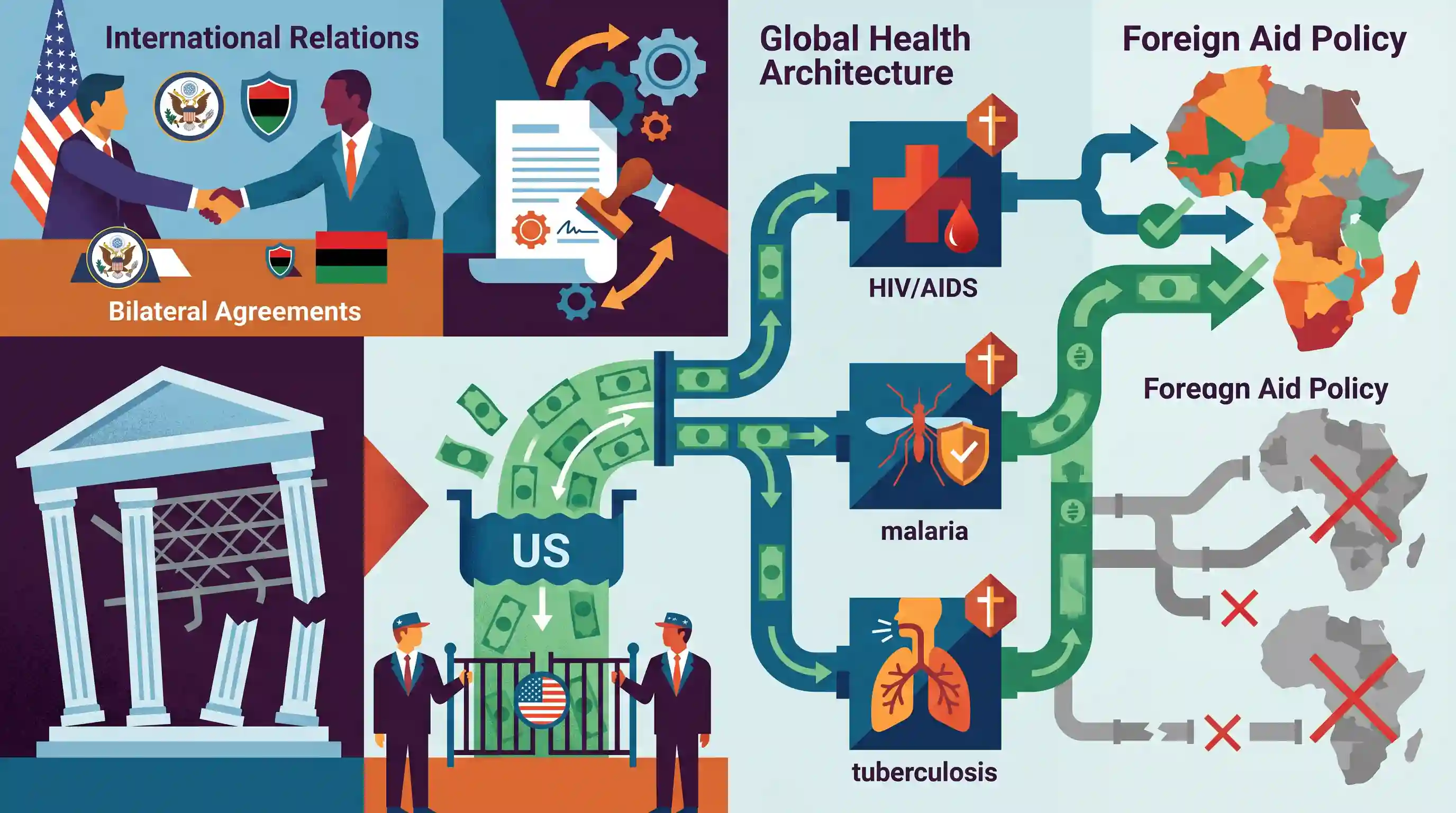
The dismantling of USAID and the shift toward transactional 'America First' bilateral deals fundamentally alters the global health financing architecture. This weaponization of foreign aid requires civil services aspirants to understand how health assistance is increasingly tied to geopolitical alignment, impacting global health security and the broader developmental trajectory of the Global South.
Summary
The U.S. and Kenya have signed a five-year, $2.5 billion global health agreement, the first of many anticipated 'America First' bilateral deals initiated by the Trump administration. Following the dismantling of USAID, these new agreements represent a major shift in U.S. foreign aid architecture, tying health assistance directly to alignment with American geopolitical interests. The funding prioritizes combating HIV/AIDS, malaria, and tuberculosis, heavily leveraging faith-based medical providers, while countries misaligned with U.S. policy may lose access to critical health funding.
Key Points
- The U.S. and Kenya signed a five-year, $2.5 billion health agreement, with the U.S. contributing $1.7 billion and Kenya $850 million.
- The deal replaces programs formerly run by USAID, which was dismantled by the Trump administration, disrupting hundreds of global health and development initiatives.
- Funding will target HIV/AIDS, malaria, and tuberculosis, emphasizing partnerships with faith-based medical providers.
- The new 'America First' bilateral agreements explicitly tie global health funding to a partner country's alignment with U.S. geopolitical objectives.
- Kenya secured the deal partly due to its deployment of an international stabilization force to Haiti, while countries like Nigeria and South Africa may be excluded due to policy differences.
Important Terms
America First Global Health Strategy (AFGHS)

A 2025-26 U.S. policy shifting health aid from multilateral/NGO channels to direct bilateral agreements, prioritizing U.S. national security and recipient alignment with American geopolitical interests.
UPSC context
GS-II: International Relations (Effect of policies of developed countries on developing nations; Bilateral agreements).
USAID (Status in 2026)
Formerly the primary U.S. aid agency; it was dismantled/absorbed into the State Department in mid-2025 to streamline "America First" foreign policy and reduce the "NGO industrial complex."
UPSC context
GS-II: Important International institutions and their structure; Role of foreign aid in development.
Faith-Based Medical Providers
Religious hospitals and clinics used as primary health delivery channels in the AFGHS to replace secular NGOs, leveraging their established community trust and local infrastructure.
UPSC context
GS-II: Welfare schemes for vulnerable sections; Role of NGOs/SHGs/Religious bodies in development.
PEPFAR (Restructured)
The flagship U.S. HIV/AIDS program, restructured under AFGHS to operate through direct government funding and performance-based metrics rather than broad international grants.
UPSC context
GS-II: Issues relating to development and management of Social Sector/Services relating to Health.
Co-investment Model
A funding mechanism where recipient nations (e.g., Kenya) must match U.S. grants with domestic funds, aiming to reduce long-term donor dependency and foster "self-reliance."
UPSC context
GS-III: Economics of aid; Resource mobilization; Global financial architecture.
Health Data Sovereignty
The right of a nation to control its citizens' health information; a major friction point in Kenya where courts challenged U.S. requirements for mandatory health data sharing.
UPSC context
GS-III: Cyber security; Privacy issues; Science & Technology (Data as a strategic asset).
Trade Over Aid Initiative
A U.S. policy shift emphasizing private capital, free market reforms, and strategic resource partnerships over traditional humanitarian aid to secure supply chains and influence.
UPSC context
GS-II: Bilateral, regional and global groupings and agreements involving India and/or affecting India’s interests.
Prelims Trap
"The America First global health agreements are administered globally by USAID in coordination with the WHO."
The Trump administration dismantled USAID and bypasses multilateral institutions in favor of transactional, bilateral deals leveraging faith-based providers.
Static Concepts Connected
What differentiates Official Development Assistance (ODA) from Tied Aid?
- ODA Definition: Aid aimed primarily at the economic development and welfare of developing nations, containing a specific grant element, and often routed multilaterally.
- Tied/Conditional Aid: Assistance requiring the recipient to align with donor geopolitical objectives or purchase donor goods, significantly reducing the recipient's sovereign autonomy.
- Geopolitical Impact: Tied aid shifts the focus from pure humanitarian and developmental needs to transactional foreign policy leverage for the donor state.
How does Global Health Diplomacy function in modern International Relations?
- Soft Power Projection: Providing critical medical funding, vaccines (e.g., India's Vaccine Maitri), and health infrastructure to build long-term strategic goodwill and soft power.
- Multilateral Bypassing: Donors increasingly bypass UN agencies (like WHO) to strike direct bilateral deals, maximizing their negotiation leverage and ensuring geopolitical alignment.
- Coercive Conditionality: Linking life-saving disease funding to unrelated strategic actions (e.g., military or peacekeeping deployments), effectively weaponizing humanitarian developmental aid.
Cross-Topic Patterns
Conditional aid vs. Debt-trap diplomacy
While China is scrutinized for infrastructure 'debt traps,' the U.S. shift highlights a new Western 'health diplomacy,' tying vital medical funding to strict geopolitical alignment.
The retreat of multilateral institutions
The dismantling of USAID and bypassing of multilateral health architectures mirrors broader global governance crises, like WTO dysfunction, pushing the Global South toward transactional bilateralism.

Expect GS-2 questions analyzing the retreat of multilateral health architectures in favor of transactional 'conditional aid' by great powers.
Linked PYQs · 2
Linked PYQs · 2
- 2020MainsGS2
Critically examine the role of WHO in providing global health security during the Covid-19 pandemic.
- 2021MainsGS2
If the last few decades were of Asia's growth story, the next few are expected to be of Africa's.” In the light of this statement, examine India's influence in Africa in recent years.
