Judicial Review of Federal Emergency Powers in America
Source:Indian Express ↗
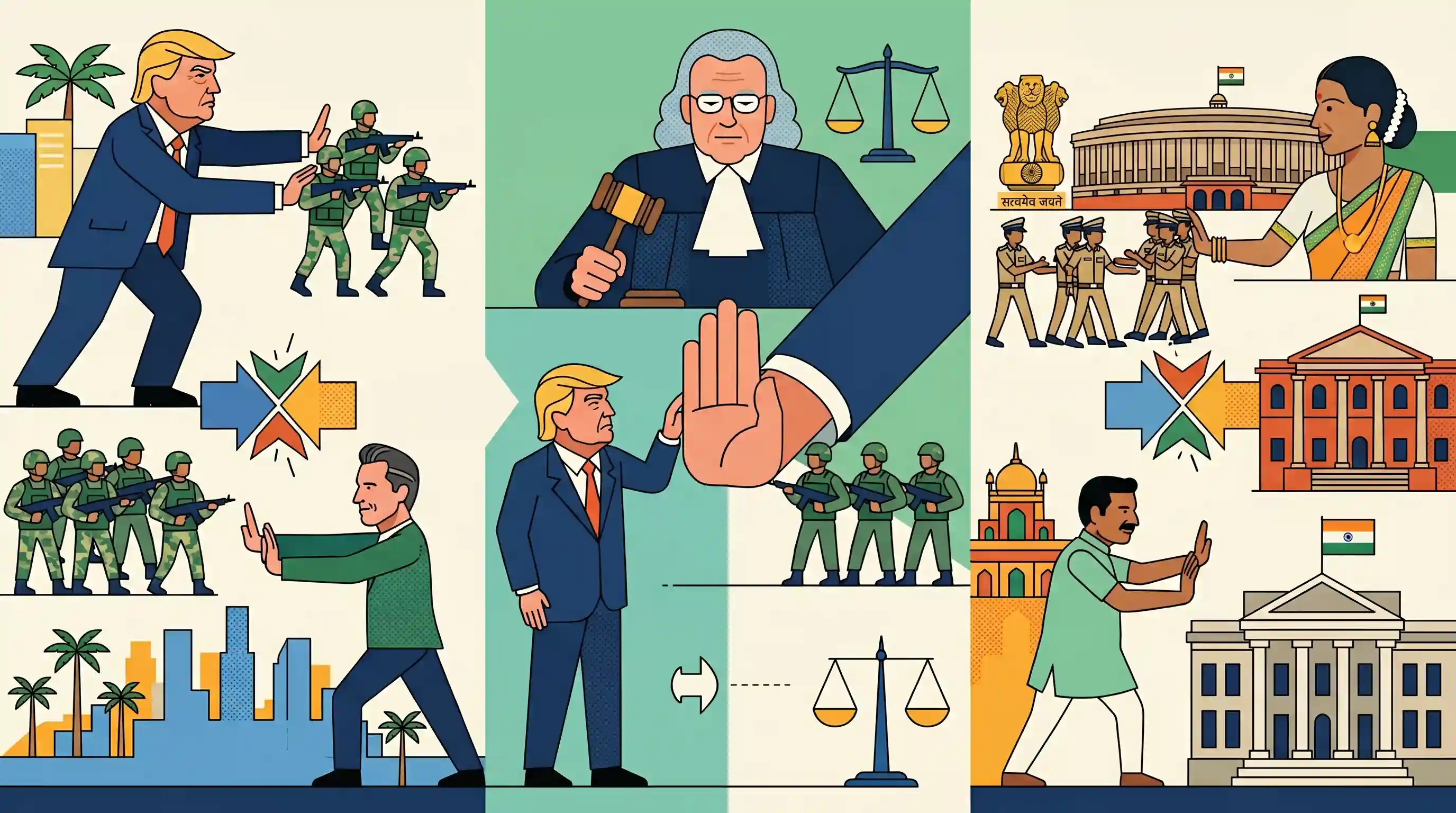
Why It Matters
It provides a clear, contemporary comparative example of judicial checks on executive emergency powers and federal overreach, relevant for GS2 answers on federalism, the deployment of central forces (akin to Article 355/356 debates in India), and the separation of powers.
Summary
A US federal judge has halted the deployment of the National Guard to Los Angeles, a measure previously ordered by Donald Trump over the objections of California's state governor. The court's decision underscored that presidential emergency powers are not absolute and remain subject to judicial review. For civil services aspirants, this development serves as an excellent case study in 'Separation of Powers' and 'Checks and Balances'. Furthermore, it highlights inherent frictions in federal systems regarding domestic security, drawing parallels to Indian Centre-State relations and the contentious deployment of central forces within states.
Key Points
- A US federal judge issued an order blocking the deployment of the National Guard in Los Angeles, which had been directed by Donald Trump against the wishes of the California state governor.
- The judicial ruling firmly rejected the notion of unreviewable presidential emergency powers, reinforcing the constitutional principle of checks and balances.
- The incident highlights a core conflict in federalism: the jurisdictional battle between the federal executive and state authorities over internal security and domestic law enforcement.
- For Indian administrative context, this mirrors debates regarding the Union Government's power to deploy Central Armed Police Forces (CAPFs) in states without state consent, engaging Articles 355 and 356.
Important Terms
National Guard

A dual-status US military reserve force serving both state (under governors) and federal roles (under the President) for domestic emergencies and national security.
UPSC context
GS Paper 2 (Comparative Constitutions); tests understanding of domestic security jurisdiction and federal-state power dynamics.
US Federal Court
The three-tiered American judicial system (District, Circuit, Supreme Court) with jurisdiction over cases involving federal law, treaties, and the US Constitution.
UPSC context
GS Paper 2 (Judiciary); critical for comparing the integrated Indian judiciary with the dual US state-federal system.
Separation of Powers
A doctrine dividing government functions into Legislative, Executive, and Judicial branches to prevent power concentration and enable 'checks and balances'.
UPSC context
GS Paper 2 (Constitution); a 'Basic Structure' feature tested via functional overlaps between government organs.
Judicial Review
The power of the judiciary to examine and invalidate legislative or executive actions that violate the constitution.
UPSC context
GS Paper 2 (Judiciary); tests constitutional supremacy and the protection of fundamental rights under Articles 13, 32, and 226.
Federalism
A constitutional structure where power is divided between a central government and regional states, balancing national unity with regional autonomy.
UPSC context
GS Paper 2 (Polity); focuses on India's 'quasi-federal' nature and comparative analysis with classical federal systems.
Centre-State Relations
Administrative interactions between tiers of government; frequently tested via frictions regarding the deployment of central armed forces in states (Article 355).
UPSC context
GS Paper 2 (Governance); involves Sarkaria and Punchhi Commission recommendations on preserving state autonomy in law and order.
Prelims Trap
The Union Government cannot deploy Central Armed Police Forces (CAPFs) in a State without the express consent of the State Government.
This is false. Under Entry 2A of the Union List (added by the 42nd Amendment) and Article 355, the Union can legally deploy armed forces without state consent.
Static Concepts Connected
How does the Indian Constitution govern the deployment of Central forces in states?
- Article 355: Imposes a duty on the Union to protect every state against external aggression and internal disturbance.
- Entry 2A, List I: Grants the Union exclusive power to deploy armed forces "in aid of the civil power" within any State, added by the 42nd Amendment.
- List II overlaps: "Public Order" and "Police" remain State subjects, causing inherent federal friction when Central forces are deployed unilaterally.
Can the Indian Judiciary review the Executive's emergency powers?
- S.R. Bommai Case: Established that executive emergency powers (like imposing President's Rule under Article 356) are not absolute and are subject to judicial scrutiny.
- Scope of Review: Courts cannot judge the adequacy of the material, but can strike down actions if the foundational material is irrelevant or the action is malafide.
Cross-Topic Patterns
Comparative Emergency Federalism
While the US relies heavily on judicial injunctions against Presidential overreach, India uses Article 355 and the Bommai framework to balance Union intervention with State autonomy.
AFSPA and Internal Disturbance friction
Unilateral deployment of central forces often links to AFSPA imposition, creating flashpoints between the Union's 'internal disturbance' mandate and the State's 'public order' domain.

Comparative prelims Qs mapping US federal emergency constraints against India's Article 355 and Entry 2A (Union List) are highly probable.
Linked PYQs · 4
Linked PYQs · 4
- 2019MainsGS2
Do you think that Constitution of India does not accept principle of strict separation of powers rather it is based on the principle of 'checks and balance'? Explain.
- 2024MainsGS2
What changes has the Union Government recently introduced in the domain of Centre-State relations ? Suggest measures to be adopted to build the trust between the Centre and the States and for strengthening federalism.
- 2023MainsGS2
Account for the legal and political factors responsible for the reduced frequency of using Article 356 by the Union Governments since mid 1990s.
- 2019MainsGS2
From the resolution of contentious issues regarding distribution of legislative powers by the courts, 'Principle of Federal Supremacy' and 'Harmonious Construction' have emerged. Explain.
