US Judicial Stay on Refugee Detention and Separation of Powers
Source:The Hindu ↗
Why It Matters
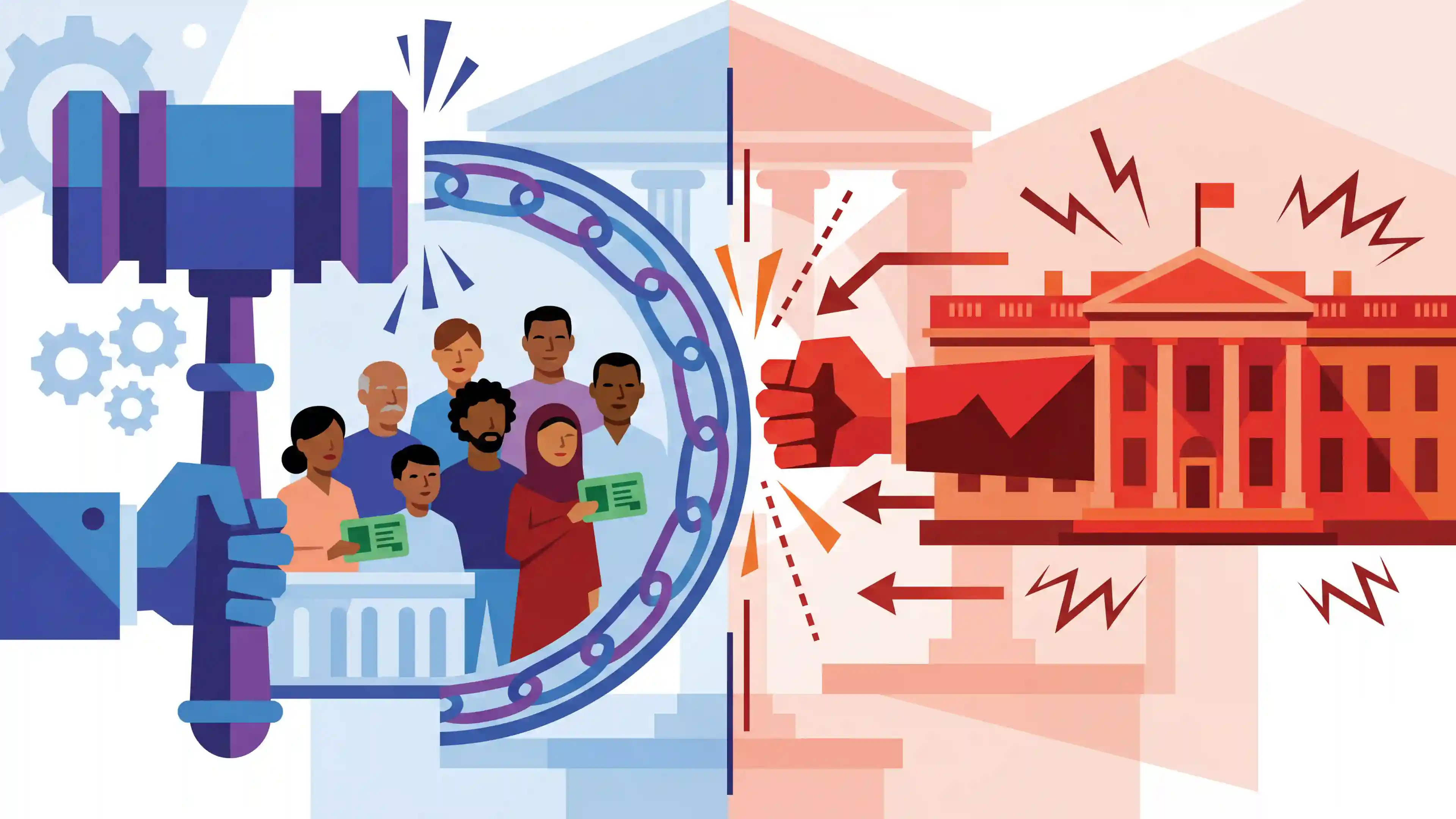
This development serves as a prime international case study for GS-2 on the doctrine of checks and balances, illustrating how the judiciary can act as a check on executive actions, particularly concerning human rights and immigration policies.
Summary
A U.S. federal judge in Minnesota has temporarily blocked the Trump administration from detaining refugees awaiting green cards under Operation PARRIS. The ruling sparked a sharp rebuke from the White House, which condemned the decision as judicial overreach, thereby highlighting the ongoing institutional friction over immigration enforcement and the separation of powers.
Key Points
- U.S. District Judge John Tunheim issued a temporary restraining order blocking the Trump administration from detaining refugees in Minnesota who are awaiting permanent residency status.
- The judicial order halts enforcement actions under 'Operation PARRIS', a federal initiative reviewing the legal standing of roughly 5,600 refugees.
- The White House strongly criticized the decision, with officials labeling it 'judicial sabotage' and an overreach into executive immigration authority.
- The conflict highlights ongoing friction between the U.S. judiciary and executive branch concerning immigration enforcement, refugee rights, and the separation of powers.
Important Terms
Operation PARRIS

Acronym for 'Post-Admission Refugee Reverification and Integrity Strengthening'; a U.S. policy aimed at re-vetting admitted refugees, often leading to legal disputes over detention and executive authority.
UPSC context
Relevant for GS Paper II (International Relations/Immigration Policy) and Case Studies involving executive-judiciary friction and refugee rights.
Judicial Review
The power of the judiciary to examine the constitutionality of legislative and executive actions. It is a 'basic structure' feature of the Indian Constitution (Articles 13, 32, 226).
UPSC context
Core GS Paper II topic; tests the judiciary's role as the guardian of the Constitution and the limits of executive power.
Separation of Powers
A doctrine dividing government into three branches—Legislature, Executive, and Judiciary—to ensure checks and balances. The US follows a strict model, while India follows 'fusion of powers.'
UPSC context
High-priority topic for GS Paper II; examines institutional balance and prevents the rise of absolute power in any single branch.
Comparative Constitution
A specific UPSC syllabus sub-topic involving the study of Indian constitutional provisions in contrast with other nations, particularly the USA's presidential and India's parliamentary systems.
UPSC context
GS Paper II (Polity); tests the ability to analyze different governance models and their impact on civil liberties and executive accountability.
Due Process of Law
A legal principle ensuring the state respects all legal rights of a person. In the US, it covers substantive fairness; in India, it was interpreted via 'procedure established by law.'
UPSC context
GS Paper II (Polity); essential for understanding Article 21 and the evolution of judicial protection of individual life and liberty.
U.S. Federal Court
The U.S. judicial system composed of three main levels: District Courts (trial), Circuit Courts (appeals), and the Supreme Court. Unlike India’s integrated system, it operates alongside state courts.
UPSC context
GS Paper II (Polity); relevant for comparing the dual-court system of the US with India’s single integrated judicial hierarchy.
Prelims Trap
India is a signatory to the 1951 UN Refugee Convention and its 1967 Protocol.
India is not a signatory to either. It manages refugees via domestic laws like the Foreigners Act, 1946, though it generally respects customary non-refoulement principles.
Static Concepts Connected
How does the Separation of Powers differ between the US and Indian Constitutions?
- US rigid model: The US Constitution dictates a strict, rigid separation between the executive, legislative, and judicial branches based on Montesquieu's doctrine.
- Indian blended model: India employs a flexible system of checks and balances, inherently fusing the executive and legislative branches through its parliamentary democratic structure.
What is the legal framework governing refugees in India?
- No specific law: India lacks a dedicated national refugee law. Asylum seekers are legally treated as 'aliens' and managed under the Foreigners Act, 1946.
- Non-Refoulement principle: Despite not signing the 1951 Convention, India observes this customary international law norm, prohibiting the forced return of individuals to countries where they face persecution.
Cross-Topic Patterns
Judicial Review vs Executive Authority
US executive-judicial friction mirrors India's own constitutional debates, such as the striking down of the NJAC and ongoing tensions over judicial appointments and tribunalization.
Domestic Laws vs Global Refugee Norms
Like the US, India relies heavily on domestic policy levers (CAA, Foreigners Act) rather than international treaties (1951 Convention) to manage complex migration and asylum issues.

Expect a comparative polity question contrasting US executive-judiciary friction with India's doctrine of checks and balances.
Linked PYQs · 2
Linked PYQs · 2
- 2019MainsGS2
Do you think that Constitution of India does not accept principle of strict separation of powers rather it is based on the principle of 'checks and balance'? Explain.
- 2020MainsGS2
Judicial Legislation is antithetical to the doctrine of separation of powers as envisaged in the Indian Constitution. In this context justify the filing of large number of public interest petitions praying for issuing guidelines to executive authorities.
