Strategic Autonomy and Energy Security in Russian Oil Imports
Source:The Hindu ↗
Why It Matters
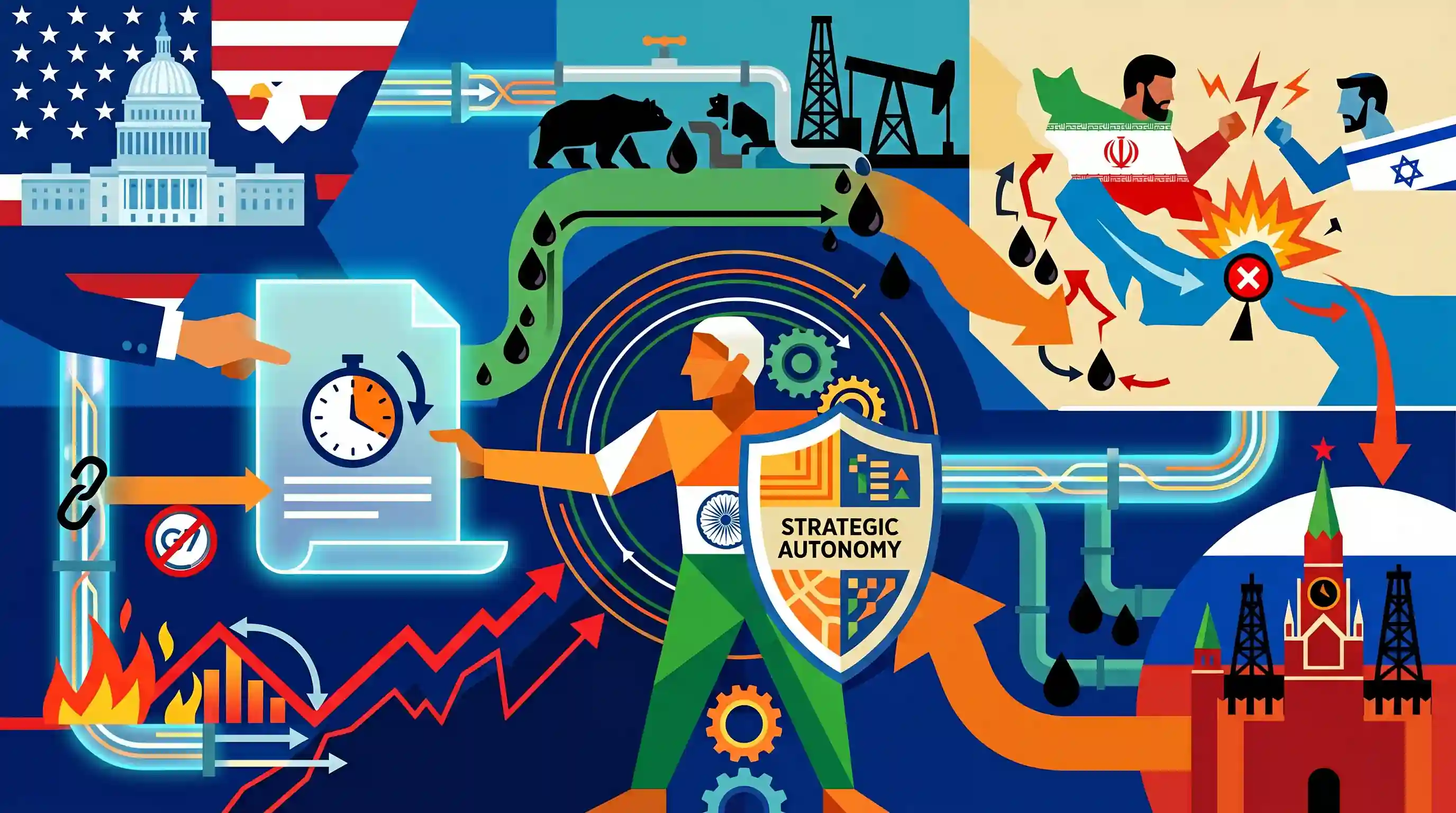
The development is a prime example of India's strategic autonomy in action, balancing its ties with the US and Russia while prioritizing national energy security. It provides crucial context for UPSC questions on the geopolitical impact of West Asian conflicts on global supply chains and India's foreign policy maneuvers regarding energy diplomacy.
Summary
The United States has issued a 30-day waiver allowing India to continue purchasing Russian crude oil without adhering to the G7 price cap. This temporary exemption comes in response to escalating geopolitical tensions in West Asia, specifically the Iran-Israel conflict, which has raised concerns about potential disruptions to global oil supplies through the Strait of Hormuz. By granting this waiver, the US aims to prevent a sudden spike in global energy prices that could result from a simultaneous squeeze on Russian and Middle Eastern oil. For India, the waiver reinforces its strategic autonomy and ensures short-term energy security by allowing continued access to discounted Russian crude amid volatile international markets.
Key Points
- The United States has granted India a 30-day waiver to purchase Russian crude oil, temporarily bypassing the G7 price cap mechanism.
- The decision is primarily driven by fears of a global oil supply shock exacerbated by the escalating Iran-Israel conflict in West Asia.
- A major concern is the potential disruption of oil shipments through the strategic Strait of Hormuz, which could cause a severe spike in global oil prices.
- The waiver highlights India's successful diplomatic maneuvering to maintain strategic autonomy and secure discounted energy resources for domestic stability.
- The move illustrates the US balancing act between enforcing sanctions on Russia and maintaining stability in the global energy market.
Important Terms
G7 Russian Oil Price Cap

A $60-per-barrel limit on seaborne Russian crude imposed by G7/EU to restrict Moscow’s revenue while maintaining global supply by denying Western shipping services for oil sold above this price.
UPSC context
GS Paper II/III: Tests understanding of international sanctions, global energy trade, and India's economic diplomacy with major powers.
Strategic Autonomy
India's foreign policy doctrine emphasizing independent decision-making based on national interest, allowing for multi-alignment with competing powers (like the US and Russia) without joining formal military alliances.
UPSC context
GS Paper II: Core concept of Indian Foreign Policy; tests knowledge of India's evolving global stance and multi-alignment.
Strait of Hormuz
A critical maritime chokepoint between Iran and Oman connecting the Persian Gulf to the Arabian Sea. It handles nearly 20% of global oil transit, making it vital for international energy security.
UPSC context
GS Paper I/II: Geographic chokepoint; tests knowledge of West Asian geopolitics and its impact on India's energy supply.
Sanctions Waiver
A legal exemption granted by the U.S. government (e.g., under CAATSA) allowing a partner country to bypass specific economic sanctions without facing penalties, usually to preserve strategic bilateral interests.
UPSC context
GS Paper II: International Relations; tests understanding of U.S. domestic law and its influence on bilateral strategic partnerships.
Energy Security
The uninterrupted availability of energy sources at an affordable price. For India, it involves balancing domestic production, diversifying imports, and maintaining strategic reserves to mitigate global supply shocks.
UPSC context
GS Paper III: Indian Economy; tests ability to analyze resource mobilization and geopolitical risks to economic growth.
Prelims Trap
The G7 price cap mechanism strictly prohibited India from importing any Russian seaborne crude oil.
India was never banned from buying Russian oil. The cap only barred Western firms from providing shipping and insurance if the oil was purchased above the $60/barrel limit.
Static Concepts Connected
What is the geographical significance of the Strait of Hormuz?
- Maritime Location: It connects the resource-rich Persian Gulf to the Gulf of Oman and the wider Arabian Sea.
- Bordering Nations: It is bounded by Iran to the north, and by Oman (Musandam Peninsula) and the UAE to the south.
- Economic Chokepoint: It facilitates roughly 20% of global seaborne oil trade, making it one of the world's most critical vulnerabilities for energy security.
How does the G7 price cap on Russian crude operate?
- Price Ceiling: It establishes a maximum allowable price (e.g., $60 per barrel) for Russian seaborne crude oil purchases.
- Enforcement Mechanism: It prohibits G7 and EU entities from providing maritime insurance and shipping services unless the oil is sold below the designated cap.
- Dual Objective: It aims to restrict Russian war revenues without banning the oil entirely, preventing catastrophic global supply shocks and inflation.
Cross-Topic Patterns
Strategic Autonomy vs. Secondary Sanctions
India's oil purchases mirror its S-400 missile deal, repeatedly testing US waiver mechanisms (like CAATSA) and proving India's shift from strict non-alignment to issue-based multi-alignment.
Imported Inflation & CAD Vulnerability
With over 87% oil import dependence, West Asian supply shocks directly worsen India's Current Account Deficit, accelerating the RBI's push for Rupee-denominated trade settlements to shield forex.

Mapping of West Asian chokepoints (Hormuz, Bab-el-Mandeb) alongside G7 economic sanctions is a high-probability 2026 Prelims question.
Linked PYQs · 3
Linked PYQs · 3
- 2025MainsGS2
"Energy security constitutes the dominant kingpin of India's foreign policy, and is linked with India's overarching influence in Middle Eastern countries.” How would you integrate energy security with India's foreign policy trajectories in the coming years?
- 2019MainsGS2
‘What introduces friction into the ties between India and the United States is that Washington is still unable to find for India a position in its global strategy, which would satisfy India's national self-esteem and ambitions.’ Explain with suitable examples.
- 2024PrelimsGS1
Consider the following statements : Statement-I : Sumed pipeline is a strategic route for Persian Gulf oil and natural gas shipments to Europe. Statement-II : Sumed pipeline connects the Red Sea with the Mediterranean Sea. Which one of the following is correct in respect of the above statements?
