Strait of Hormuz Strikes Escalate West Asia Energy Security Risks
Source:The Hindu ↗
Why It Matters
The conflict in West Asia directly impacts global energy markets. For India, a major oil importer, disruptions at the Strait of Hormuz threaten energy security, trigger inflation, and pose strategic challenges for its foreign policy in the Middle East.
Summary
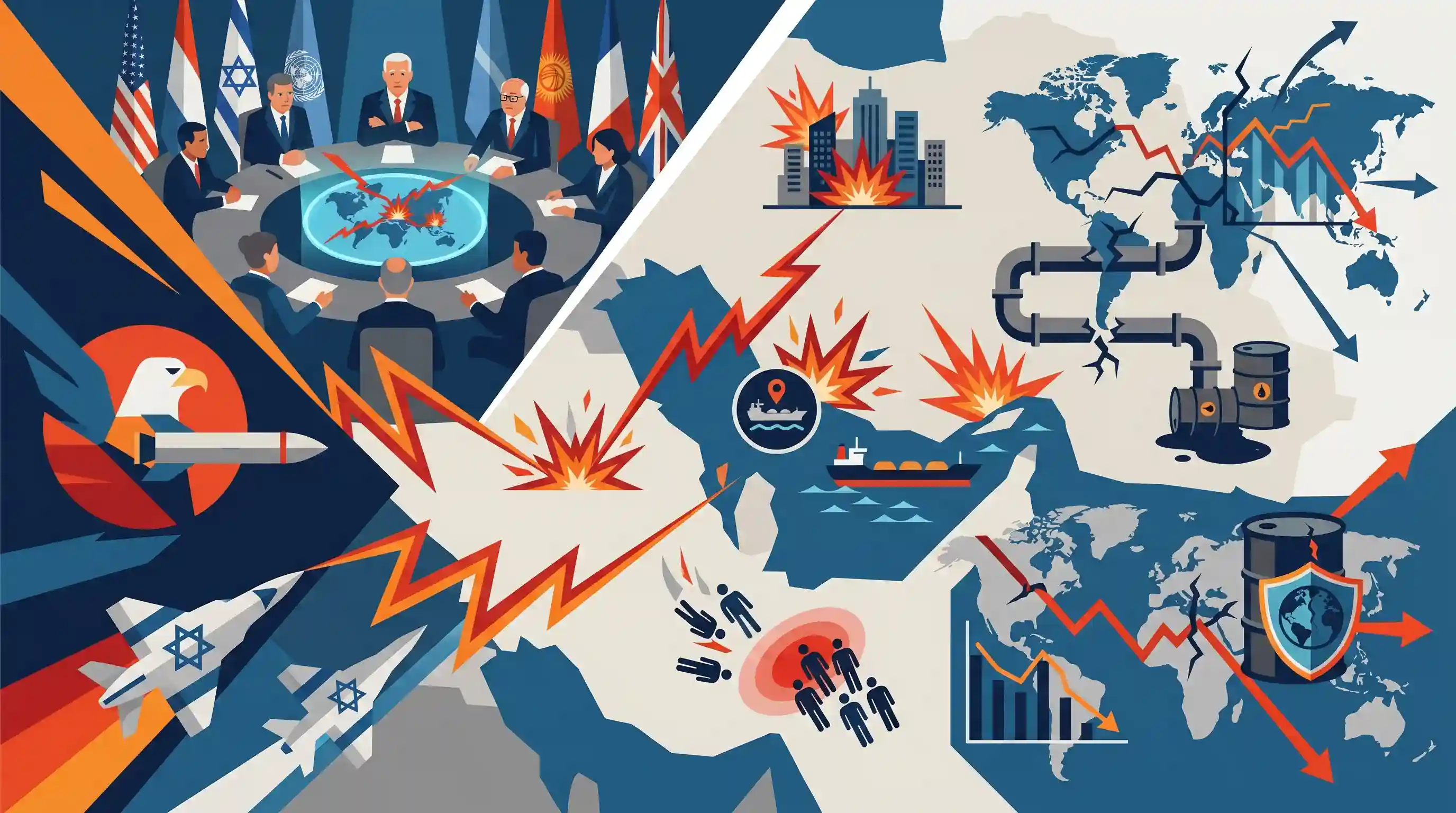
U.S. and Israeli strikes targeted the Iranian port city of Bandar Khamir near the Strait of Hormuz, killing five individuals and exacerbating tensions in the Middle East. Additional explosions were heard in Tehran, signaling a major escalation in the ongoing Iran-Israel conflict. The strikes near the Strait of Hormuz, a crucial chokepoint for international oil shipments, raise severe concerns regarding global energy security and maritime stability in West Asia.
Key Points
- U.S. and Israeli forces carried out military strikes on a quay at Bandar Khamir, an Iranian port city located near the strategic Strait of Hormuz, resulting in five deaths.
- Loud explosions were also reported in northern Tehran, with smoke rising from impacted areas, marking a significant escalation in the Iran-Israel conflict.
- The strikes highlight the vulnerability of the Strait of Hormuz, a critical maritime chokepoint that is vital to global energy flows and trade.
- The direct involvement of the U.S. alongside Israel against Iranian targets signals widening geopolitical instability in the Middle East, with major implications for global energy security.
Important Terms
Strait of Hormuz

A critical maritime chokepoint between the Persian Gulf and Gulf of Oman, through which approximately 20% of global oil and LNG shipments transit daily, making it vital for international trade.
UPSC context
GS Paper 2 (International Relations) and GS Paper 1 (Geography); essential for understanding maritime security, energy lifelines, and India's energy import vulnerability.
IRNA (Islamic Republic News Agency)
The official state news agency of Iran, established in 1934 and controlled by the Ministry of Culture and Islamic Guidance; it serves as the primary media outlet for Iranian government narratives.
UPSC context
GS Paper 2 (International Relations); relevant for evaluating source credibility and state-driven diplomatic narratives in the West Asian conflict.
Israel Defense Forces (IDF)
The unified military force of Israel, responsible for the country's defense across land, air, and sea; it is a central actor in the ongoing regional conflict with Iran and its proxies.
UPSC context
GS Paper 2 (International Relations); critical for studying regional security dynamics, defense cooperation, and the Israel-Palestine-Iran geopolitical nexus.
Bandar Khamir
A strategic Iranian port city in Hormozgan province, situated along the Persian Gulf near the Strait of Hormuz; it serves as both a UNESCO Learning City and a military outpost.
UPSC context
GS Paper 1 (World Geography) and GS Paper 3 (Security); highlights key target locations in West Asian military escalations and maritime infrastructure.
Energy Security
The reliable availability of energy sources at an affordable price, often threatened in West Asia by regional conflicts and disruptions to maritime shipping lanes like the Strait of Hormuz.
UPSC context
GS Paper 3 (Economy/Environment); tests knowledge of global supply chains, India's crude oil dependency, and the economic impact of geopolitical instability.
West Asia Geopolitics
The geopolitical study of political, economic, and security relations within Western Asia, characterized by power struggles between regional states and influence from global powers like the U.S. and Russia.
UPSC context
GS Paper 2 (International Relations); a core syllabus area focusing on India's interests, diaspora safety, and regional stability in the Gulf.
Prelims Trap
"The Strait of Hormuz connects the Persian Gulf to the Red Sea."
Aspirants frequently confuse Middle Eastern chokepoints. Hormuz connects the Persian Gulf to the Gulf of Oman, whereas Bab-el-Mandeb connects the Red Sea to the Gulf of Aden.
Static Concepts Connected
What are the major maritime chokepoints in the Middle East?
- Strait of Hormuz: Connects the Persian Gulf to the Gulf of Oman and Arabian Sea. Bordered by Iran, Oman, and the UAE. Processes 20% of global oil.
- Bab-el-Mandeb: Connects the Red Sea to the Gulf of Aden. Bordered by Yemen, Djibouti, and Eritrea. Crucial for Suez Canal transit.
How do crude oil price shocks impact India's macroeconomic indicators?
- Current Account Deficit: Elevated crude prices swell India's import bill, directly widening the CAD and putting downward pressure on the Rupee.
- Imported Inflation: Higher domestic fuel prices cascade across sectors, increasing logistics and production costs, which drives up both WPI and CPI.
- Fiscal Deficit: The government may reduce fuel excise duties to cushion consumers, leading to lower tax revenues and a widened fiscal deficit.
Cross-Topic Patterns
Bandar Khamir's Ramsar Connection
Bandar Khamir is an accredited Wetland City near the Khorkhoran Wetland under the Ramsar Convention. UPSC often tests obscure environmental features embedded within geopolitical conflict zones.
Strategic Petroleum Reserves (SPRs)
The vulnerability of the Strait of Hormuz directly links to India's Strategic Petroleum Reserves (SPRs) policy, import diversification strategies, and the structural push toward renewable energy.

Expect a 2026 multi-statement question linking West Asian chokepoints (Hormuz) with macroeconomic impacts on India like CAD and inflation.
Linked PYQs · 3
Linked PYQs · 3
- 2025MainsGS2
"Energy security constitutes the dominant kingpin of India's foreign policy, and is linked with India's overarching influence in Middle Eastern countries.” How would you integrate energy security with India's foreign policy trajectories in the coming years?
- 2017MainsGS2
The question of India's Energy Security constitutes the most important part of India's economic progress. Analyze India's energy policy cooperation with West Asian countries.
- 2014PrelimsGS1
Turkey is located between
