Iran military preparedness and proxy deterrence against US strikes
Source:Indian Express ↗
Why It Matters
The evolving conflict dynamics between Iran and Israel deeply impact global geopolitics, global supply chains, and international energy markets. For UPSC aspirants, understanding Iran's strategic deterrence is critical for analyzing the Middle East crisis and its cascading effects on India's strategic interests and energy security.
Summary
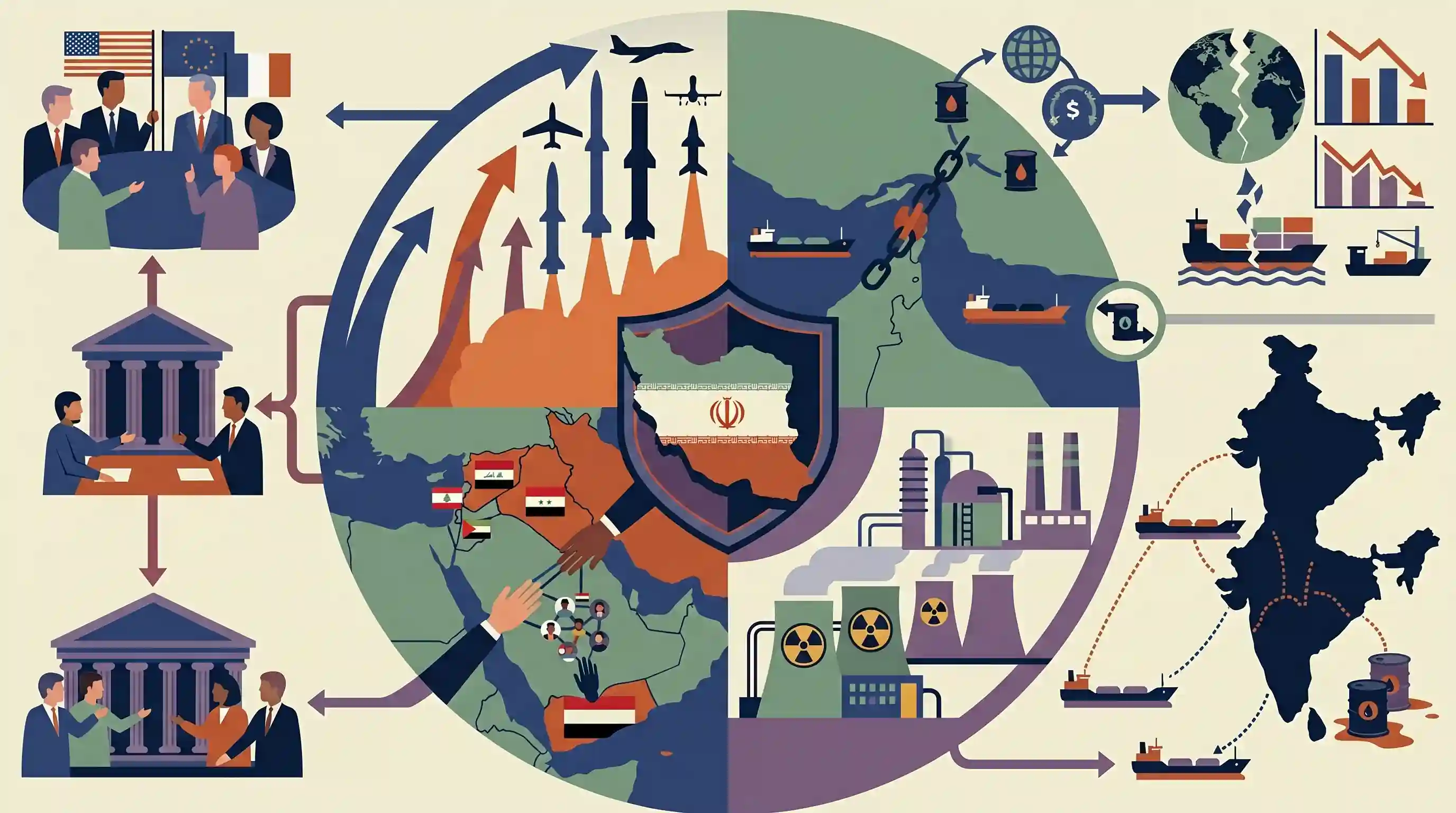
The article analyzes Iran's strategic preparedness in the face of potential direct military confrontation with the US and Israel. It outlines Iran's multi-layered defense and deterrence framework, often characterized by its 'four layers' of power: its expansive proxy network (Axis of Resistance), advanced asymmetric capabilities in ballistic missiles and drones, leverage over critical global energy chokepoints like the Strait of Hormuz, and its advancing nuclear program. These layers ensure that any direct strike on Iran would trigger widespread regional retaliation and disrupt global energy markets, transforming a localized conflict into a global geopolitical and economic nightmare. For India, this underscores the vulnerability of its energy security linked to Middle Eastern stability.
Key Points
- Iran relies on a multi-layered deterrence strategy to counter the conventional military superiority of the US and Israel.
- The 'Axis of Resistance', comprising proxies like Hezbollah, Hamas, and the Houthis, serves as Iran's first line of forward defense and regional retaliation.
- Iran's advanced asymmetric warfare capabilities, particularly its vast arsenal of ballistic missiles and drones, enable it to project power and strike deep into adversary territory.
- Iran's geographic control over the Strait of Hormuz gives it the leverage to disrupt global energy supplies, turning a regional conflict into a global economic crisis.
- Iran's advancing nuclear program and reduced breakout time act as a latent deterrent, significantly raising the stakes of any direct military confrontation.
- A direct US-Israel strike on Iran risks igniting a broader Middle Eastern war with severe ramifications for global supply chains, oil prices, and India's energy security.
Important Terms
Axis of Resistance

An informal Iran-led coalition of state and non-state actors (including Hezbollah and Houthis) seeking to counter Western and Israeli influence in West Asia through coordinated asymmetric warfare.
UPSC context
GS-II (International Relations); crucial for understanding regional security architecture and India’s 'Link West' policy.
JCPOA (Joint Comprehensive Plan of Action)
A 2015 multilateral agreement limiting Iran's nuclear program in exchange for sanctions relief. Its effectiveness declined following the 2018 US withdrawal and subsequent Iranian enrichment breaches.
UPSC context
GS-II (International Relations); tests non-proliferation regimes and their impact on India’s energy security.
Islamic Revolutionary Guard Corps (IRGC)
An elite branch of the Iranian Armed Forces reporting to the Supreme Leader. It manages foreign operations (Quds Force), internal security, and significant national economic sectors.
UPSC context
GS-II (International Relations); relevant for analyzing state-sponsored actors and regional stability in West Asia.
Houthis
A Yemen-based Zaydi Shia militant group (Ansar Allah) aligned with Iran. They control key territories near the Bab-el-Mandeb, impacting global maritime trade and Indian exports.
UPSC context
GS-II & III (IR and Economy); vital for maritime security and Indian trade interests in the Red Sea.
Hezbollah
A Lebanon-based Shia militant group and political party that serves as Iran’s most powerful proxy and a primary military deterrent on Israel’s northern border.
UPSC context
GS-II (International Relations); tests knowledge of non-state actors and Lebanon’s strategic role in Middle East stability.
Strait of Hormuz
A critical maritime chokepoint between the Persian Gulf and Gulf of Oman. It is the world’s most important energy transit route for crude oil and LNG.
UPSC context
GS-I & III (Geography and Economy); essential for India’s energy security and strategic petroleum reserve planning.
Prelims Trap
"The Strait of Hormuz connects the Red Sea to the Gulf of Aden and is heavily influenced by Houthi rebels."
UPSC often swaps geographic chokepoints. Hormuz connects the Persian Gulf to the Gulf of Oman (Iran/Oman), while Bab el-Mandeb connects the Red Sea to the Gulf of Aden (Yemen).
Static Concepts Connected
What are the critical maritime chokepoints in West Asia?
- Strait of Hormuz: Connects the Persian Gulf to the Gulf of Oman and the Arabian Sea. It is bordered by Iran, Oman, and the UAE.
- Bab el-Mandeb: Connects the Red Sea to the Gulf of Aden. It is bordered by Yemen on the Arabian Peninsula, and Djibouti and Eritrea in the Horn of Africa.
How does 'Asymmetric Warfare' differ from conventional warfare?
- Definition: Conflict between belligerents whose relative military power differs significantly, shifting away from standing armies.
- Tactics: Relies on unconventional tactics like proxy groups, drones, cyberattacks, and guerrilla warfare to offset a conventionally superior adversary.
- Modern Example: Iran's "Axis of Resistance" and its reliance on cheap drone swarms over expensive fighter jets is a classic geopolitical example.
Cross-Topic Patterns
INSTC & Regional Conflict
US-Iran hostilities threaten India's strategic investments in Chabahar Port and the International North-South Transport Corridor, disrupting connectivity to Central Asia and Russia.
Oil Shocks & Imported Inflation
Strait of Hormuz disruptions directly widen India's Current Account Deficit and drive imported inflation, tightly linking West Asian geopolitics to domestic monetary policy.

Map questions matching West Asian proxies to their host countries and adjacent maritime chokepoints are highly likely in 2026 Prelims.
Linked PYQs · 4
Linked PYQs · 4
- 2025MainsGS2
"Energy security constitutes the dominant kingpin of India's foreign policy, and is linked with India's overarching influence in Middle Eastern countries.” How would you integrate energy security with India's foreign policy trajectories in the coming years?
- 2017MainsGS2
The question of India's Energy Security constitutes the most important part of India's economic progress. Analyze India's energy policy cooperation with West Asian countries.
- 2018MainsGS2
“India’s relations with Israel have, of late, acquired a depth and diversity, which cannot be rolled back.” Discuss.
- 2003PrelimsGS1
Israel has common borders with
