Strategic Challenges and Exit Strategy Deficit in West Asia War
Source:Indian Express ↗
Why It Matters
The escalating conflict in West Asia directly impacts India's strategic interests, including energy security, diaspora welfare, and trade corridors (like IMEC). Understanding the limitations of US and Israeli strategies is crucial for evaluating regional stability and predicting future geopolitical realignments.
Summary
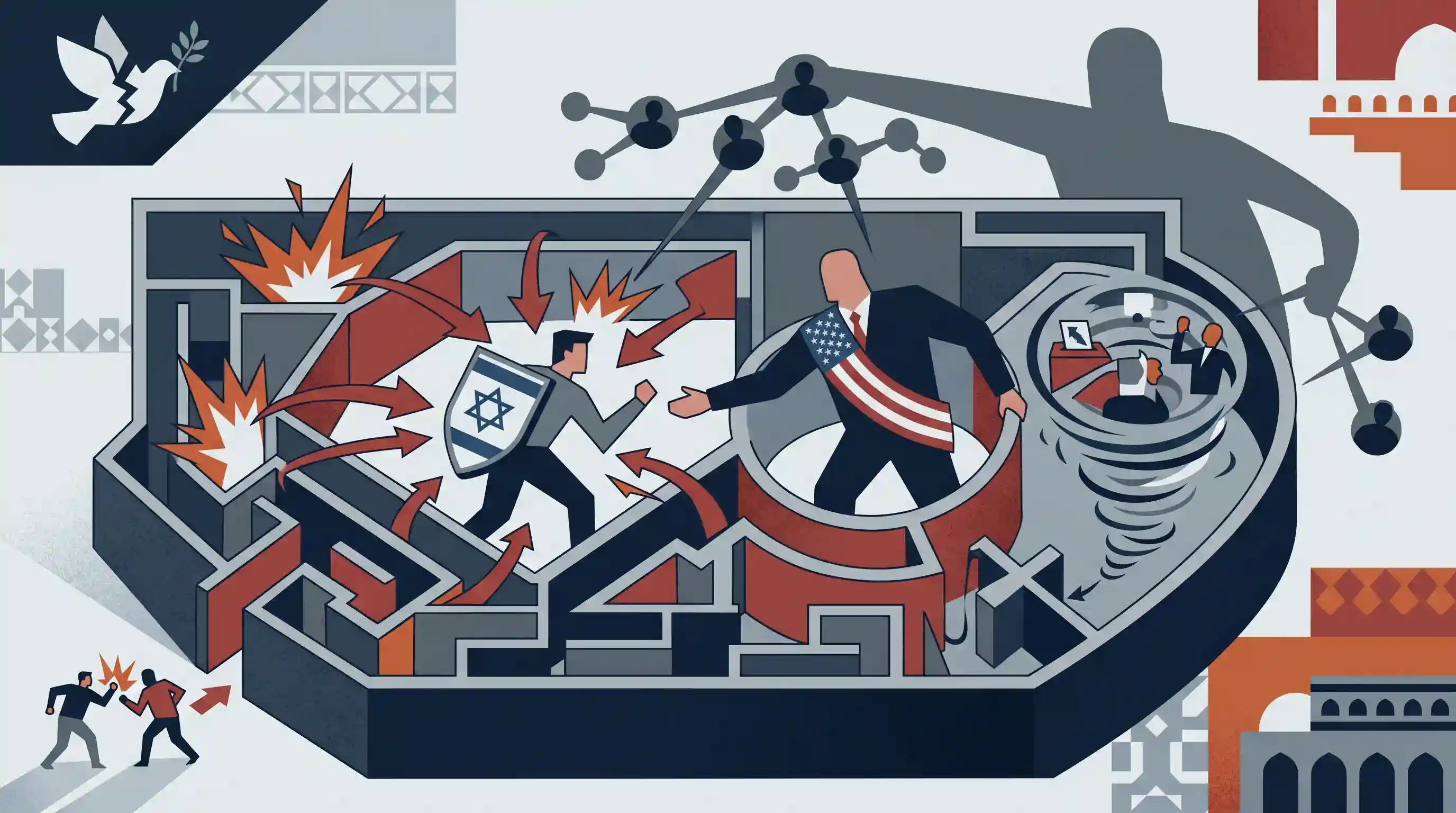
The article argues that both the United States and Israel lack a viable exit strategy from the escalating conflict in West Asia. What began as a localized war has expanded into a complex regional confrontation involving Iran and its proxies. With maximalist goals clashing with ground realities, Israel faces a protracted multi-front war. Meanwhile, the US is caught between supporting its ally and managing domestic political pressures, particularly with the influence of figures like Donald Trump. The absence of an 'honourable exit' underscores the failure of deterrence and the complexities of achieving a sustainable diplomatic resolution in a highly volatile region.
Key Points
- The ongoing conflict in West Asia has escalated from a localized war in Gaza into a broader regional confrontation involving Israel, Iran, and Iranian-backed proxies.
- Israel finds itself in a prolonged multi-front conflict without a clear strategic end-state or 'honourable exit', risking perpetual military engagement.
- The United States is strategically entangled, attempting to manage regional escalation while domestic political shifts, notably involving Donald Trump's policy perspectives, complicate long-term commitments.
- The lack of a coherent diplomatic off-ramp threatens regional stability, with significant implications for global energy security and international geopolitical alignments.
Important Terms
Abraham Accords

2020 US-brokered agreements normalizing diplomatic ties between Israel and several Arab nations, including the UAE and Bahrain, marking a major regional realignment away from traditional Arab consensus.
UPSC context
GS Paper 2: International Relations; tests knowledge of Middle East peace processes and India's plurilateral engagements like I2U2.
Hamas
A Palestinian Islamist militant and political organization that has governed the Gaza Strip since 2007, advocating for Palestinian statehood through both governance and armed resistance.
UPSC context
GS Paper 2: Bilateral Relations; relevant for understanding the Israel-Palestine conflict and India’s balanced diplomatic stance.
Hezbollah
A Lebanese Shia militant group and political party backed by Iran, serving as a key regional power player and a primary component of the anti-Israel "Axis of Resistance."
UPSC context
GS Paper 2: Regional Security; tests understanding of non-state actors and proxy warfare impacting India's energy interests.
Axis of Resistance
A strategic alliance led by Iran, including the Syrian government, Hezbollah, Hamas, and Houthi rebels, united by opposition to Western and Israeli influence in West Asia.
UPSC context
GS Paper 2: Geopolitics; crucial for analyzing multi-front regional conflicts and their effect on global stability.
Deterrence
A military strategy intended to dissuade an adversary from taking action by making the costs of such action outweigh the perceived benefits.
UPSC context
GS Paper 2/3: International Relations and Security; fundamental for analyzing conflict prevention and regional power dynamics.
Strait of Hormuz
A vital maritime chokepoint between the Persian Gulf and the Gulf of Oman, through which a significant portion of the world's oil supply passes.
UPSC context
GS Paper 1 (Geography) and GS Paper 2/3; tests awareness of energy security and critical global trade routes.
Prelims Trap
"The 'Axis of Resistance' refers to the Arab states that signed the Abraham Accords to counter Iranian influence."
The 'Axis of Resistance' is an Iran-led informal network (Hezbollah, Houthis, Hamas) opposed to US/Israel, whereas the Abraham Accords are normalization agreements between Israel and select Arab states.
Static Concepts Connected
Which key maritime chokepoints are directly threatened by West Asian instability?
- Strait of Hormuz: Connects the Persian Gulf to the Gulf of Oman and Arabian Sea; the world's most critical transit point for global oil shipments.
- Bab-el-Mandeb Strait: Connects the Red Sea to the Gulf of Aden; highly vulnerable to Houthi attacks, directly disrupting Suez Canal shipping lanes.
What are the core foundational pillars of the IMEC project?
- Eastern Corridor: Designed to connect India to the Arabian Gulf via robust maritime sea lanes, enhancing trade efficiency.
- Northern Corridor: Designed to connect the Arabian Gulf to Europe through an extensive transnational rail and port network across the Middle East.
Cross-Topic Patterns
Multi-front war stalling IMEC progress
The escalation jeopardizes the infrastructure timeline for the India-Middle East-Europe Economic Corridor (IMEC), inadvertently providing strategic breathing room for China's Belt and Road Initiative (BRI).
West Asian instability and imported inflation
Protracted conflict in the Persian Gulf threatens to spike crude oil prices, straining India's Current Account Deficit (CAD) and complicating the RBI's domestic inflation targeting.

Expect a 2026 Mains question linking West Asian instability directly to India's energy security and the stalling of IMEC infrastructure.
Linked PYQs · 2
Linked PYQs · 2
- 2025MainsGS2
"Energy security constitutes the dominant kingpin of India's foreign policy, and is linked with India's overarching influence in Middle Eastern countries.” How would you integrate energy security with India's foreign policy trajectories in the coming years?
- 2018MainsGS2
“India’s relations with Israel have, of late, acquired a depth and diversity, which cannot be rolled back.” Discuss.
