West Asia Conflict Escalation and Global Crude Price Surge
Source:The Hindu ↗
Why It Matters
The events illustrate the extreme fragility of global energy supply chains dependent on maritime chokepoints like the Strait of Hormuz. For UPSC aspirants, this serves as a critical case study on how Middle Eastern instability directly impacts India's macroeconomic stability and energy security. It also highlights the intricate diplomacy involving proxy warfare, nuclear containment, and major power mediations in West Asia.
Summary
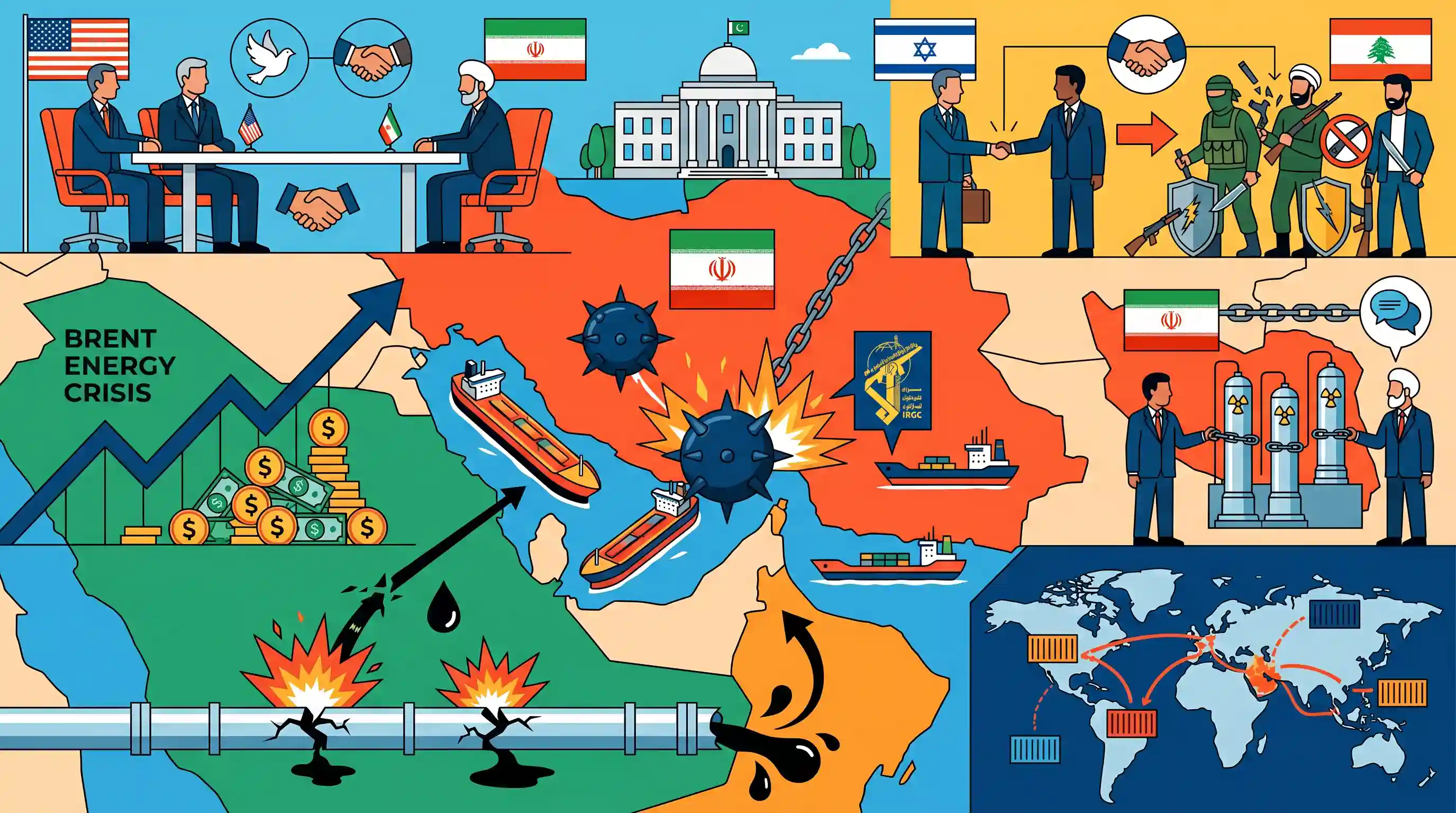
Escalating conflicts in West Asia have prompted diplomatic interventions, with the United States and Iran preparing for high-level ceasefire talks in Islamabad, and Israel initiating direct negotiations with Lebanon to disarm Hezbollah. Meanwhile, Iran's Revolutionary Guard has mined the Strait of Hormuz, effectively creating a blockade that has trapped oil tankers and caused Brent crude prices to surge to $96 per barrel. Compounded by damage to Saudi Arabia's East-West pipeline, this chokehold has triggered a global energy crisis. Amidst these geopolitical tensions, Iran has shown potential willingness to negotiate limits on its uranium enrichment program.
Key Points
- The United States and Iran are preparing for high-level ceasefire talks in Islamabad, Pakistan, aiming to de-escalate the broader Middle Eastern conflict.
- Israeli Prime Minister Benjamin Netanyahu has authorized direct negotiations with Lebanon to disarm the Iranian-backed militant group Hezbollah.
- Iran's Revolutionary Guard has reportedly laid sea mines in the Strait of Hormuz, severely disrupting global oil supply chains and trapping oil tankers.
- The blockade of the Strait of Hormuz, coupled with damage to Saudi Arabia's East-West pipeline, has triggered a global energy crisis, pushing Brent crude oil prices to $96 a barrel.
- As part of the diplomatic maneuverings, Iran has indicated it may consider placing restrictions on its uranium enrichment program.
Important Terms
Hezbollah

A Lebanese Shia militant group and political party founded in 1982 with Iranian support. It operates as a major regional proxy and "state within a state," opposing Israeli and Western influence in West Asia.
UPSC context
GS II: International Relations/West Asia; GS III: Security. Tests understanding of non-state actors and regional proxy dynamics in Middle Eastern conflicts.
Islamic Revolutionary Guard Corps (IRGC)
A powerful multi-service branch of Iran’s military established in 1979 to protect the Islamic system. It operates independently of the regular army and oversees elite units like the expeditionary Quds Force.
UPSC context
GS II: International Relations. Tests knowledge of Iran’s security architecture and its role in regional geopolitics and global security.
Strait of Hormuz
A critical maritime chokepoint between the Persian Gulf and Gulf of Oman. It handles roughly 20-25% of the world’s seaborne oil trade, making it vital for global energy security.
UPSC context
GS I: Geography; GS II: International Relations. Tests strategic geography, maritime chokepoints, and India’s energy supply chain vulnerabilities.
Brent Crude
A major global price benchmark for crude oil sourced from the North Sea. This "light, sweet" oil is used to price approximately two-thirds of the world’s internationally traded crude contracts.
UPSC context
GS III: Indian Economy. Tests understanding of global commodity benchmarks and their impact on India’s inflation, fiscal deficit, and trade balance.
Saudi East-West Pipeline
A 1,200-km strategic pipeline (Petroline) that transports crude from Saudi Arabia’s eastern fields to the Red Sea port of Yanbu, serving as a vital bypass for the vulnerable Strait of Hormuz.
UPSC context
GS II: International Relations; GS III: Energy Security. Tests knowledge of strategic infrastructure and diversification efforts to mitigate geopolitical risks.
Uranium Enrichment
The physical process of increasing the concentration of the fissile isotope Uranium-235. Low levels (3-5%) fuel nuclear power plants, while high levels (90%) are required for nuclear weapons development.
UPSC context
GS III: Science & Technology/Security; GS II: Nuclear Policy. Tests concepts of nuclear proliferation, dual-use technology, and international non-proliferation frameworks.
Prelims Trap
"The Strait of Hormuz is a critical chokepoint connecting the Persian Gulf to the Red Sea."
It connects the Persian Gulf to the Gulf of Oman. Bab el-Mandeb is the strait connecting the Red Sea to the Gulf of Aden.
Static Concepts Connected
What are West Asia's critical maritime chokepoints for energy trade?
- Strait of Hormuz: Connects the Persian Gulf to the Gulf of Oman. Bordered by Iran, Oman, and the UAE, it handles roughly 20% of global oil trade.
- Bab el-Mandeb: Links the Red Sea to the Gulf of Aden and Arabian Sea. Bordered by Yemen, Djibouti, and Eritrea.
- Suez Canal: Artificial waterway in Egypt connecting the Mediterranean Sea to the Red Sea, eliminating the need to navigate around Africa.
How does a sudden crude oil price surge impact India's macroeconomy?
- Widens CAD: An inflated import bill for inelastic crude oil demand widens the CAD, putting severe downward pressure on the Rupee.
- Imported Inflation: Elevated global fuel costs cascade into domestic transport and manufacturing sectors, driving up both Wholesale and Consumer Price Indices.
- Fiscal Deficit pressure: Government interventions, such as cutting excise duties to shield retail consumers from price shocks, can constrain tax revenues.
Cross-Topic Patterns
Chokepoint mapping + Macroeconomic indicators
Disruptions in the Strait of Hormuz directly link geographic mapping to core economic concepts like widened Current Account Deficit and imported inflation, a dual-concept testing favorite.
Nuclear diplomacy + IAEA safeguards
Iran's potential willingness to negotiate uranium enrichment caps brings the JCPOA framework, Non-Proliferation Treaty (NPT), and IAEA safeguards back into focus for GS-2.

A multi-statement Prelims question mapping West Asian chokepoints (Hormuz, Bab el-Mandeb) alongside their pipeline bypasses is highly probable.
Linked PYQs · 5
Linked PYQs · 5
- 2025MainsGS2
"Energy security constitutes the dominant kingpin of India's foreign policy, and is linked with India's overarching influence in Middle Eastern countries.” How would you integrate energy security with India's foreign policy trajectories in the coming years?
- 2018MainsGS2
In what ways would the ongoing US-Iran Nuclear Pact Controversy affect the national interest of India? How should India respond to this situation?
- 2012MainsGS2
How have the US sanctions against Iran affected India's bilateral relations with Iran?
- 2018MainsGS2
“India’s relations with Israel have, of late, acquired a depth and diversity, which cannot be rolled back.” Discuss.
- 2024PrelimsGS1
Consider the following statements : Statement-I : Sumed pipeline is a strategic route for Persian Gulf oil and natural gas shipments to Europe. Statement-II : Sumed pipeline connects the Red Sea with the Mediterranean Sea. Which one of the following is correct in respect of the above statements?
