Indian diaspora resilience amid West Asian geopolitical crisis
Source:Indian Express ↗
Why It Matters
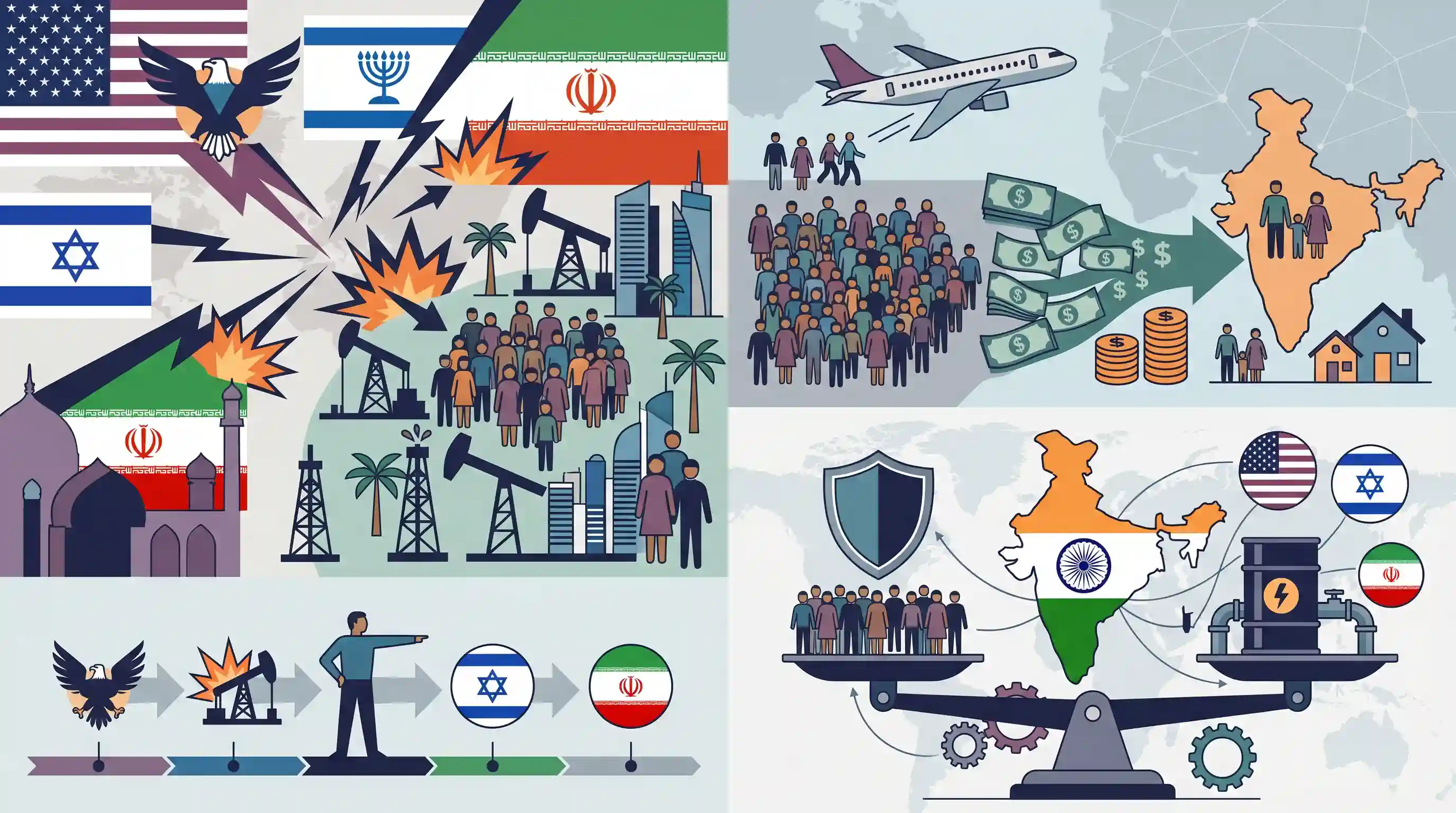
The safety and economic well-being of the Indian diaspora in the Gulf is a central tenet of India's foreign policy. Their massive remittances support the Indian economy, while India's energy security is heavily reliant on Middle Eastern stability. Conflicts in this region directly test India's strategic autonomy and crisis-response mechanisms.
Summary
As geopolitical tensions and direct military strikes escalate between the US, Israel, and Iran, the massive 8.8 million-strong Indian diaspora in the Gulf region finds itself in the crossfire. However, this 'silent force' of expatriates is largely choosing to remain in the region rather than rush for evacuation. Their reluctance to leave is driven by compelling economic necessities, the critical importance of remittances to their families in India, and a historical resilience to Middle Eastern conflicts. The unfolding crisis underscores India's complex geopolitical challenge in West Asia: protecting its vast diaspora and securing vital energy supplies without alienating its diverse strategic partners.
Key Points
- The Gulf region is home to approximately 8.8 million Indian expatriates who serve as a critical economic pillar for both the host nations and India via remittances.
- Escalating geopolitical tensions and military strikes involving the US, Israel, and Iran have placed this massive demographic squarely in the crossfire of regional instability.
- Despite the escalating risks, the Indian diaspora in the Gulf—often termed the ‘silent force’—is opting not to evacuate in large numbers, driven by economic necessity, job security, and historical resilience to regional volatility.
- The situation demands a delicate diplomatic balancing act by India to safeguard its citizens, ensure undisrupted energy supplies, and maintain strategic ties with all opposing factions in West Asia.
Prelims Trap
"The UAE and Gulf nations currently stand as the single largest country-wise source of inward remittances to India."
A common trap. While the Gulf is a major bloc, the United States has recently overtaken the UAE as the single largest source country for remittances to India.
Static Concepts Connected
What is India's 'De-hyphenation' policy in West Asia?
- Bilateral Independence: Maintaining relations with rival nations (e.g., Israel-Palestine, Iran-Saudi) independently, without linking the foreign policy of one to the other.
- Strategic Autonomy: Allows India to secure Israeli defense tech while simultaneously importing Arab oil and developing Iran's Chabahar port without alienating partners.
How does the 'Kafala' system structurally impact the Gulf Indian diaspora?
- Sponsorship Model: Binds a migrant worker's legal residency and visa status directly to a specific employer or sponsor (Kafeel) in Gulf nations.
- Structural Vulnerability: Restricts job mobility, limits labor rights, and strictly prevents naturalization, leaving temporary blue-collar workers highly exposed during regional conflicts.
Cross-Topic Patterns
Remittances vs. Oil Trade Deficit
Gulf remittances (invisibles in the Current Account) act as a critical macroeconomic hedge against India's structural trade deficit caused by importing crude oil from the very same region.
Evacuations and Strategic Lift
Recurrent regional instability frequently tests India's military logistics and strategic airlift capacities, linking diaspora policy to defense operations (e.g., Operations Rahat, Ajay, and Kaveri).

Expect a 2026 Mains question on India's West Asia paradox: balancing energy import vulnerabilities with diaspora remittance dependency.
Linked PYQs · 5
Linked PYQs · 5
- 2025MainsGS2
"Energy security constitutes the dominant kingpin of India's foreign policy, and is linked with India's overarching influence in Middle Eastern countries.” How would you integrate energy security with India's foreign policy trajectories in the coming years?
- 2017MainsGS2
The question of India's Energy Security constitutes the most important part of India's economic progress. Analyze India's energy policy cooperation with West Asian countries.
- 2020MainsGS2
Indian diaspora has a decisive role to play in the politics and economy of America and European Countries'. Comment with examples.
- 2023MainsGS2
Indian diaspora has scaled new heights in the West. Describe its economic and political benefits for India.
- 2018MainsGS2
“India’s relations with Israel have, of late, acquired a depth and diversity, which cannot be rolled back.” Discuss.
