Desalination Plant Attacks and West Asian Water Security
Source:The Hindu ↗
Why It Matters
The targeting of desalination plants in the Middle East brings an acute water-security dimension to regional conflicts. For UPSC aspirants, this bridges GS-2 (International Relations and Middle East Geopolitics) with GS-3 (Alternative Technologies for Freshwater and Critical Infrastructure Vulnerability), highlighting how geopolitical disputes can weaponize basic human needs like water.
Summary
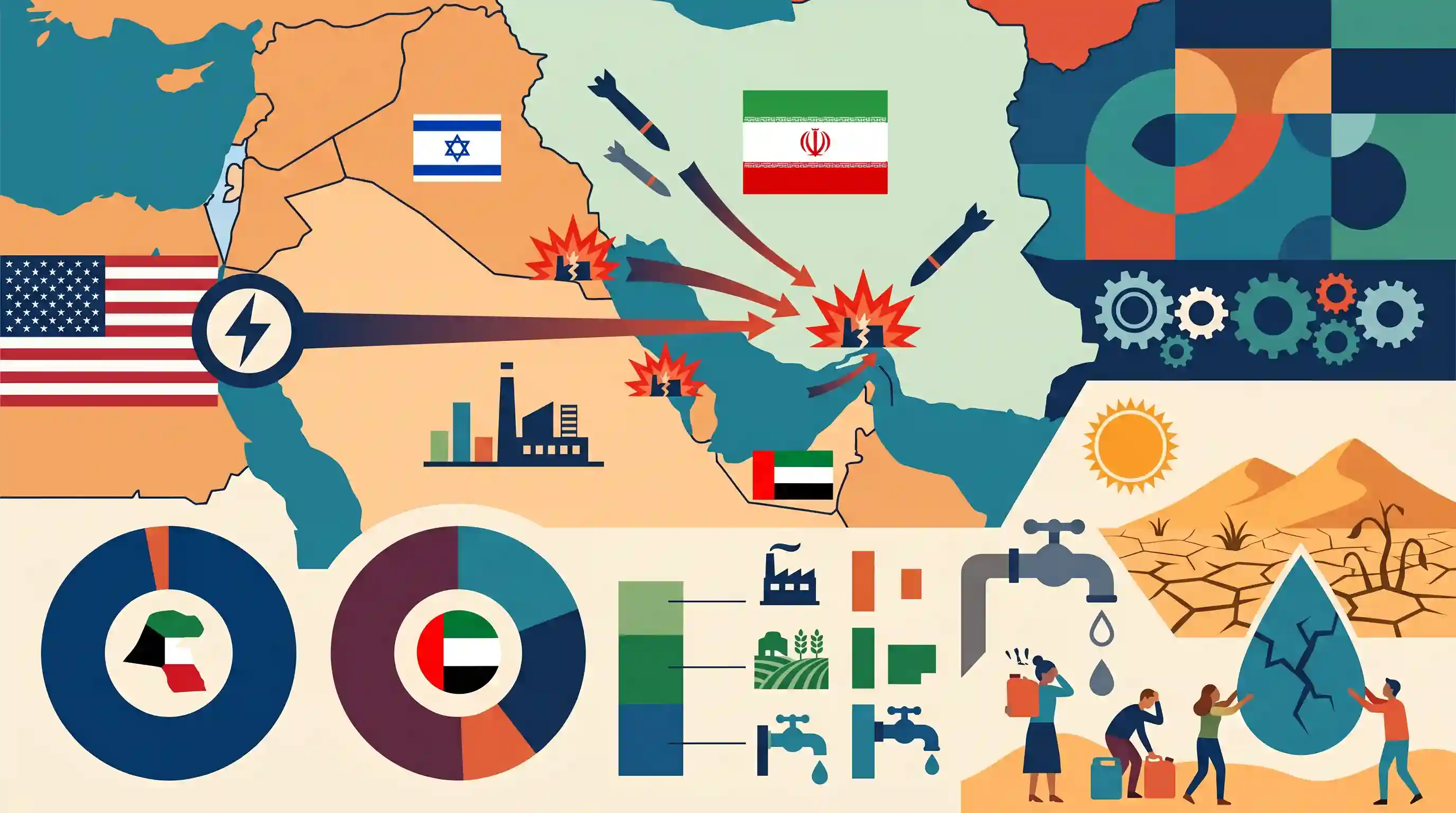
Amidst the escalating US-Israel-Iran conflict, military strikes have targeted critical desalination plants in the Persian Gulf, including a major facility on Iran's Qeshm island in the Strait of Hormuz. Iran has blamed the US for the attack, while similar incidents have affected plants in Bahrain and Kuwait. This development highlights a perilous shift in modern warfare towards targeting essential civilian infrastructure. Given the extreme aridity of West Asia and the heavy reliance of Gulf states on desalination for freshwater (ranging from 42% in the UAE to 90% in Kuwait), such strikes pose a severe threat to regional water security and could precipitate massive humanitarian emergencies alongside the geopolitical instability.
Key Points
- A strategic desalination plant on Iran's Qeshm island in the Strait of Hormuz was knocked out of service following a military strike, which Iran attributes to the US.
- The attack signifies a dangerous escalation where critical civilian infrastructure, specifically water security systems, is being targeted in the ongoing US-Israel-Iran conflict.
- West Asian nations are acutely vulnerable to such tactics due to their massive reliance on desalination: Kuwait (90%), Oman (86%), Saudi Arabia (70%), and the UAE (42%).
- Recent tit-for-tat strikes involving facilities in Bahrain and Kuwait underscore how the geopolitical conflict could trigger an unprecedented regional water and humanitarian crisis.
Prelims Trap
"The Strait of Hormuz connects the Persian Gulf to the Red Sea."
Aspirants frequently confuse West Asian chokepoints. Hormuz connects the Persian Gulf to the Gulf of Oman; Bab-el-Mandeb connects the Red Sea to the Gulf of Aden.
Static Concepts Connected
What are the key geographical features of the Strait of Hormuz?
- Water Bodies: It connects the Persian Gulf to the Gulf of Oman and the wider Arabian Sea.
- Bordering Nations: Bounded by Iran to the north, and the UAE and Oman (Musandam Peninsula) to the south.
- Strategic Islands: Hosts highly strategic Iranian islands, including Qeshm (the largest in the Persian Gulf), Kish, and Hormuz.
How does International Law protect water infrastructure during armed conflicts?
- Geneva Conventions: Additional Protocol I (1977) explicitly prohibits attacking, destroying, or removing objects indispensable to civilian survival.
- Specific Protections: The protection specifically covers drinking water installations, supplies, irrigation works, and desalination plants.
- Rome Statute: Deliberate destruction of such infrastructure causing severe civilian suffering can be prosecuted as a war crime.
Cross-Topic Patterns
Desalination brine & marine ecology
The concentrated toxic brine discharged from Gulf desalination plants alters local salinity, exacerbating coral reef degradation in the Persian Gulf. Links geography to marine ecology.
Critical infrastructure as the new frontline
Physical strikes on Qeshm's water plant mirror modern cyber-attacks on power grids, linking kinetic warfare in West Asia to India's internal security focus on protecting critical infrastructure under NCIIPC.

Expect a 2026 multi-statement Prelims question pairing West Asian map locations (Qeshm, Hormuz) with reverse osmosis/desalination tech.
Linked PYQs · 4
Linked PYQs · 4
- 2024MainsGS3
The world is facing an acute shortage of clean and safe freshwater. What are the alternative technologies which can solve this crisis? Briefly discuss any three such technologies citing their key merits and demerits.
- 2025MainsGS2
"Energy security constitutes the dominant kingpin of India's foreign policy, and is linked with India's overarching influence in Middle Eastern countries.” How would you integrate energy security with India's foreign policy trajectories in the coming years?
- 2017MainsGS2
The question of India's Energy Security constitutes the most important part of India's economic progress. Analyze India's energy policy cooperation with West Asian countries.
- 2024PrelimsGS1
Consider the following statements : Statement-I : Sumed pipeline is a strategic route for Persian Gulf oil and natural gas shipments to Europe. Statement-II : Sumed pipeline connects the Red Sea with the Mediterranean Sea. Which one of the following is correct in respect of the above statements?
