Energy security implications of prolonged Middle East conflict
Source:Indian Express ↗
Why It Matters
This article perfectly illustrates the intersection of geopolitics, energy security, and diaspora welfare. It serves as a prime case study for UPSC aspirants to understand how instability in West Asia directly impacts India's macroeconomic stability (via oil inflation and remittance disruptions) and underscores the strategic importance of maritime chokepoints like the Strait of Hormuz.
Summary
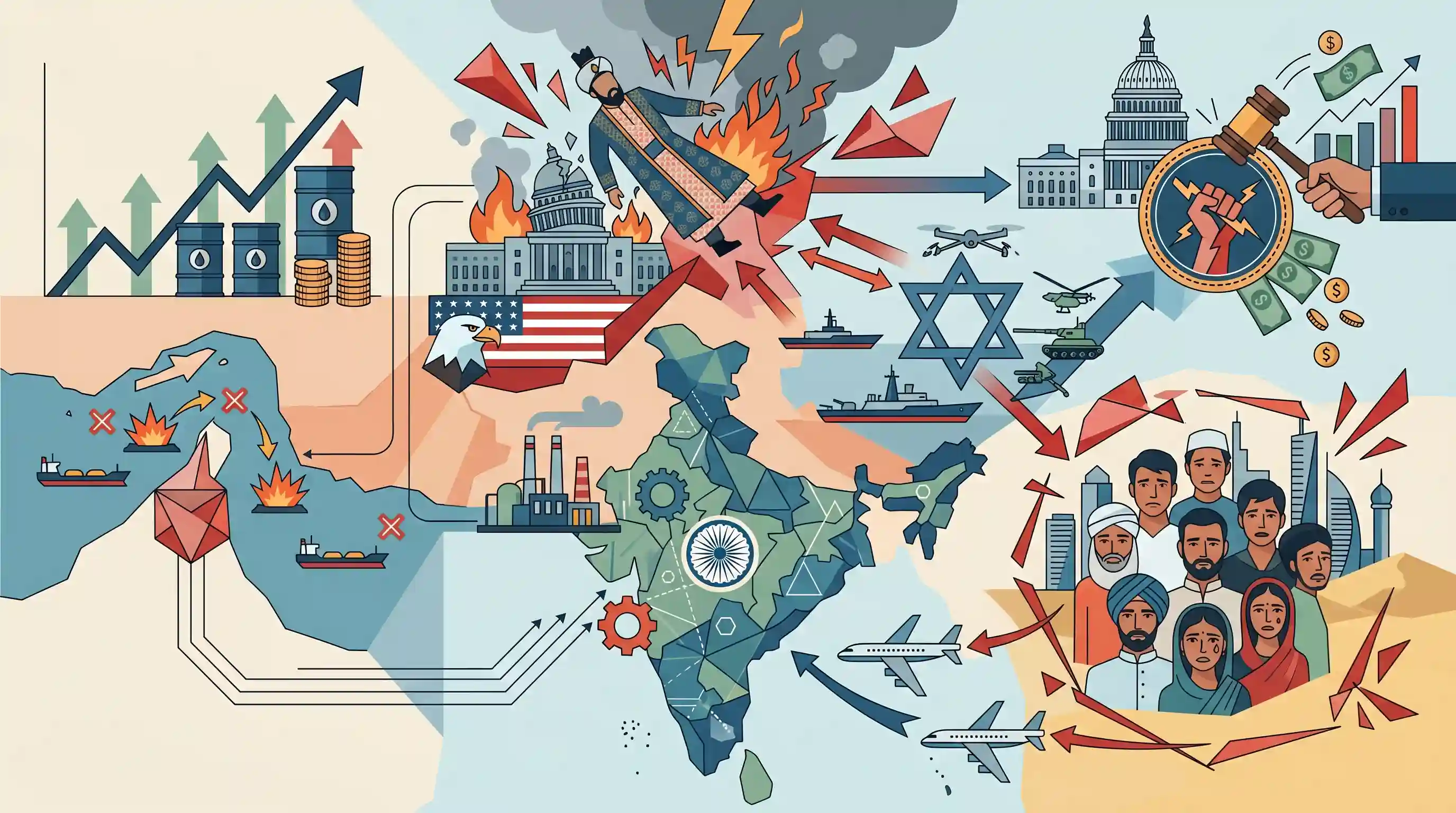
The 100-day mark of the US-Israel-Iran war highlights widespread geopolitical and economic fallout, particularly concerning global energy security and the safety of the Indian diaspora in the Gulf. Sparked by the killing of Iranian Supreme Leader Ayatollah Ali Khamenei, the conflict has disrupted shipping through the strategic Strait of Hormuz, pushing global oil prices over $100 a barrel and directly threatening India's crucial oil imports. The regional escalation has jeopardized the lives of millions of Indian expatriates in the Middle East and triggered domestic pushback in the US, where the House of Representatives voted to curb President Trump's war powers amid soaring military expenditures.
Key Points
- The US-Israel-Iran conflict reached its 100-day mark, originating from the US-Israeli strikes that killed Iranian Supreme Leader Ayatollah Ali Khamenei.
- The conflict has created a blockade-like situation in the Strait of Hormuz, severely impacting global energy markets and pushing crude oil prices past $100 per barrel.
- India's energy security is heavily vulnerable, as 65-70% of its oil supply transits through the Strait of Hormuz.
- The 9-10 million strong Indian diaspora in the Gulf faces significant security risks (including the death of an Indian national in Kuwait), threatening crucial remittance inflows.
- In response to mounting financial costs, the US House voted to restrict President Donald Trump's war-making authority through a war powers resolution.
Important Terms
Strait of Hormuz

A strategic 33km-wide maritime chokepoint connecting the Persian Gulf to the Gulf of Oman. It handles approximately 20% of global oil trade, making it the world's most critical energy transit route.
UPSC context
GS Paper I (Geography - Chokepoints) and GS Paper II (IR); crucial for India's energy security and Middle East stability.
War Powers Resolution
A 1973 U.S. federal law designed to limit the President's power to commit the United States to armed conflict without Congressional consent, requiring notification within 48 hours.
UPSC context
GS Paper II (International Relations - Comparison of Constitutions); tests understanding of executive versus legislative checks and balances in democracy.
Hezbollah
A Lebanon-based Shiite political party and militant group backed by Iran. It is a major non-state actor in the Middle East, exercising significant influence over regional security and conflicts.
UPSC context
GS Paper II (IR); significant for understanding West Asian dynamics, proxy wars, and the role of non-state actors in global security.
Indian Diaspora
The community of Indian citizens and persons of Indian origin living abroad. In the Gulf, they contribute over $100 billion in annual remittances and ensure India’s energy influence.
UPSC context
GS Paper II (IR); specifically mentioned in the syllabus as 'Effect of Policies and Politics on Indian interests' and 'Indian Diaspora'.
Energy Security
The reliable and affordable access to energy sources required for economic stability. It involves securing maritime lanes and diversifying suppliers to mitigate risks from regional conflicts.
UPSC context
GS Paper III (Economy/Environment) and GS II (IR); critical for India’s growth and the strategic management of international oil dependencies.
US House of Representatives
The lower chamber of the U.S. Congress, responsible for initiating revenue bills and having the joint authority with the Senate to declare war and fund military operations.
UPSC context
GS Paper II (IR - Comparative Constitutions); tests knowledge of foreign legislative systems and their impact on global geopolitics.
Pentagon
The headquarters of the United States Department of Defense, serving as the central command for all U.S. military forces and global defense policy.
UPSC context
GS Paper II (IR); often used as a metonym for U.S. military authority and strategic defense decision-making.
Prelims Trap
"The Strait of Hormuz connects the Persian Gulf to the Red Sea and is bordered by Saudi Arabia and Iran."
The Strait of Hormuz connects the Persian Gulf to the Gulf of Oman/Arabian Sea. Its bordering nations are Iran, Oman, and the UAE (not Saudi Arabia).
Static Concepts Connected
What are the primary maritime chokepoints governing West Asian energy trade?
- Strait of Hormuz: Connects the Persian Gulf to the Gulf of Oman. It is bordered by Iran to the north and the UAE and Oman to the south.
- Bab-el-Mandeb: Connects the Red Sea to the Gulf of Aden. It is geographically bordered by Yemen on the Arabian Peninsula, and Djibouti and Eritrea in Africa.
- Suez Canal: An artificial sea-level waterway in Egypt connecting the Mediterranean Sea to the Red Sea, offering the shortest maritime route between Europe and Asia.
How does a sustained global crude oil price spike impact India's macroeconomy?
- CAD Widening: Higher import bills expand the Current Account Deficit (CAD), since India imports approximately 85% of its crude oil requirements.
- Imported Inflation: Elevated fuel costs cascade into higher transportation and manufacturing expenses, simultaneously driving up both WPI and CPI inflation.
- Rupee Depreciation: Increased demand for US dollars to pay for expensive oil imports puts downward pressure on the exchange rate of the Indian Rupee.
Cross-Topic Patterns
Gulf Diaspora and Evacuation Diplomacy
A prolonged Middle East crisis risks mass evacuations. UPSC frequently tests past interventions like Operation Raahat or Ajay alongside the macro-economic importance of Gulf remittances.
Comparative Constitution: War Powers
The US House invoking the War Powers Resolution invites a polity comparison with India, where war declarations strictly require parliamentary assent and the aid/advice of the Council of Ministers.

Map questions on West Asian chokepoints (Hormuz/Bab-el-Mandeb) will likely be fused with economic statements on CAD and imported inflation.
Linked PYQs · 3
Linked PYQs · 3
- 2025MainsGS2
"Energy security constitutes the dominant kingpin of India's foreign policy, and is linked with India's overarching influence in Middle Eastern countries.” How would you integrate energy security with India's foreign policy trajectories in the coming years?
- 2017MainsGS2
The question of India's Energy Security constitutes the most important part of India's economic progress. Analyze India's energy policy cooperation with West Asian countries.
- 2020MainsGS2
Indian diaspora has a decisive role to play in the politics and economy of America and European Countries'. Comment with examples.
