US and Israel Strategy in Iran and Regional Stability Risks
Source:Indian Express ↗
Why It Matters
The strategic stability of the Middle East is vital for India's energy security, strategic trade initiatives (such as the Chabahar port and INSTC), and the safety of the large Indian diaspora. Escalations between the US/Israel and Iran directly impact global oil prices and regional peace, requiring careful diplomatic maneuvering by India.
Summary
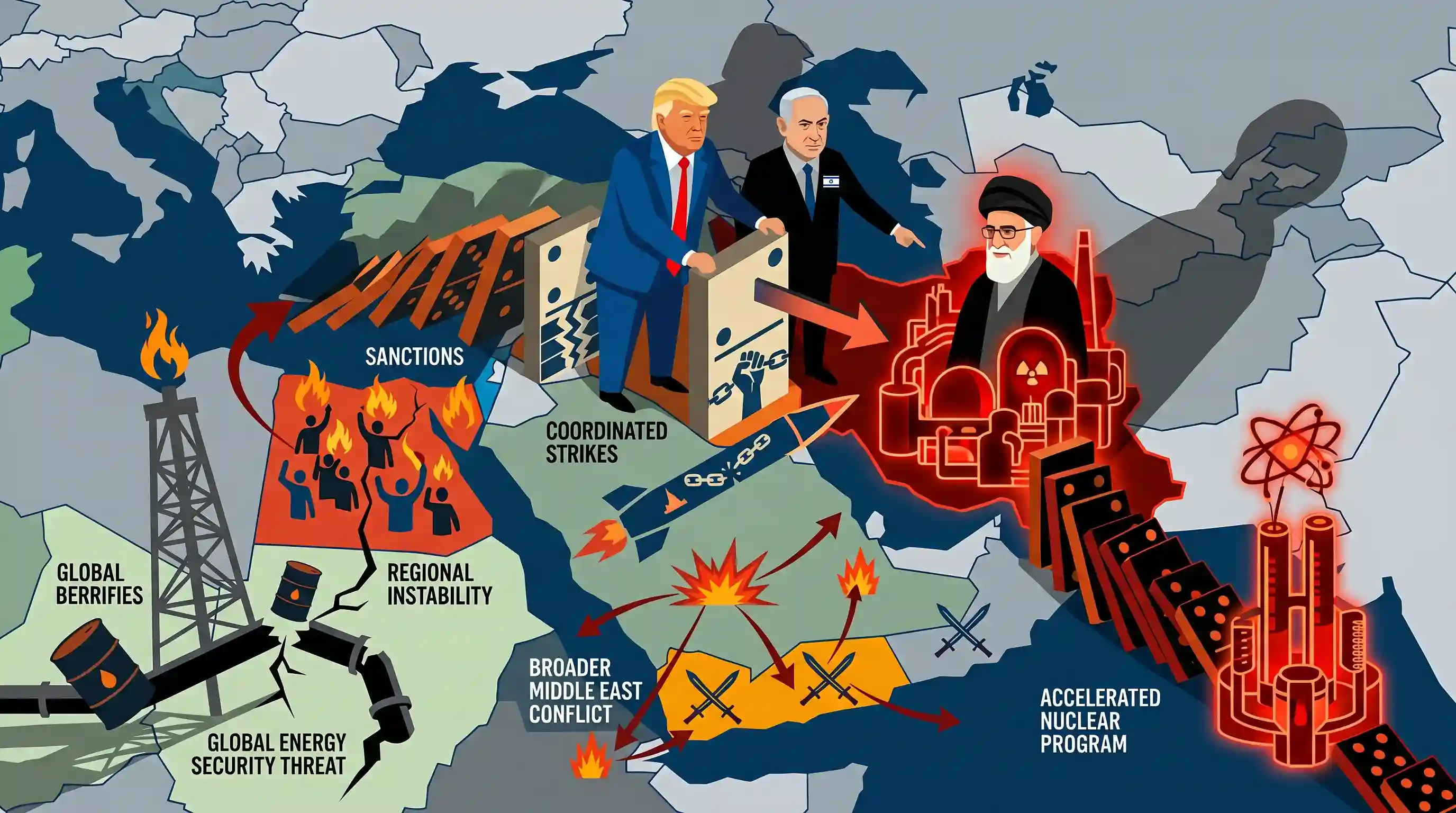
The article critically examines the coordinated strategy of the United States and Israel against Iran, spearheaded by Donald Trump and Benjamin Netanyahu. It warns that aggressive moves targeting the regime of Supreme Leader Ali Khamenei constitute a "dangerous gamble." Rather than deterring Iran, this confrontational approach could backfire by escalating regional instability, accelerating Iranian nuclear ambitions, and triggering a broader conflict in the Middle East. Such an escalation would have severe implications for global energy security and geopolitical stability.
Key Points
- The article analyzes the aggressive geopolitical posturing and coordinated actions by the US (under Donald Trump) and Israel (under Benjamin Netanyahu) against Iran.
- It characterizes these policies as a "dangerous gamble" aimed at weakening or destabilizing the Iranian regime led by Supreme Leader Ali Khamenei.
- The author warns that this approach may backfire, potentially sparking a broader regional conflict in the Middle East and severely disrupting global energy markets.
- Maximalist pressure could lead to unintended consequences, such as accelerating Iran's nuclear program or solidifying domestic support for the hardline leadership.
Important Terms
Joint Comprehensive Plan of Action (JCPOA)

A 2015 agreement between Iran and the P5+1 powers (plus EU) to limit Iran's nuclear program in exchange for international sanctions relief.
UPSC context
GS Paper 2: Important international agreements affecting India's interests and regional security.
West Asia Geopolitics
The complex interplay of power, religion, and resources involving regional actors like Iran and Israel, and global powers like the US, influencing regional stability.
UPSC context
GS Paper 2: Effect of policies and politics of developed and developing countries on India's interests.
Global Energy Security
The uninterrupted availability of energy sources at an affordable price, often threatened by maritime blockades or conflicts in major oil-producing regions.
UPSC context
GS Paper 3: Infrastructure; Energy security challenges and their impact on the Indian economy.
Strategic Depth
A military strategy utilizing geographic distance or regional proxy networks to deter adversaries and protect a nation’s core territory from direct offensive strikes.
UPSC context
GS Paper 2: India and its neighborhood relations; security challenges in the West Asian region.
Regional Hegemony
The political, military, or economic dominance of a single state over its neighboring countries within a specific geographic region.
UPSC context
GS Paper 2: Regional security, balance of power, and international relations.
Axis of Resistance
An informal Iran-led coalition including Hezbollah, Hamas, and the Houthis, focused on countering Western and Israeli influence in the Middle East.
UPSC context
GS Paper 2: Regional groupings and agreements involving India and/or affecting India’s interests.
Prelims Trap
"The Strait of Hormuz connects the Persian Gulf to the Red Sea."
Aspirants routinely confuse West Asian straits. Hormuz connects the Persian Gulf to the Gulf of Oman. It is Bab-el-Mandeb that connects the Red Sea to the Gulf of Aden.
Static Concepts Connected
What are the key maritime chokepoints in West Asia?
- Strait of Hormuz: Connects the Persian Gulf to the Gulf of Oman. A vital artery for global crude oil transit, bordered by Iran, Oman, and the UAE.
- Bab-el-Mandeb: Links the Red Sea to the Gulf of Aden. Crucial for Suez Canal maritime traffic, bordered by Yemen, Djibouti, and Eritrea.
How does Iran anchor India's Eurasian connectivity strategy?
- Chabahar Port: A strategic terminal allowing India to bypass Pakistan, providing direct maritime and subsequent land access to Afghanistan and Central Asian republics.
- INSTC: The International North-South Transport Corridor is a 7,200-km multi-modal transit network connecting India to Russia and Europe via Iranian territory.
Cross-Topic Patterns
Energy Security + Macroeconomics
Middle East escalation spikes crude oil prices, which directly widens India's Current Account Deficit (CAD) and imports inflation, linking geopolitical tensions to domestic monetary policy constraints.
I2U2 vs. Chabahar Balancing
India’s strategic involvement in the "West Asian Quad" (I2U2) with the US and Israel creates a delicate diplomatic balancing act with Iran, India's vital Eurasian connectivity hub.

Expect a 2026 map-based prelims question linking West Asian conflict zones to their adjacent maritime chokepoints and bordering nations.
Linked PYQs · 4
Linked PYQs · 4
- 2025MainsGS2
"Energy security constitutes the dominant kingpin of India's foreign policy, and is linked with India's overarching influence in Middle Eastern countries.” How would you integrate energy security with India's foreign policy trajectories in the coming years?
- 2022MainsGS2
How will I2U2 (India, Israel, UAE and USA) grouping transform India's position in global politics?
- 2018MainsGS2
“India’s relations with Israel have, of late, acquired a depth and diversity, which cannot be rolled back.” Discuss.
- 2023PrelimsGS1
Consider the following statements: Statement-I: Israel has established diplomatic relations with some Arab States. Statement-II: The 'Arab Peace Initiative' mediated by Saudi Arabia was signed by Israel and Arab League. Which one of the following is correct in respect of the above statements?
