US Israel strikes on Iran and leadership vacuum implications
Source:Indian Express ↗
Why It Matters
The direct conflict between the US/Israel and Iran, compounded by the death of Iran's Supreme Leader, presents critical challenges for India. It forces India to navigate a complex diplomatic tightrope, safeguarding its energy security, protecting its large diaspora in West Asia, and managing strategic investments like the Chabahar port amidst extreme regional volatility.
Summary
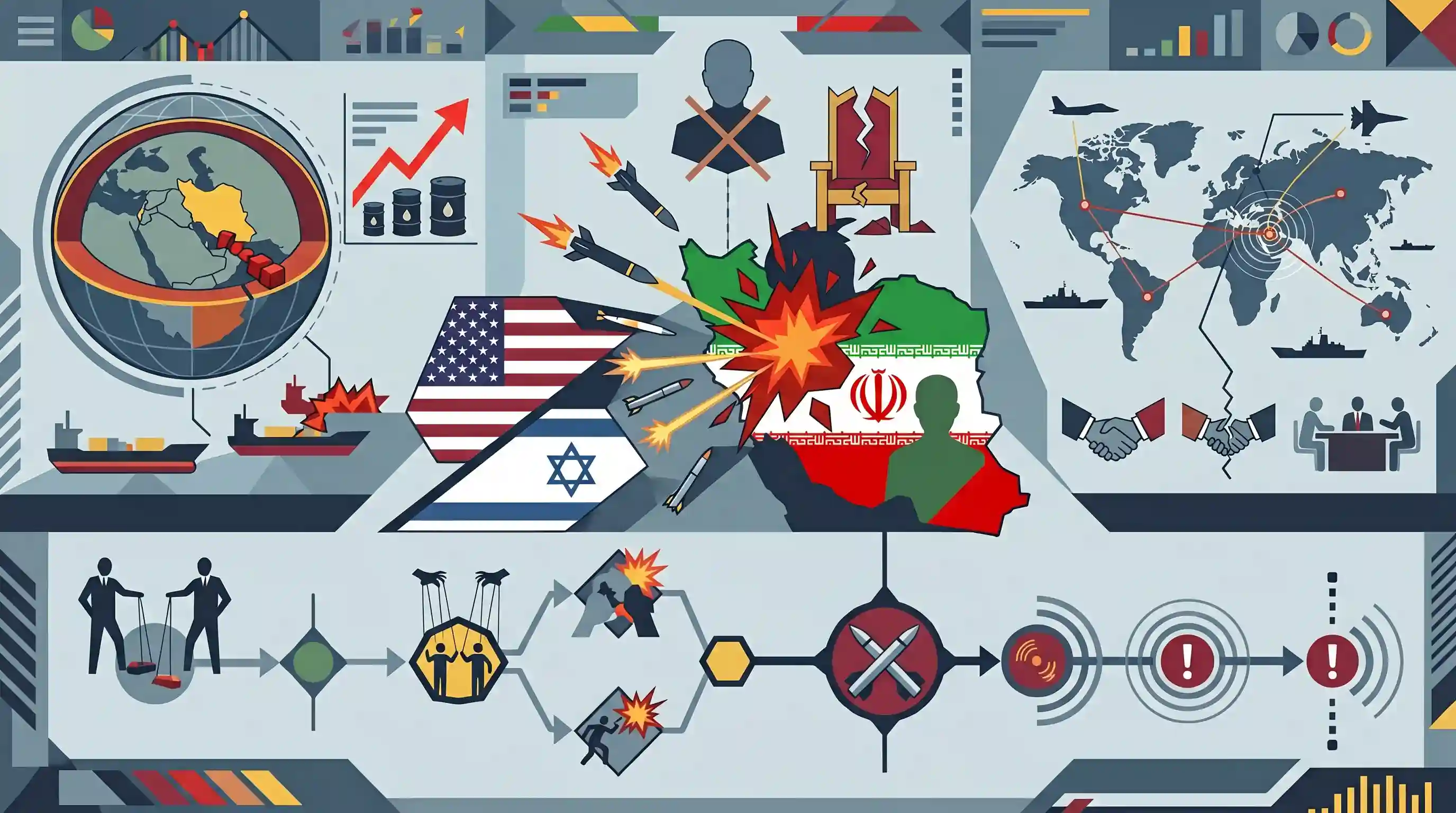
A major geopolitical crisis has erupted in the Middle East following coordinated military attacks by the United States and Israel on Iran, resulting in the death of Iran's Supreme Leader, Ayatollah Ali Khamenei. The timeline of key events illustrates a rapid escalation from proxy conflicts to direct confrontation. This development fundamentally alters the regional balance of power, creating a massive leadership void in Iran and threatening to ignite a broader regional war. The implications are profound for global security, energy supply chains via the Strait of Hormuz, and diplomatic realignments.
Key Points
- The United States and Israel launched coordinated military attacks against Iran, marking a severe escalation in Middle Eastern geopolitics.
- Iran's Supreme Leader, Ayatollah Ali Khamenei, was reported dead following the strikes, creating a major leadership vacuum and destabilizing Iran's political structure.
- The timeline of events highlights intensifying regional hostilities involving Israel, Iran, and Iran's proxy networks ('Axis of Resistance') such as Hezbollah and Hamas.
- The conflict poses immense risks to global energy markets, security along critical maritime chokepoints like the Strait of Hormuz, and regional stability.
Important Terms
Supreme Leader of Iran

The highest political and religious authority in Iran; holds ultimate command over the military, judiciary, and foreign policy, surpassing the elected President.
UPSC context
GS-II: International Relations. Leadership transitions in West Asia significantly impact regional stability and India's strategic partnerships.
Strait of Hormuz
A strategic maritime chokepoint between Iran and Oman, connecting the Persian Gulf with the Arabian Sea; vital for transporting 20% of global oil supply.
UPSC context
GS-II & III: International Relations and Energy Security. Crucial for India as 40% of its crude oil imports pass through this channel.
Proxy Conflict
A conflict where major powers indirectly confront each other by supporting third parties, such as militias or non-state actors, to minimize direct risks.
UPSC context
GS-II: International Relations. Tests understanding of indirect warfare and its destabilizing effects on regional security architectures.
Hezbollah
A Lebanon-based Shia militant group and political party supported by Iran; a key member of the 'Axis of Resistance' opposing Israeli and Western influence.
UPSC context
GS-II: International Relations. Examines the role of non-state actors in Middle East geopolitics and their impact on global security.
Hamas
A Sunni Islamist political and military organization that has governed the Gaza Strip since 2007, engaging in armed resistance against Israel.
UPSC context
GS-II: International Relations. Essential for analyzing the Israel-Palestine conflict and its repercussions on Indian foreign policy.
Energy Security
The reliable availability of energy sources at an affordable price; heavily dependent on stable maritime routes like the Strait of Hormuz in West Asia.
UPSC context
GS-III: Economic Development. Evaluates how regional volatility affects global oil prices, India’s inflation, and its fiscal deficit.
Prelims Trap
Chabahar Port is situated in the Persian Gulf and its maritime traffic must pass through the Strait of Hormuz.
Chabahar is actually in the Gulf of Oman, outside the Strait of Hormuz. Its strategic value to India relies precisely on bypassing this vulnerable chokepoint.
Static Concepts Connected
What are the key maritime chokepoints critical to West Asian trade?
- Strait of Hormuz: Links the Persian Gulf to the Gulf of Oman; handles roughly 20% of global oil consumption. Highly vulnerable to Iranian blockade.
- Bab el-Mandeb: Connects the Red Sea to the Gulf of Aden and Arabian Sea; an essential gateway for all Suez Canal maritime traffic.
How does Iran anchor India's 'Connect Central Asia' policy?
- Chabahar Port: An oceanic port in the Gulf of Oman allowing India to bypass Pakistan for direct trade access to Afghanistan and Central Asia.
- INSTC: The International North-South Transport Corridor is a 7,200-km multi-mode network of ship, rail, and road utilizing Iran to reach Russia and Europe.
Cross-Topic Patterns
Hormuz disruption + Imported Inflation
A supply shock via the Strait of Hormuz spikes crude prices, immediately widening India's Current Account Deficit and fueling imported inflation, which complicates RBI's monetary policy.
Regional War + Indian Diaspora
A broader Middle Eastern conflict endangers the massive Indian diaspora in the Gulf, threatening critical remittance inflows and potentially triggering large-scale non-combatant evacuation operations (NEOs).

Mapping of West Asian chokepoints combined with INSTC/Chabahar disruptions will likely feature as a hybrid IR/Geography question in 2026.
Linked PYQs · 5
Linked PYQs · 5
- 2025MainsGS2
"Energy security constitutes the dominant kingpin of India's foreign policy, and is linked with India's overarching influence in Middle Eastern countries.” How would you integrate energy security with India's foreign policy trajectories in the coming years?
- 2018MainsGS2
“India’s relations with Israel have, of late, acquired a depth and diversity, which cannot be rolled back.” Discuss.
- 2018MainsGS2
In what ways would the ongoing US-Iran Nuclear Pact Controversy affect the national interest of India? How should India respond to this situation?
- 2022MainsGS2
How will I2U2 (India, Israel, UAE and USA) grouping transform India's position in global politics?
- 2003PrelimsGS1
Israel has common borders with
