US Israel strategy against Iran and regional conflict risks
Source:Indian Express ↗
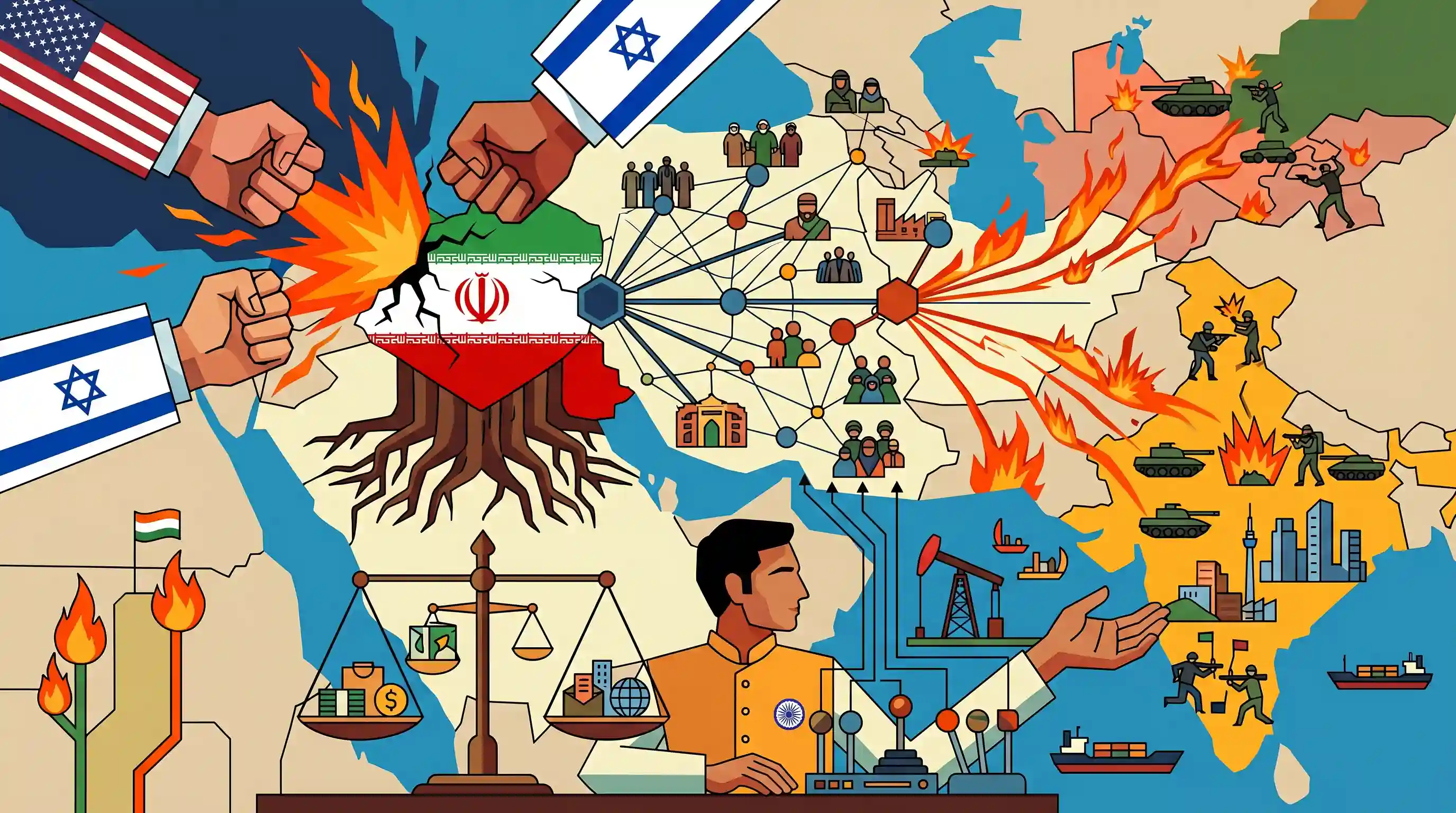
Why It Matters
The US-Israel-Iran triangle is the core driver of conflict and stability in West Asia. For UPSC aspirants, understanding this dynamic is crucial as any escalation directly impacts global energy security, the safety of the Indian diaspora, and India's delicate balancing act in its foreign policy towards Middle Eastern nations.
Summary
The article critically examines the geopolitical rhetoric and strategies of the US and Israel regarding Iran. It argues that the notion of completely 'obliterating' Iran or its regime is a dangerous strategic illusion. Such maximalist military ambitions underestimate Iran's resilience, its strategic depth, and its extensive network of regional proxies across the Middle East. The author cautions that pursuing total destruction or forced regime change in Iran could trigger a broader, uncontrollable regional war, emphasizing the necessity of realistic strategic calculations and deterrence over escalating conflict in West Asia.
Key Points
- The strategic objective of completely 'obliterating' Iran or forcing regime change through military means is a dangerous illusion.
- Iran possesses significant strategic depth and asymmetric warfare capabilities, primarily through its network of regional proxies (Axis of Resistance).
- Maximalist military strategies by the US and Israel risk igniting a broader, uncontrollable regional conflict in West Asia.
- The complexities of the Middle East demand nuanced diplomatic and deterrence strategies rather than absolutist military solutions that could lead to widespread instability.
Important Terms
JCPOA (Joint Comprehensive Plan of Action)

The 2015 agreement between Iran and world powers (P5+1) limiting Tehran's nuclear program in exchange for the lifting of international sanctions.
UPSC context
GS Paper II: International Relations. Crucial for understanding nuclear non-proliferation, India's energy security, and the Chabahar Port project.
Axis of Resistance
An Iran-led informal geopolitical and military alliance comprising state and non-state actors (Hezbollah, Houthis, Hamas) aimed at countering US and Israeli influence.
UPSC context
GS Paper II: West Asia Geopolitics. Tests understanding of regional power dynamics and the impact of proxy warfare on global stability.
Strategic Depth
Iran's strategy of utilizing its regional proxy network and missile arsenal to create defensive buffers far beyond its own national borders.
UPSC context
GS Paper II/III: Security and Geopolitics. Essential for analyzing asymmetric warfare and why conventional military 'obliteration' remains a strategic challenge.
Maximum Pressure Policy
A US foreign policy strategy using severe economic sanctions and military posturing to force Iran into concessions regarding its nuclear and regional activities.
UPSC context
GS Paper II: International Relations. Tests the impact of US unilateralism on multilateral diplomacy and India's 'strategic autonomy' in oil imports.
Deterrence
A military and diplomatic concept where a state uses the threat of significant retaliation to prevent an adversary from initiating hostile actions.
UPSC context
GS Paper II: Security and IR. Vital for discussing the shift from 'shadow wars' to direct military confrontation in the Middle East.
Prelims Trap
"The 'Axis of Resistance' is a formal military alliance of sovereign states in West Asia led by Iran."
It is not a formal state alliance, but an informal, asymmetric network comprising mostly non-state or quasi-state actors (Hezbollah, Hamas, Houthis) backed by Iran.
Static Concepts Connected
What are the critical geographical features defining Iran's strategic depth?
- Strait of Hormuz: A vital maritime chokepoint between the Persian Gulf and the Gulf of Oman, handling roughly 20% of global crude oil consumption.
- Zagros Mountains: Forming Iran's western border, this rugged mountain range acts as a massive natural defensive barrier against conventional land invasions.
- Central Deserts: Dasht-e Kavir and Dasht-e Lut create an inhospitable interior, severely complicating military logistics and granting Iran immense geographic depth.
How does India balance its 'Strategic Autonomy' in West Asia?
- Western Quad (I2U2): Deepening geo-economic and technological partnerships with the US, Israel, and the UAE to boost regional infrastructure and security cooperation.
- Eurasian Connectivity: Investing in Iran's Chabahar Port and the INSTC to secure vital transit routes to Central Asia and Russia, bypassing Pakistan.
- Energy Security: Maintaining transactional neutrality to ensure stable oil supplies from both Arab Gulf nations and Iran, insulating the domestic economy from shocks.
Cross-Topic Patterns
Chokepoints & Imported Inflation
Disruptions in the Strait of Hormuz spike crude prices, threatening India's Current Account Deficit and forcing the RBI to adopt tightening measures to combat imported inflation.
Asymmetric Warfare & Maritime Trade
Iran’s reliance on non-state proxies links West Asian geopolitics directly to global supply chain disruptions, bridging the gap between conventional state security and asymmetric maritime threats.

Expect a 2026 Prelims map question pairing West Asian proxies with bases, or a Mains Q on balancing I2U2 with INSTC.
Linked PYQs · 5
Linked PYQs · 5
- 2018MainsGS2
In what ways would the ongoing US-Iran Nuclear Pact Controversy affect the national interest of India? How should India respond to this situation?
- 2023PrelimsGS1
Consider the following statements: Statement-I: Israel has established diplomatic relations with some Arab States. Statement-II: The 'Arab Peace Initiative' mediated by Saudi Arabia was signed by Israel and Arab League. Which one of the following is correct in respect of the above statements?
- 2015PrelimsGS1
The area known as 'Golan Heights' sometimes appears in the news in the context of the events related to
- 2018PrelimsGS1
The term "two-state solution" is sometimes mentioned in the news in the context of the affairs of
- 2018MainsGS2
“India’s relations with Israel have, of late, acquired a depth and diversity, which cannot be rolled back.” Discuss.
