US Military Strikes on Iran Disrupt Strait of Hormuz Shipping Lanes
Source:Indian Express ↗
Why It Matters
The Strait of Hormuz is the world's most critical transit chokepoint for global oil and gas. Any conflict here directly threatens India's energy security, raises fiscal and inflation risks due to oil price spikes, risks the safety of Indian seafarers, and impacts India's diplomatic relations with both the US and West Asian nations.
Summary
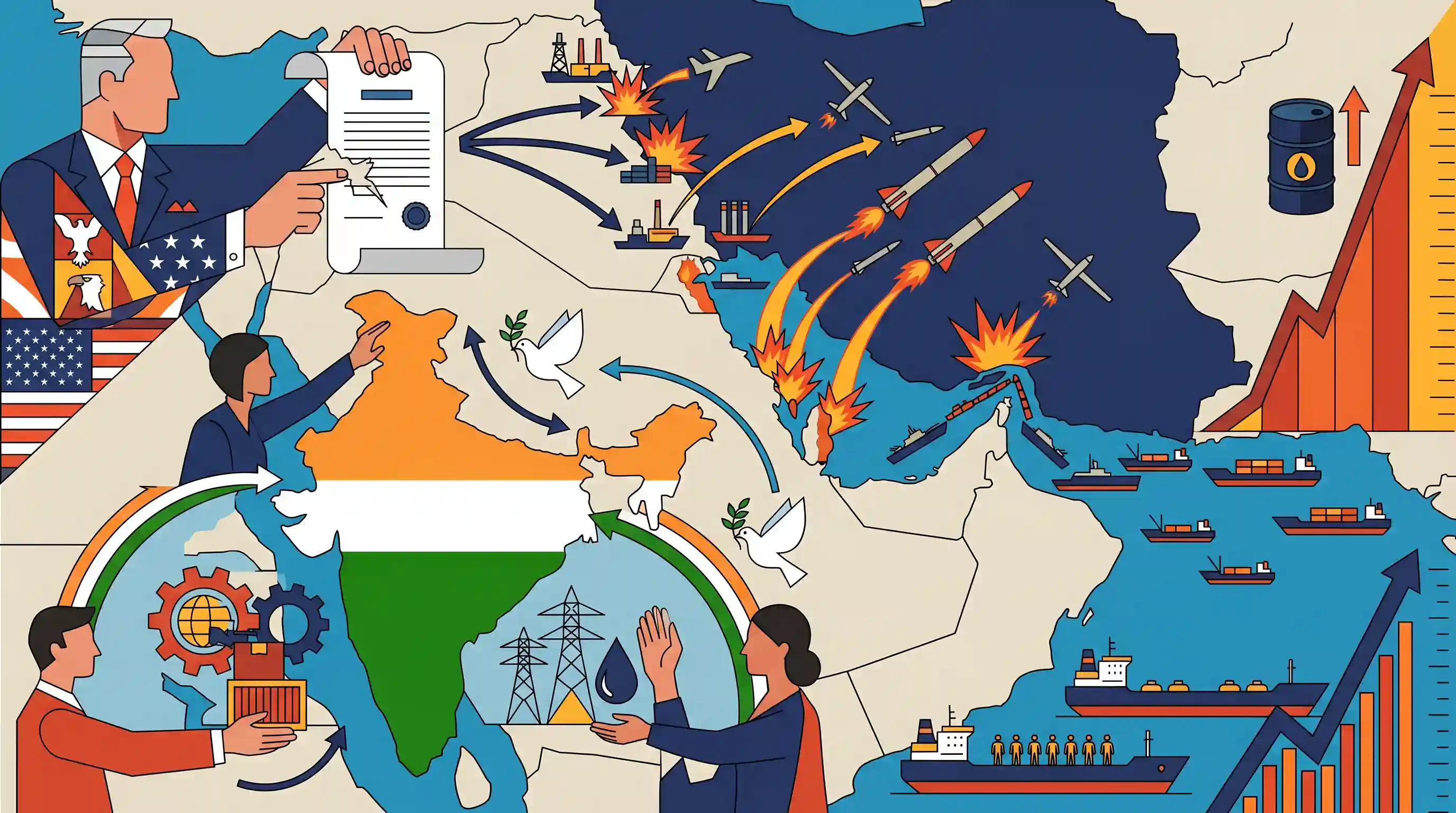
In July 2026, the US-Iran conflict escalated dramatically after US President Donald Trump terminated an interim MoU and launched airstrikes on Iranian ports and military installations to protect navigation in the Strait of Hormuz. In response, Iran carried out drone and missile attacks targeting Bahrain, Kuwait, and Qatar, and threatened to close the strategic waterway. The conflict has severely disrupted shipping, stranded 6,000 seafarers, and caused a 4% surge in global oil prices. India has called for restraint, de-escalation, civilian safety, and the protection of global trade and energy flows through diplomacy.
Key Points
- US-Iran Conflict Escalation: US President Donald Trump declared the fragile interim Memorandum of Understanding (MoU) with Iran 'over,' triggering a major escalation of military hostilities in West Asia.
- Targeted Military Strikes: The US military conducted multiple air and cruise missile strikes on Iranian naval, port, and air facilities (including Bandar Abbas, Chabahar, Konarak, Sirik, and northern Golestan) to weaken Tehran's capacity to disrupt maritime transit.
- Regional Retaliation: Iran retaliated by launching drone and missile attacks against neighboring Gulf states, including Bahrain, Kuwait, and Qatar, activating regional missile defences.
- Shipping and Trade Disruption: Shipping operations in the strategic Strait of Hormuz have been severely affected; over 6,000 seafarers are stranded, a Qatari LNG tanker was hit, and an Indian oil tanker was turned back. Oman and the IMO have initiated a temporary corridor for vessel evacuations.
- Global Economic Impact: Global oil prices spiked by over 4% amid concerns over a prolonged conflict and threats from Iran to shut down the Strait of Hormuz, while Trump floated the idea of a naval blockade on Iran and targeting Kharg Island.
- India's Strategic Stance: The Indian Ministry of External Affairs expressed deep concern, urging restraint, de-escalation, the safety of civilians, and the safeguarding of uninterrupted energy flows and maritime commerce through diplomatic dialogue.
Important Terms
US-Iran Interim Memorandum of Understanding (MoU)

A June 2026 framework agreement, also called the Islamabad MoU, signed between the US and Iran to pause hostilities, lift certain US oil sanctions, and restore safe transit through the strategic Strait of Hormuz.
UPSC context
GS Paper II: Bilateral Agreements. Tests understanding of West Asian geopolitical shifts and their impact on Indian energy security.
Islamic Revolutionary Guard Corps (IRGC)
An elite branch of Iran’s military, separate from its regular armed forces, tasked with defending the country's Islamic system, internal security, and conducting external operations through its Quds Force.
UPSC context
GS Paper II: International Relations. Tests awareness of regional military groups and their security implications for Indian interests.
International Maritime Organisation (IMO)
A specialized United Nations agency responsible for regulating global shipping, enhancing maritime safety, securing trade routes, and preventing marine pollution from ships.
UPSC context
GS Paper II: International Organizations. Tests knowledge of international regulatory bodies overseeing shipping, trade safety, and marine environmental protection.
Ministry of External Affairs (MEA)
The central government ministry of India responsible for managing foreign relations, executing foreign policy, representing India at the UN, and safeguarding Indian diaspora interests abroad.
UPSC context
GS Paper II: Indian Polity. Tests understanding of India's executive machinery for foreign policy and bilateral diplomacy.
Prelims Trap
The Strait of Hormuz is bordered to the south entirely by the mainland of the United Arab Emirates and Saudi Arabia.
Saudi Arabia has no coastline on the Strait of Hormuz. Furthermore, the southern coast of the strait is formed by Oman's Musandam Peninsula (an exclave) and the UAE, not the UAE mainland alone.
Static Concepts Connected
What are the key maritime chokepoints of West Asia and their legal transit regimes?
- Strait of Hormuz: Connects the Persian Gulf to the Gulf of Oman/Arabian Sea, bordered by Iran and Oman (Musandam Peninsula).
- Bab-el-Mandeb: Connects the Red Sea to the Gulf of Aden, bordered by Yemen, Djibouti, and Eritrea.
- UNCLOS Regime: Under UNCLOS, merchant and military vessels enjoy 'transit passage' through international straits, which coastal states cannot unilaterally suspend during peacetime.
What is the mandate and operational scope of India's Operation Sankalp?
- Origin: Launched in June 2019 by the Indian Navy following attacks on oil tankers in the Gulf of Oman.
- Objective: To ensure the safe passage of Indian-flagged merchant vessels transiting through the Persian Gulf, Gulf of Oman, and Strait of Hormuz.
- Assets Deployed: Deploys stealth frigates, destroyers, and maritime patrol aircraft (like P-8I) to conduct continuous surveillance and escort operations.
Cross-Topic Patterns
Hormuz disruptions + Strategic Petroleum Reserves
Disruptions in Hormuz highlight the inadequacy of India's current 9.5-day SPR capacity, pushing policy towards accelerated Phase II expansions and strategic storage partnerships with Gulf nations.
Chabahar investment + US-Iran escalation
US strikes near Chabahar threaten India's flagship connectivity project to Central Asia (INSTC), forcing India to balance its US strategic partnership with Iranian developmental ties.

West Asian maritime chokepoints, Operation Sankalp, and UNCLOS transit passage rules are highly likely to feature in a 2026 Prelims MCQ.
Linked PYQs · 3
Linked PYQs · 3
- 2026PrelimsGS1
Ships from which of the following countries have to cross the Strait of Hormuz to reach out to the Indian Ocean ? 1. Bahrain 2. Syria 3. Qatar 4. Egypt Select the answer using the code given below :
- 2025MainsGS2
"Energy security constitutes the dominant kingpin of India's foreign policy, and is linked with India's overarching influence in Middle Eastern countries.” How would you integrate energy security with India's foreign policy trajectories in the coming years?
- 2017MainsGS2
The question of India's Energy Security constitutes the most important part of India's economic progress. Analyze India's energy policy cooperation with West Asian countries.
