US Iran Switzerland Summit and Regional Geopolitics
Source:Indian Express ↗
Why It Matters
The agreement directly impacts global energy security by addressing tensions in the Strait of Hormuz and alters the Middle Eastern geopolitical balance involving Israel, Iran, and US interests. Understanding these dynamics is crucial for evaluating India's foreign policy challenges, energy stability, and diaspora interests in West Asia.
Summary
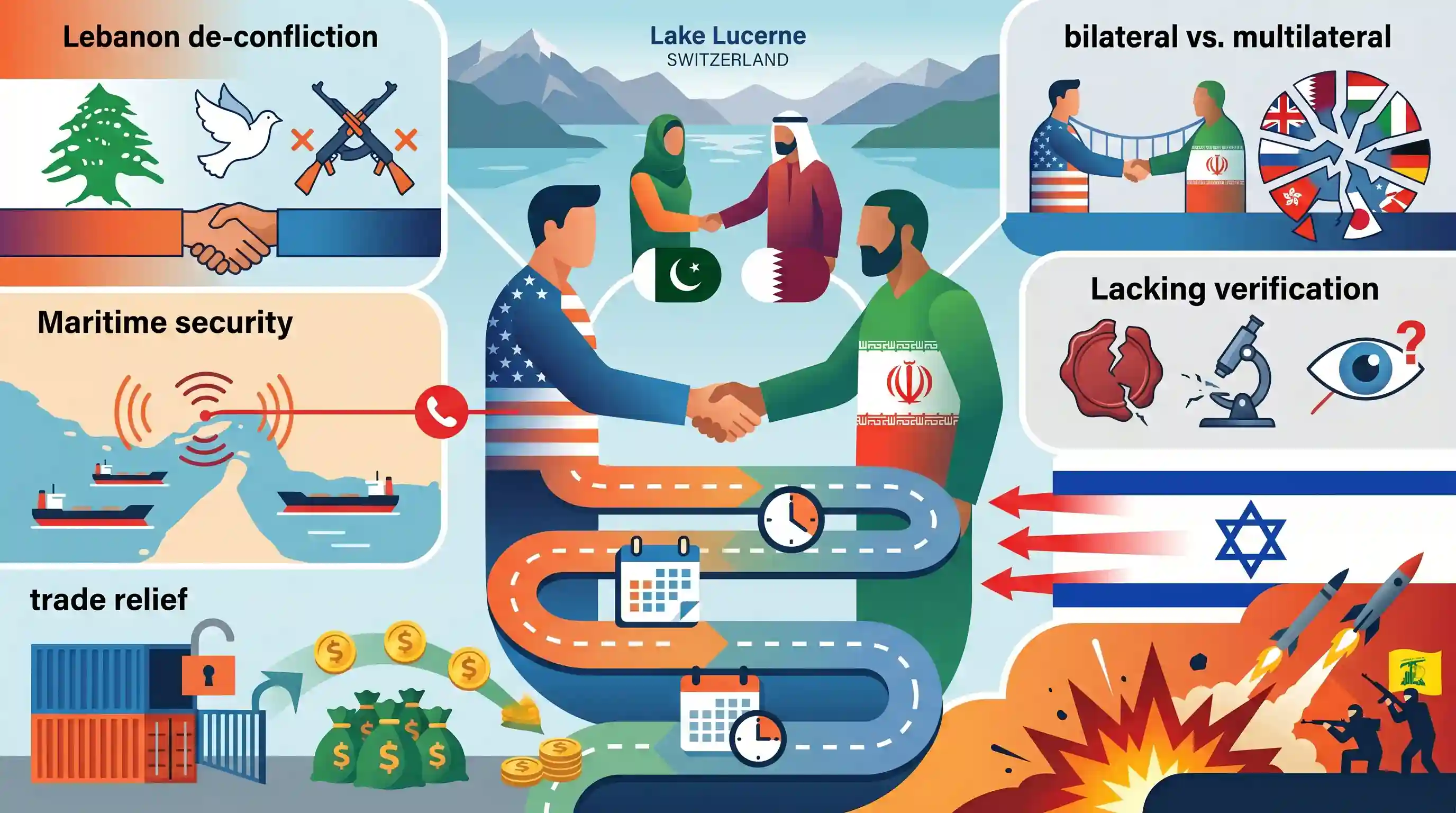
The US and Iran have reached a preliminary agreement at the Lake Lucerne Summit in Switzerland to create a 60-day road map toward a formal deal. Mediated by Pakistan and Qatar, the tentative agreement includes measures for Lebanon "de-confliction," a direct communication line for the Strait of Hormuz to manage maritime tensions, and some trade and asset relief for Iran. However, experts note significant shortcomings: it is a bilateral MoU rather than a multilateral treaty like the 2015 JCPOA, it lacks robust IAEA verification and enforcement mechanisms, and it faces staunch opposition from Israel, which is currently involved in escalating conflicts with Hezbollah in Lebanon.
Key Points
- The US and Iran signed an initial MoU at the Lake Lucerne Summit, establishing a 60-day road map for a comprehensive agreement, with Pakistan and Qatar acting as mediators.
- The agreement includes provisions for de-escalating tensions in Lebanon and establishing a direct communication line in the Strait of Hormuz to safeguard maritime navigation.
- In return for regional and nuclear compliance, Iran is slated to receive limited trade relief, leniency on oil exports, and access to certain frozen assets.
- Unlike the 2015 JCPOA, the new framework is bilateral and lacks robust multilateral backing and rigorous IAEA verification mechanisms.
- Israel's government opposes the deal, complicating the regional security landscape amid ongoing Israeli military engagements with Hezbollah.
Important Terms
Joint Comprehensive Plan of Action (JCPOA)

A 2015 landmark agreement between Iran and P5+1 powers to restrict Iran's nuclear program in exchange for the lifting of economic sanctions.
UPSC context
GS Paper-II (International Relations). Tests knowledge of global nuclear diplomacy, India’s energy interests, and West Asian stability.
IAEA
An autonomous UN-affiliated organization (est. 1957) that promotes peaceful nuclear energy use and verifies non-proliferation through safeguards and inspections.
UPSC context
GS Paper-II (Global Institutions). Essential for understanding nuclear safety regimes and international oversight.
Hezbollah
A Lebanon-based Shia Islamist political and militant group, heavily backed by Iran, acting as a major non-state power in the Levant.
UPSC context
GS Paper-II (International Relations). Crucial for analyzing proxy warfare and instability in West Asia.
Strait of Hormuz
A strategically vital maritime chokepoint between the Persian Gulf and Gulf of Oman through which 20% of the world's oil supply transits.
UPSC context
GS Paper-I (Geography) and GS-III (Energy Security). Highlights global energy supply chains and India's economic vulnerability.
Memorandum of Understanding (MoU)
A formal but non-legally binding agreement between parties outlining a common intent, often used to bypass legislative ratification required for treaties.
UPSC context
GS Paper-II (Governance/IR). Distinguishes between executive arrangements and formal legal treaties in diplomatic practice.
De-confliction
The practice of communication between military forces to prevent accidental clashes, misunderstandings, or unintended escalations in shared operational areas.
UPSC context
GS Paper-II (International Relations). Relates to diplomatic and military tools for regional crisis management.
Prelims Trap
The Lake Lucerne agreement is a multilateral treaty replacing the JCPOA with UN-backed IAEA verification.
The Lake Lucerne framework is a bilateral MoU between the US and Iran, explicitly lacking the robust multilateral backing and strict IAEA verification mechanisms of the 2015 JCPOA.
Static Concepts Connected
What is the strategic and geographic importance of the Strait of Hormuz?
- Geographic Location: It links the Persian Gulf to the Gulf of Oman and the Arabian Sea.
- Bordering Nations: It is bounded by Iran to its north and Oman and the UAE to its south.
- Economic Significance: It is a critical global chokepoint, handling roughly 20% of the world's global oil consumption.
How does the IAEA enforce and verify nuclear agreements?
- Comprehensive Safeguards: Mandatory agreements for non-nuclear-weapon NPT states to ensure nuclear materials are used purely for peaceful purposes.
- Additional Protocol: A voluntary agreement that grants the IAEA expanded rights of access to information and undeclared locations.
- Board of Governors: It assesses compliance and reports violations to the UN Security Council, which can impose international sanctions.
Cross-Topic Patterns
Rise of Middle-Power Mediation
Qatar and Pakistan's involvement highlights a structural shift where regional middle powers are displacing traditional Western or UN mediation in complex West Asian conflicts.
Iran Sanctions & India's Energy Security
Leniency on Iranian oil exports could revive India-Iran energy ties, directly impacting India's import bill and potentially revitalizing Rupee-Rial payment mechanisms halted by previous US sanctions.
Chokepoints + Proxy Conflicts
The Hormuz communication line reflects broader regional maritime vulnerability, mirroring Red Sea disruptions by Houthis. UPSC increasingly links these maritime geographic chokepoints to proxy conflict zones.

Map-based matching questions linking West Asian chokepoints (Hormuz, Bab-el-Mandeb) to regional proxy actors (Hezbollah) are highly likely.
Linked PYQs · 4
Linked PYQs · 4
- 2018MainsGS2
In what ways would the ongoing US-Iran Nuclear Pact Controversy affect the national interest of India? How should India respond to this situation?
- 2025MainsGS2
"Energy security constitutes the dominant kingpin of India's foreign policy, and is linked with India's overarching influence in Middle Eastern countries.” How would you integrate energy security with India's foreign policy trajectories in the coming years?
- 2018MainsGS2
“India’s relations with Israel have, of late, acquired a depth and diversity, which cannot be rolled back.” Discuss.
- 2024PrelimsGS1
Consider the following statements : Statement-I : Sumed pipeline is a strategic route for Persian Gulf oil and natural gas shipments to Europe. Statement-II : Sumed pipeline connects the Red Sea with the Mediterranean Sea. Which one of the following is correct in respect of the above statements?
