Geopolitical and Legal Challenges in the Strait of Hormuz MOU
Source:Indian Express ↗
Why It Matters
The Strait of Hormuz is the world's most critical maritime chokepoint for crude oil and LNG. Any prolonged disruption directly impacts India's energy security, crude pricing, and maritime trade. Furthermore, the decoupling of major Gulf partners (like Saudi Arabia and Oman) from US military operations toward diplomatic engagement with Iran marks a paradigm shift in West Asian geopolitics, directly affecting India's 'Link West' policy.
Summary
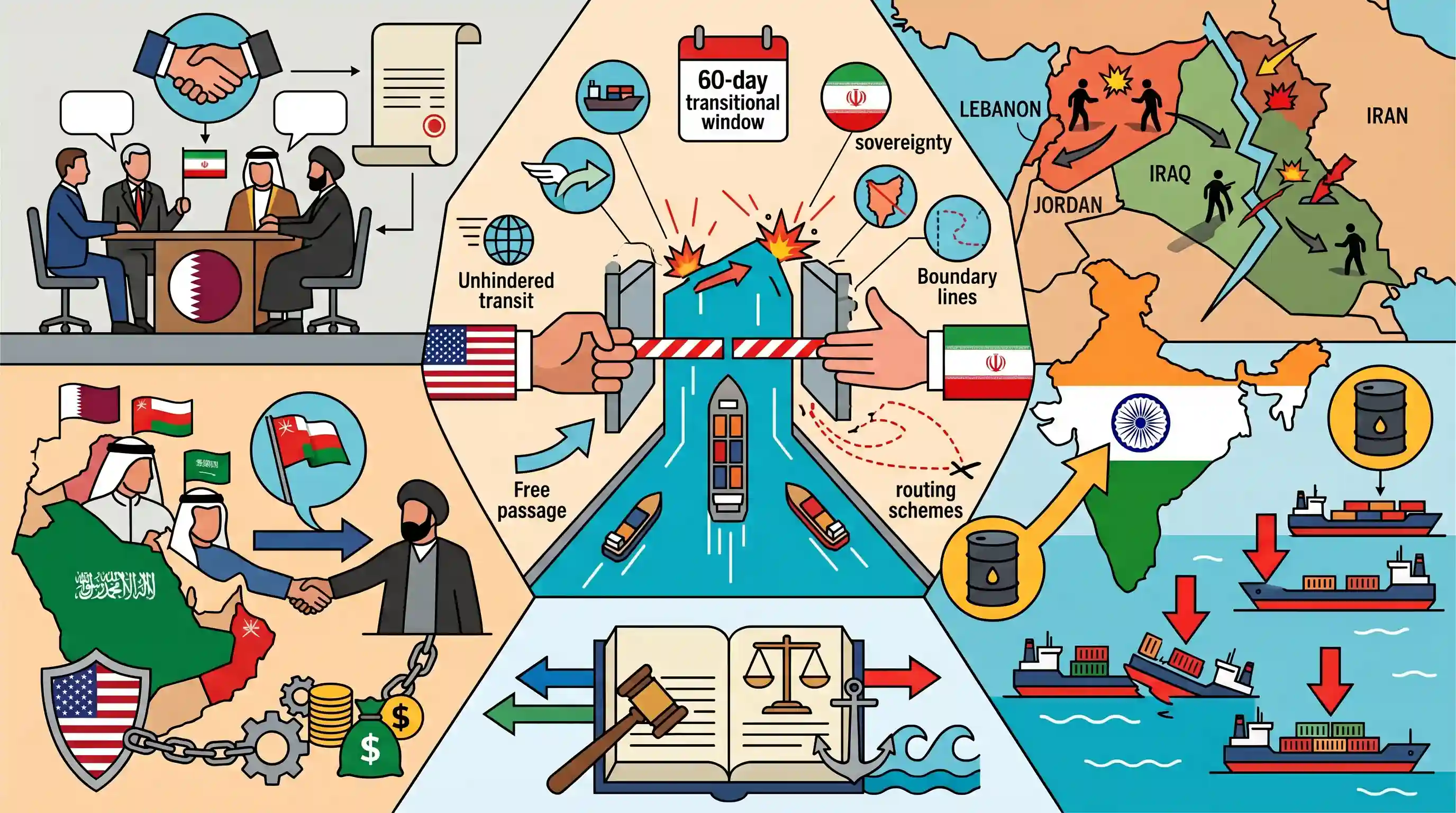
Despite indirect technical talks mediated by Qatar to operationalize the June 18 US-Iran Memorandum of Understanding (MoU), deep tactical divisions and regional geopolitics continue to spark military friction. The principal trigger is the short-term administration of the Strait of Hormuz during the 60-day transitional window, with the US seeking unhindered transit and Iran asserting sovereignty over temporary routing schemes. Concurrently, major Gulf states like Saudi Arabia, Qatar, and Oman are shifting away from US-led military containment toward economic reconciliation with Iran, highlighting a changing post-war order in West Asia. Meanwhile, maritime trade has plummeted, and proxy landscapes in Iraq and Lebanon add further friction to the path of a final peace settlement.
Key Points
- The June 18 Memorandum of Understanding (MoU) between the US and Iran, negotiated indirectly via Qatari mediators, seeks to address the nuclear issue and unfreeze $6 billion in Iranian funds, but faces major implementation hurdles over Article 5 (Strait of Hormuz administration).
- Long-term administration of the Strait is planned to be jointly managed by Oman and Iran under international law, proposing a tolling mechanism for 'services rendered' to bypass the UNCLOS Article 26 ban on flat transit tolls, using a liberal interpretation of UNCLOS Article 43.
- Short-term administration remains highly contested; the US and Oman back an IMO-proposed temporary southern shipping route to ensure unconditional 60-day transit without Iranian coordination, which Iran actively rejects, leading to military skirmishes (US CENTCOM strikes on Qeshm Island and Iranian retaliation against US bases in Bahrain and Kuwait).
- Shipping traffic in the Strait of Hormuz has collapsed, with IMF seven-day moving averages dropping from 104-115 daily crossings in the previous year to just 6-12 daily crossings during May-June.
- US-Saudi relations have experienced a downturn due to Riyadh's refusal to support US military attempts in May to forcibly reopen the Strait of Hormuz, highlighting a broader shift where Gulf powers (Saudi Arabia, Qatar, Oman) favor diplomatic engagement and economic integration with Iran over military containment.
- Regional flashpoints such as Iraq and Lebanon continue to complicate the post-MoU landscape. In Iraq, US pressure led to raids on 47 senior pro-Iranian leaders, while in Lebanon, the June 26 framework tying Israeli withdrawal to Hezbollah's disarmament remains a source of high volatility.
Important Terms
United Nations Convention on the Law of the Sea (UNCLOS)

An international treaty adopted in 1982 that establishes a comprehensive legal framework for ocean governance, maritime boundaries, marine resource management, and navigation rights.
UPSC context
GS Paper II: International Relations. Tests understanding of maritime laws, exclusive economic zones, and global geopolitical conflicts over maritime transit.
US-Iran June 18 Memorandum of Understanding (MoU)
A 14-point framework signed in June 2026 to halt hostilities, offering Iran targeted sanctions relief and unfreezing funds in exchange for down-blending enriched nuclear material and ensuring commercial shipping transit.
UPSC context
GS Paper II: Bilateral Agreements & Global Groupings. Tests analysis of West Asian geopolitical stability and its impact on India's energy security.
US-Israel-Lebanon Trilateral Framework Agreement
A U.S.-mediated peace framework signed on June 26, 2026, sequencing Israeli military redeployment from Lebanon with the disarmament of Hezbollah and restoration of full Lebanese state sovereignty.
UPSC context
GS Paper II: Important International Agreements. Tests knowledge of Middle Eastern conflict resolution frameworks and regional power dynamics.
Popular Mobilization Forces (PMF)
An Iraqi state-sponsored, predominantly Shia paramilitary umbrella organization formalized in 2014 to combat ISIS, which maintains close operational and ideological links with Iran's security apparatus.
UPSC context
GS Paper II: Effect of policies of developed and developing countries. Tests awareness of non-state actors, proxy warfare, and regional instability in West Asia.
International Maritime Organization (IMO)
A specialized United Nations agency responsible for regulating global shipping safety, maritime security, and preventing marine pollution caused by commercial vessels.
UPSC context
GS Paper II: Important International Institutions. Tests understanding of global maritime regulatory mechanisms and transit security.
US Central Command (CENTCOM)
One of eleven unified combatant commands of the United States military, responsible for protecting American security interests across 20 nations in the Middle East and Central Asia.
UPSC context
GS Paper II: Bilateral and Global Groupings. Tests knowledge of major global military structures active in strategic geopolitical regions.
Prelims Trap
UNCLOS allows coastal states to levy flat transit tolls on foreign merchant vessels for passing through international straits.
Article 26 prohibits flat transit taxes. Charges can only be levied for specific services rendered, such as pilotage or safety aids.
Static Concepts Connected
What is the difference between Innocent Passage and Transit Passage under UNCLOS?
- Geographical scope: Transit passage applies to straits used for international navigation; innocent passage applies to general territorial seas.
- Submarine navigation: Submarines must surface and show flag during innocent passage, but can transit submerged under transit passage.
- Suspension of rights: Coastal states can temporarily suspend innocent passage for security, but transit passage cannot be suspended.
How does India's Strategic Petroleum Reserve (SPR) program bolster energy security?
- Phase-1 storage: India built 5.33 MMT capacity across underground rock caverns in Visakhapatnam, Mangaluru, and Padur.
- Phase-2 expansion: Commercial-cum-strategic reserves planned at Chandikhol (Odisha) and Padur (Karnataka) under Public-Private Partnership model.
- Strategic buffer: Provides roughly 9.5 days of India's crude oil requirements to mitigate supply shocks from chokepoints.
Cross-Topic Patterns
West Asian realignment + India's IMEC corridor
GCC-Iran economic reconciliation reduces regional friction, making alternative multi-modal routes like the India-Middle East-Europe Economic Corridor (IMEC) more structurally viable.
Maritime chokepoints + Green Hydrogen transition
Frequent disruptions in Hormuz and Bab-el-Mandeb accelerate India's National Green Hydrogen Mission to achieve permanent energy independence.

UNCLOS transit passage rules and sovereign rights over international straits (like Hormuz) will likely be framed as a 2026 Prelims question.
Linked PYQs · 4
Linked PYQs · 4
- 2026PrelimsGS1
Ships from which of the following countries have to cross the Strait of Hormuz to reach out to the Indian Ocean ? 1. Bahrain 2. Syria 3. Qatar 4. Egypt Select the answer using the code given below :
- 2012MainsGS2
How have the US sanctions against Iran affected India's bilateral relations with Iran?
- 2017MainsGS2
The question of India's Energy Security constitutes the most important part of India's economic progress. Analyze India's energy policy cooperation with West Asian countries.
- 2025MainsGS3
Why is maritime security vital to protect India's sea trade? Discuss maritime and coastal security challenges and the way forward.
