Strategic Implications of US Iran Maritime Tensions and MOU
Source:Indian Express ↗
Why It Matters
The Strait of Hormuz is the world's most critical oil transit chokepoint, carrying a significant portion of India's crude imports. Escalating US-Iran tensions and maritime disruptions directly threaten India's energy security, trade routes, and economic stability. Understanding the legal (UNCLOS Articles 26 and 43) and geopolitical nuances of this region is essential for answering questions on West Asian dynamics, maritime law, and international security.
Summary
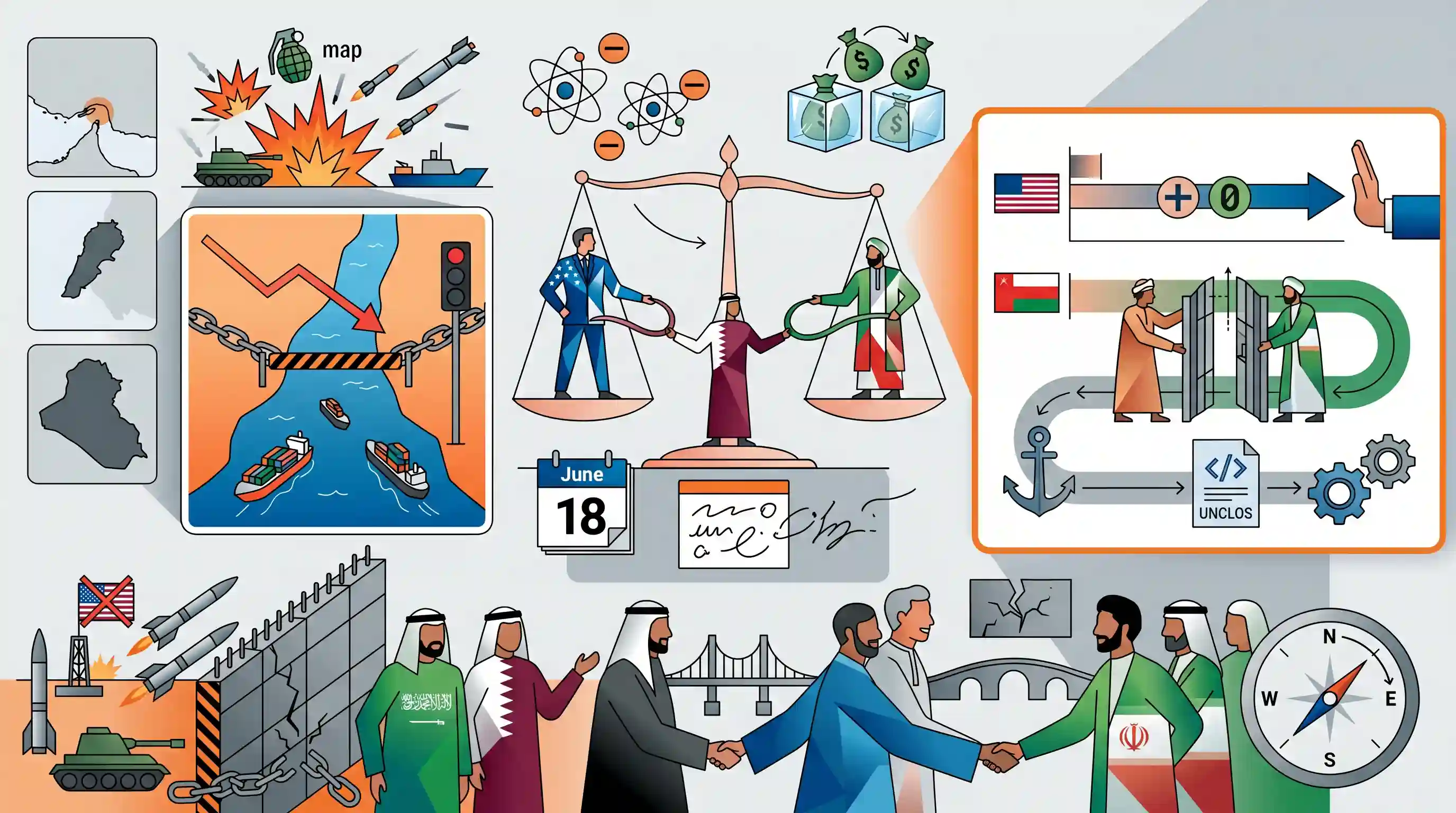
The article analyzes the fragile post-MoU (June 18) technical negotiations between the US and Iran, mediated indirectly by Qatar. Despite efforts to resolve core issues—including nuclear concessions and the unfreezing of Iranian assets—recurring military clashes in the Strait of Hormuz, Lebanon, and Iraq threaten the progress. The core legal and strategic dispute centers on Article 5 of the MoU, which governs the Strait of Hormuz. While long-term joint administration by Oman and Iran is being negotiated in line with UNCLOS, the short-term 60-day 'unconditional passage' window is a major flashpoint. The US demands zero Iranian interference, while Iran uses maritime leverage to ensure US compliance, resulting in a dramatic drop in maritime traffic. Meanwhile, a broader geopolitical realignment is underway as Gulf nations like Saudi Arabia and Qatar opt for reconciliation with Iran, shifting away from US-led military containment.
Key Points
- A June 18 Memorandum of Understanding (MoU) between the US and Iran aims to unfreeze $6 billion in Iranian funds in Doha, but implementation is stalled by friction over maritime transit rules.
- Article 5 of the MoU leaves the long-term administration of the Strait of Hormuz to Oman and Iran under UNCLOS, but disputes persist over short-term administration during a 60-day negotiation window.
- The US interprets 'unconditional passage' as precluding any ship coordination with Iranian authorities, leading to an IMO-led proposal for temporary alternative routes. Iran rejects this, insisting on coordination and striking vessels that bypass its oversight.
- Oman and Iran are designing a framework for transit payments under a liberal reading of UNCLOS Article 43 (services rendered), navigating Article 26's prohibition on flat tolls in international straits.
- Shipping volumes in the Strait have collapsed from 104-115 daily crossings in the prior year to just 6-12 crossings daily during May-June, severely impacting global energy supply chains.
- Gulf states (Oman, Qatar, Saudi Arabia) are increasingly favoring diplomatic engagement and economic integration with Iran over military confrontation, straining US-Saudi bilateral relations.
- US-Iran negotiations remain tightly linked to regional theaters, including Lebanon (disputes over Hezbollah disarmament under the June 26 framework) and Iraq (US-pressured raids on Iran-aligned political figures in Baghdad).
Important Terms
United Nations Convention on the Law of the Sea

An international treaty of 1982 establishing a comprehensive legal framework for all marine and maritime activities, defining territorial waters, exclusive economic zones, and navigation rights.
UPSC context
GS Paper 2 & 3; tests knowledge of sea lanes, exclusive economic zones, and international maritime security.
US-Iran Memorandum of Understanding
A June 2026 agreement signed by the US and Iran to formalize a ceasefire, temporarily restore free navigation in the Strait of Hormuz, and launch a 60-day window for final nuclear talks.
UPSC context
GS Paper 2; tests understanding of West Asian geopolitics, global sanctions regimes, and their economic and energy security impacts on India.
US-Israel-Lebanon Trilateral Framework Agreement
A June 2026 US-mediated peace agreement designed to restore Lebanese sovereignty, disarm Hezbollah, establish a Military Coordination Group, and resolve conflicts along the Israel-Lebanon border.
UPSC context
GS Paper 2 (IR); tests comprehension of Middle East geopolitics, US mediation, sovereignty issues, and their impact on regional peace.
International Maritime Organization
A specialized United Nations agency established to regulate shipping, focus on maritime safety, prevent marine pollution, and handle legal matters concerning global commercial navigation.
UPSC context
GS Paper 2 (International Institutions); tests familiarity with global shipping regulations, maritime security frameworks, and environmental protection standards.
Popular Mobilization Forces
An Iraqi state-sponsored umbrella organization of paramilitary groups, primarily Shia, established in 2014 to combat ISIS, which operates with significant political influence and ties to Iran.
UPSC context
GS Paper 2 & 3; tests comprehension of regional non-state actors, proxy warfare, and security dynamics influencing West Asian stability.
Council for Strategic and Defense Research
A New Delhi-based independent, nonpartisan think tank founded in 2020 that provides strategic analysis, research, and policy recommendations on foreign policy, defense, and Indo-Pacific security.
UPSC context
GS Paper 2 & 3; tests familiarity with Indian strategic think tanks, policy formulation, and research in defense and international affairs.
Prelims Trap
UNCLOS strictly prohibits coastal states from levying any financial charges on foreign ships transiting international straits.
While Article 26(1) bans flat transit tolls, Article 26(2) explicitly permits non-discriminatory levies as payment for specific services rendered (e.g., navigation aids under Article 43).
Static Concepts Connected
What are the key differences between Transit Passage and Innocent Passage under UNCLOS?
- Transit Passage: Applies to international straits; it is non-suspendable, allows submerged submarine transit, and permits military aircraft overflight.
- Innocent Passage: Applies to territorial waters; it is suspendable for security, requires submarines to transit on the surface, and prohibits aircraft overflight.
What is the current architecture of India's Strategic Petroleum Reserves (SPR)?
- Phase I Reserves: Managed by ISPRL at three coastal locations—Visakhapatnam, Mangaluru, and Padur—storing 5.33 MMT (approx. 9.5 days of net imports).
- Phase II Expansion: Approved commercial-cum-strategic expansion to add 6.5 MMT capacity at Chandikhol (Odisha) and Padur (Karnataka) via PPP mode.
Cross-Topic Patterns
UNCLOS vs Customary Law
The US enforces UNCLOS 'Transit Passage' as customary law despite never ratifying the treaty, highlighting how non-signatories project global maritime authority.
Chokepoints + INSTC bypass
Hormuz disruptions force India to accelerate the International North-South Transport Corridor (INSTC), shifting long-term transit reliance from maritime chokepoints to continental bypass routes.

UNCLOS transit vs innocent passage rules, paired with India's coastal Strategic Petroleum Reserves (SPR), is a high-yield 2026 theme.
Linked PYQs · 4
Linked PYQs · 4
- 2026PrelimsGS1
Ships from which of the following countries have to cross the Strait of Hormuz to reach out to the Indian Ocean ? 1. Bahrain 2. Syria 3. Qatar 4. Egypt Select the answer using the code given below :
- 2017MainsGS2
The question of India's Energy Security constitutes the most important part of India's economic progress. Analyze India's energy policy cooperation with West Asian countries.
- 2025MainsGS3
Why is maritime security vital to protect India's sea trade? Discuss maritime and coastal security challenges and the way forward.
- 2023MainsGS2
‘Sea is an important Component of the Cosmos’ Discuss in the light of the above statement the role of the IMO (International Maritime Organisation) in protecting environment and enhancing maritime safety and security.
