Strait of Hormuz Conflict and Global Energy Security Vulnerabilities
Source:Indian Express ↗
Why It Matters
The Strait of Hormuz handles roughly a fifth of global energy supplies. Any disruption directly impacts global crude oil prices (Brent and WTI), which significantly affects India's macroeconomic stability, import bill, and inflation. The standoff also brings core international law concepts like Freedom of Navigation (UNCLOS) into focus.
Summary
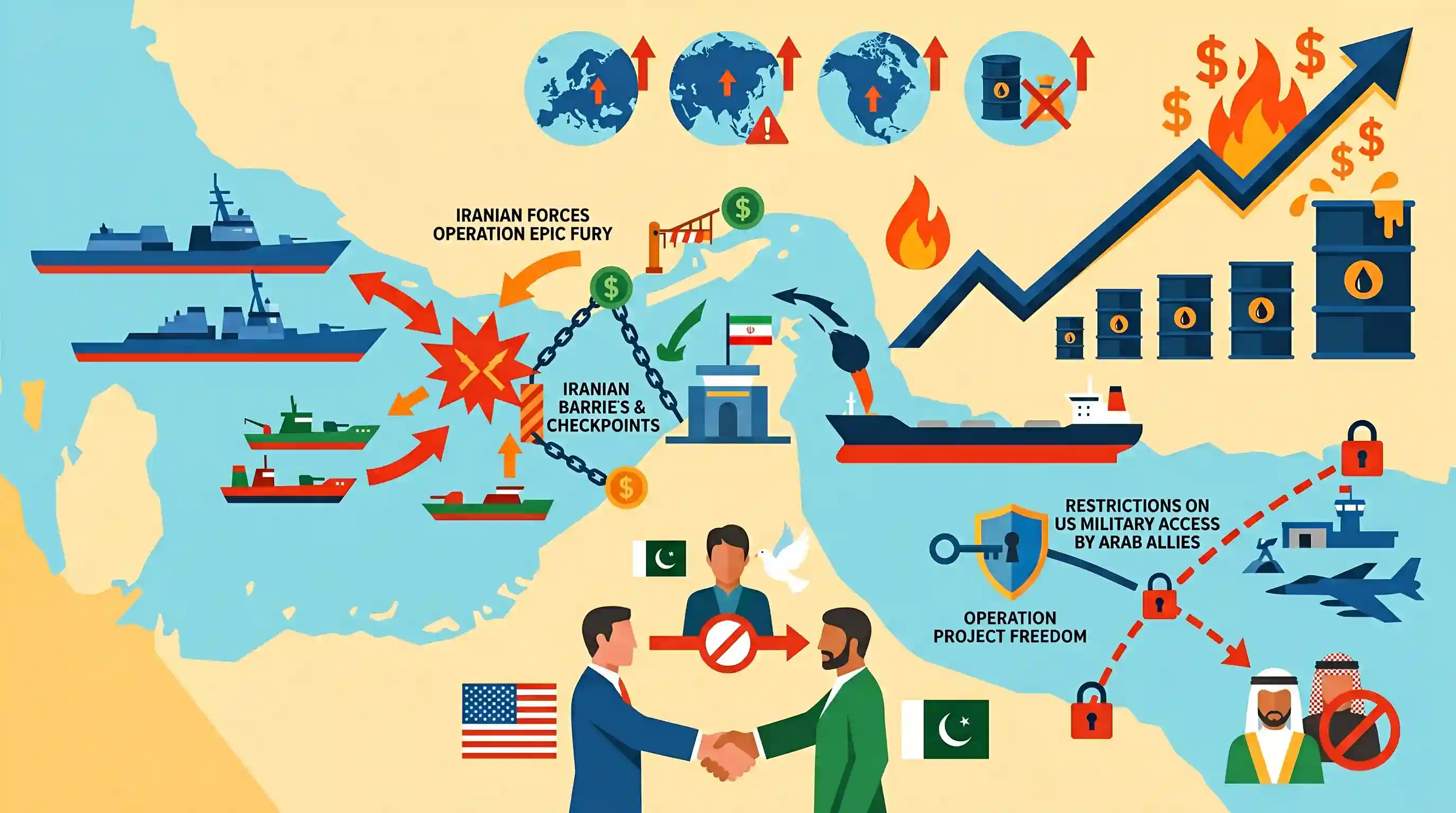
A major military confrontation between the US Navy and Iranian forces in the Strait of Hormuz has severely escalated regional tensions and threatened global energy security. Iran's establishment of the 'Persian Gulf Strait Authority' to regulate and toll maritime traffic prompted US operations aimed at restoring freedom of navigation in the critical choke point. The conflict caused an immediate spike in global oil benchmarks, with Brent Crude surging past $100 per barrel. Despite a Pakistan-brokered ceasefire extension and the end of the US 'Operation Epic Fury', efforts to secure the waterway via 'Operation Project Freedom' faced setbacks as key Arab allies restricted military access.
Key Points
- The Strait of Hormuz emerged as a major geopolitical flashpoint following a direct firefight between US Navy destroyers and Iranian forces.
- Iran formed the 'Persian Gulf Strait Authority' to formalize toll collection for friendly vessels while actively blocking hostile ships.
- The escalating maritime conflict disrupted global energy markets, sending Brent Crude past $101 and WTI Crude over $95 per barrel.
- The US initiated efforts to restore freedom of navigation and escort vessels through the choke point via 'Operation Project Freedom'.
- Regional US allies, including Saudi Arabia and Kuwait, restricted access to key bases and airspace, complicating the US military response.
Important Terms
Strait of Hormuz

A strategic maritime chokepoint between Iran and Oman, connecting the Persian Gulf to the Gulf of Oman. It handles ~25% of global seaborne oil trade and ~20% of LNG.
UPSC context
GS Paper 1 (Geography) and GS Paper 2 (IR); vital for energy security and maritime trade routes.
Operation Epic Fury
A U.S.-led military operation launched in February 2026 to dismantle Iran's security apparatus, missile production, and navy while preventing nuclear weapons development through targeted strikes.
UPSC context
GS Paper 2 (International Relations); tests understanding of regional conflicts and U.S.-Iran geopolitical dynamics.
Operation Project Freedom
A U.S. Navy mission launched in May 2026 to restore freedom of navigation by escorting merchant vessels through the Strait of Hormuz amidst Iranian blockades.
UPSC context
GS Paper 2 (IR) and GS Paper 3 (Security); concerns maritime security and protection of global supply chains.
Persian Gulf Strait Authority (PGSA)
An Iranian governmental agency established in May 2026 to regulate, permit, and toll maritime traffic in the Strait of Hormuz, challenging international transit rights.
UPSC context
GS Paper 2 (International Relations); relates to maritime sovereignty disputes and interpretation of international law.
Freedom of Navigation
A principle of international law allowing ships of all states to navigate oceans without interference, specifically via 'transit passage' through international straits under UNCLOS.
UPSC context
GS Paper 2 (IR) and GS Paper 3 (Security); core concept for Indo-Pacific and West Asian maritime stability.
UNCLOS
The 1982 treaty establishing a legal framework for all marine activities, defining maritime zones, and guaranteeing transit passage through straits used for international navigation.
UPSC context
GS Paper 2 (International Relations/International Law); the primary legal reference for maritime boundary and transit disputes.
Prelims Trap
Under UNCLOS, coastal states like Iran have the sovereign right to impose tolls on international commercial vessels transiting the Strait of Hormuz.
UNCLOS guarantees 'transit passage' through international straits, explicitly barring coastal states from unilaterally imposing tolls or blocking continuous navigation for foreign vessels.
Static Concepts Connected
How does UNCLOS regulate navigation through strategic international straits?
- Transit Passage: Guarantees continuous and unhindered navigation for all ships and aircraft through international straits connecting high seas or exclusive economic zones.
- Coastal Limitations: Coastal states cannot suspend transit passage or impose unilateral tolls solely for the right of navigation.
- Submarine Rules: Unlike 'innocent passage' in territorial waters, submarines are legally permitted to transit international straits fully submerged.
How do Brent and WTI crude benchmarks differ in global oil markets?
- Extraction Source: Brent is extracted from the North Sea, while WTI (West Texas Intermediate) is a light, sweet crude sourced from US onshore fields.
- Indian Benchmark: Brent serves as the primary pricing benchmark for two-thirds of the world's oil, including OPEC and India's import basket.
- Macroeconomic Impact: Disruptions in the Strait of Hormuz immediately spike Brent prices, widening India's Current Account Deficit and fueling imported inflation.
Cross-Topic Patterns
Strategic autonomy of Arab states
Saudi and Kuwait restricting US base access highlights a shift toward multipolarity, where regional powers hedge against US interests to maintain local diplomatic stability.
Mapping SLOCs: Hormuz and Bab el-Mandeb
Hormuz's security threats link geographically to recent Red Sea/Houthi disruptions. UPSC often pairs such maritime chokepoints in map-based match-the-following questions.
Oil shocks and INR depreciation
Surging Brent crude directly links to RBI's forex interventions. A sustained oil shock stresses India's import cover and forces structural currency depreciation.

Expect a paired-statement question mapping Middle East straits (Hormuz, Bab-el-Mandeb) to UNCLOS 'transit passage' vs 'innocent passage'.
Linked PYQs · 5
Linked PYQs · 5
- 2024PrelimsGS1
Consider the following statements : Statement-I : Sumed pipeline is a strategic route for Persian Gulf oil and natural gas shipments to Europe. Statement-II : Sumed pipeline connects the Red Sea with the Mediterranean Sea. Which one of the following is correct in respect of the above statements?
- 2025MainsGS2
"Energy security constitutes the dominant kingpin of India's foreign policy, and is linked with India's overarching influence in Middle Eastern countries.” How would you integrate energy security with India's foreign policy trajectories in the coming years?
- 2014MainsGS2
With respect to the South China sea, maritime territorial disputes and rising tension affirm the need for safeguarding maritime security to ensure freedom of navigation and over flight throughout the region. In this context, discuss the bilateral issues between India and China.
- 2020PrelimsGS1
The term 'West Texas Intermediate', sometimes found in news, refers to a grade of
- 2011PrelimsGS1
In the context of global oil prices, “Brent crude oil” is frequently referred to in the news. What does this term imply? 1. It is a major classification of crude oil. 2. It is sourced from North Sea. 3. It does not contain sulphur. Which of the statements given above is/are correct?
