Pakistan Mediates US Iran Talks Amid Ceasefire and Nuclear Demands
Source:Indian Express ↗
Why It Matters
The ongoing US-Iran friction directly impacts global energy security, given the strategic importance of the Strait of Hormuz to international oil supply chains. For India, these negotiations are critical as any disruption in the Persian Gulf affects domestic fuel prices, inflation, and the broader Indian economy. Additionally, Pakistan's role as a successful mediator in a major international conflict could shift regional diplomatic dynamics.
Summary
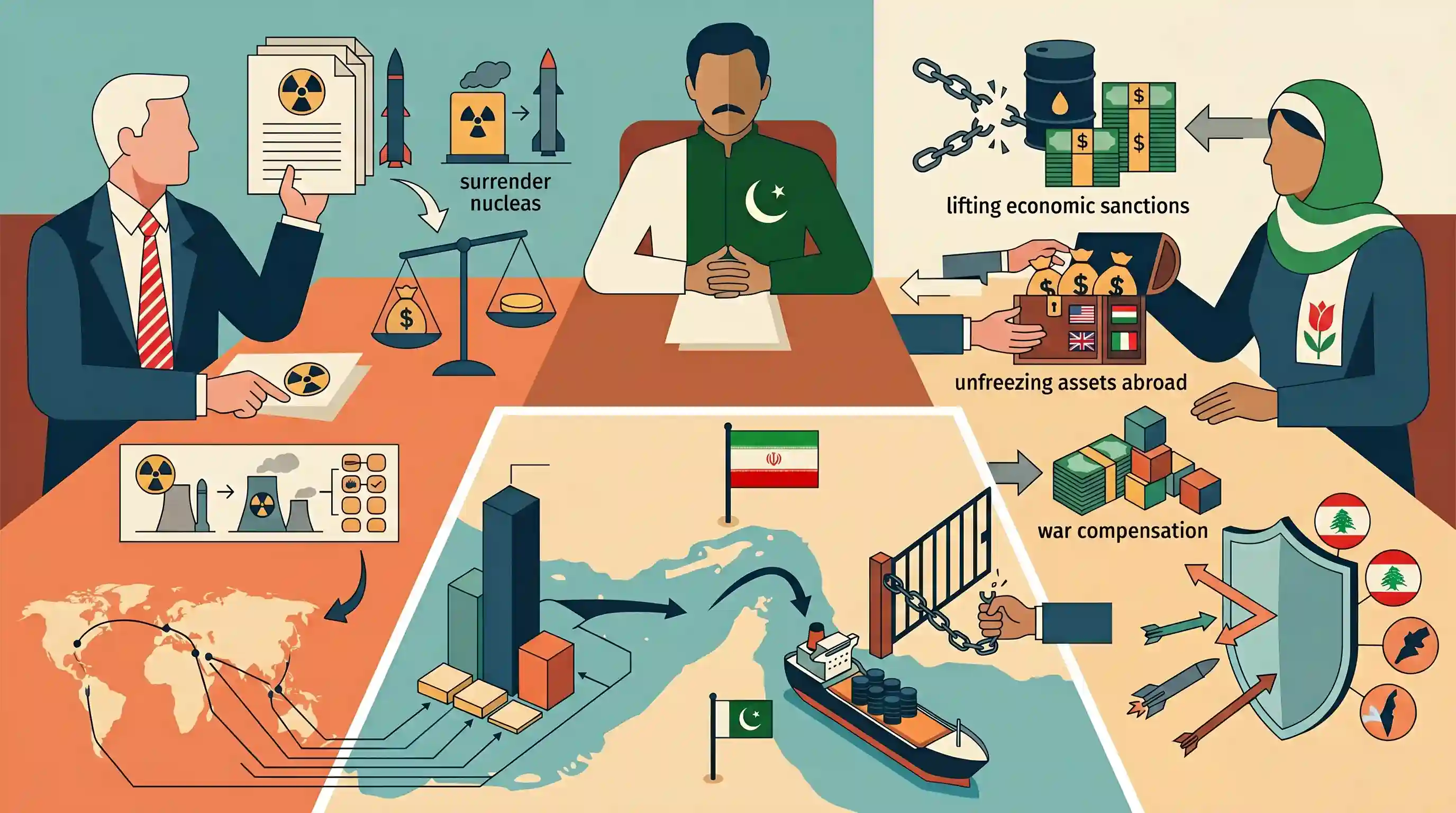
Pakistan is mediating indirect peace talks between the United States and Iran following a period of heightened military conflict in the Middle East. As part of a ceasefire framework, former US President Donald Trump proposed strict nuclear conditions, including Iran surrendering 400kg of enriched uranium and operating only one nuclear facility. In response, Tehran has outlined comprehensive counter-demands: the lifting of economic sanctions, unfreezing of assets abroad, war compensation, and an end to hostilities on all fronts, including Lebanon. Crucially, Iran is demanding international recognition of its sovereignty over the Strait of Hormuz, a vital maritime chokepoint responsible for 20% of global oil transit, which Iran had temporarily closed during the recent hostilities.
Key Points
- Pakistan is actively mediating peace talks between the US and Iran following military hostilities in early 2024.
- Donald Trump's ceasefire conditions require Iran to scale back its nuclear program to a single facility and hand over 400kg of enriched uranium to Russia.
- Iran's counter-demands include the lifting of economic sanctions, release of frozen assets, and compensation for war damages.
- A crucial geopolitical point is Iran's demand for sovereignty over the Strait of Hormuz, a maritime chokepoint handling 20% of the global oil supply.
- Iran's earlier closure of the Strait during the conflict highlighted severe vulnerabilities in global energy security.
Prelims Trap
Iran holds exclusive territorial sovereignty over the Strait of Hormuz and can legally suspend international maritime traffic.
Under UNCLOS, the Strait of Hormuz is subject to "transit passage," meaning bordering states (Iran and Oman) cannot legally suspend or deny the free navigation of international vessels.
Static Concepts Connected
What is the "Transit Passage" regime under UNCLOS for international straits?
- Applicability: It applies to straits used for international navigation connecting two parts of the high seas or Exclusive Economic Zones (EEZ).
- Navigation rights: All ships and aircraft enjoy the right of unimpeded, continuous, and expeditious transit passage through the strait.
- No suspension: Unlike "innocent passage" in standard territorial waters, bordering coastal states cannot legally suspend transit passage for foreign vessels.
How does an oil supply shock from chokepoint closures impact India's macroeconomy?
- Widens CAD: Surging global crude prices directly widen India's Current Account Deficit (CAD), as India imports over 80% of its crude oil requirements.
- Imported Inflation: Higher fuel costs cascade into domestic transport and manufacturing sectors, driving up headline CPI through cost-push inflation.
- Currency Depreciation: Increased demand for US Dollars to pay for expensive oil imports leads to the depreciation of the Indian Rupee.
Cross-Topic Patterns
Energy chokepoints & Strategic Petroleum Reserves
Disruptions in Hormuz directly test the adequacy of India's Strategic Petroleum Reserves (SPRs) at Mangaluru, Padur, and Visakhapatnam to buffer against sudden crude supply shocks.
Sanctions dynamics & INSTC viability
US sanctions relief or enforcement on Iran heavily dictates the operational success of India's Chabahar port and the broader International North-South Transport Corridor (INSTC).

Map-based questions linking West Asian chokepoints (Hormuz, Bab-el-Mandeb) with bordering nations and UNCLOS passage rights are highly probable for 2026.
Linked PYQs · 3
Linked PYQs · 3
- 2018MainsGS2
In what ways would the ongoing US-Iran Nuclear Pact Controversy affect the national interest of India? How should India respond to this situation?
- 2012MainsGS2
How have the US sanctions against Iran affected India's bilateral relations with Iran?
- 2024PrelimsGS1
Consider the following statements : Statement-I : Sumed pipeline is a strategic route for Persian Gulf oil and natural gas shipments to Europe. Statement-II : Sumed pipeline connects the Red Sea with the Mediterranean Sea. Which one of the following is correct in respect of the above statements?
