US Agrees to Temporary Waiver on Iran Oil Amid Peace Proposals
Source:Indian Express ↗
Why It Matters
The development underscores the strategic use of economic sanctions in geopolitical negotiations and highlights shifting diplomatic roles, such as Pakistan acting as a mediator between the US and Iran. The outcome significantly impacts global energy security and stability in West Asia, which directly influences India's diaspora, energy imports, and strategic interests in the region.
Summary
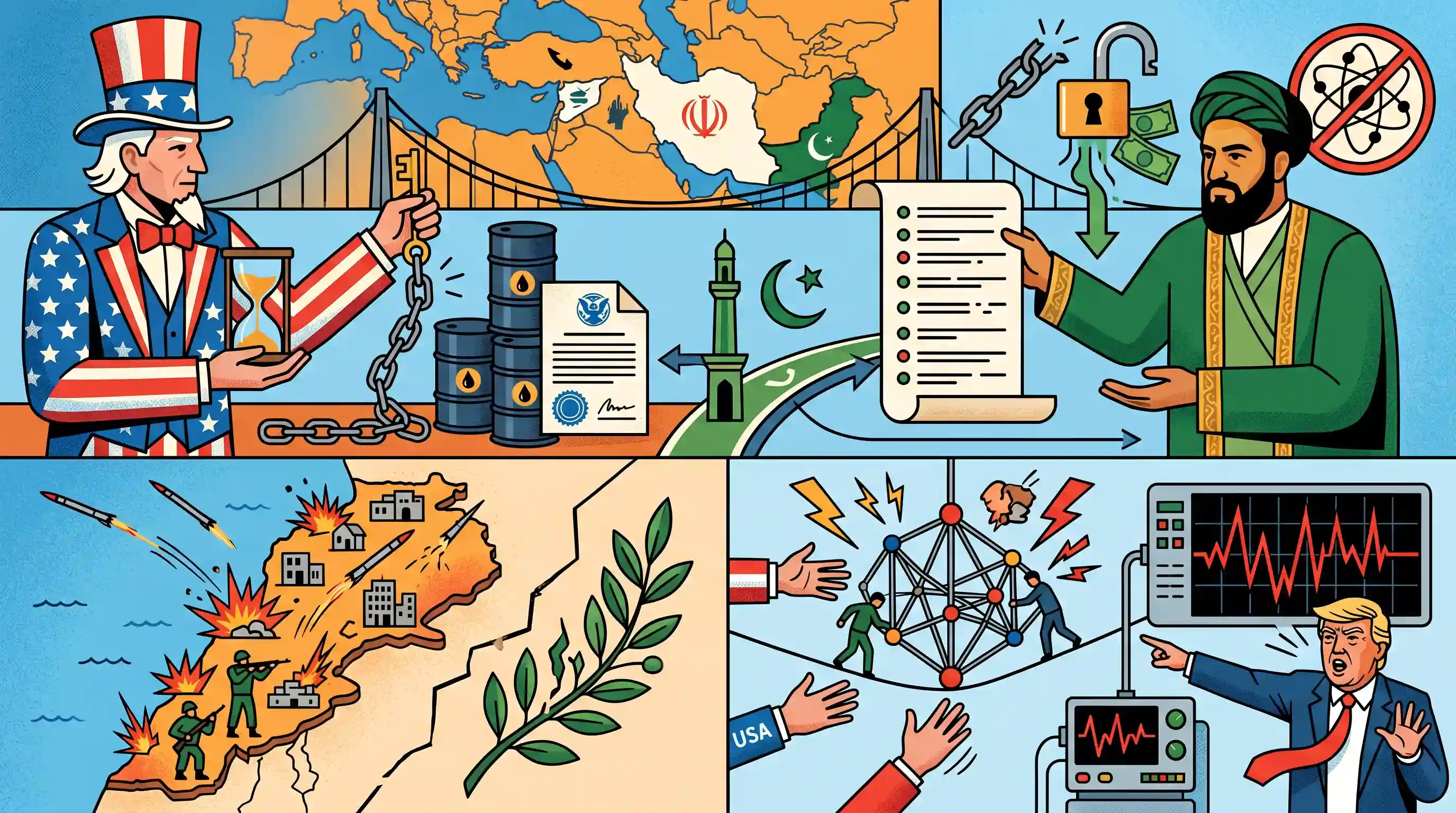
The United States has reportedly agreed to a temporary waiver of Iranian oil sanctions through the Office of Foreign Assets Control (OFAC) as part of a newly drafted negotiating framework aimed at de-escalating tensions in West Asia. In tandem with these developments, Iran has utilized Pakistan as a diplomatic mediator, delivering a comprehensive 14-point peace proposal to Washington. While the US has signaled a willingness to offer temporary sanctions relief to facilitate dialogue, Iran remains steadfast in its demand for the complete and permanent removal of all economic sanctions. Furthermore, Tehran has explicitly refused to engage in any negotiations regarding its controversial nuclear program until a permanent cessation of hostilities is achieved across the entire region. This includes an immediate end to the conflict in Lebanon, where Israel has continued its military strikes against Hezbollah despite a fragile US-backed ceasefire. The diplomatic situation remains highly precarious; US President Donald Trump recently cautioned that the broader ceasefire framework is currently on 'life support' due to profound disagreements and ongoing regional violence.
Key Points
- The US has reportedly agreed to a temporary waiver of Iranian oil sanctions via OFAC as part of a new negotiating framework.
- Iran submitted a revised 14-point peace proposal to Pakistan, which has assumed a mediator role and relayed the terms to Washington.
- Iran demands the full removal of US sanctions and refuses to discuss its nuclear program until a permanent end to regional hostilities is secured.
- The Iranian proposal emphasizes ending the conflict across West Asia, specifically calling out Israeli attacks on Hezbollah in Lebanon despite a US-backed ceasefire.
- US President Donald Trump stated that the broader ceasefire negotiations remain on 'life support' due to significant bilateral disagreements.
Important Terms
14-point peace proposal

A diplomatic framework submitted by Iran (mediated by Pakistan) to the US, demanding full sanctions removal, asset unfreezing, and an end to regional hostilities as conditions for peace.
UPSC context
GS-II: International Relations. Tests knowledge of regional peace frameworks, mediation roles, and India's strategic interests in a stable West Asia.
Office of Foreign Assets Control (OFAC)
An agency of the US Treasury Department that administers and enforces economic and trade sanctions. It issues waivers and licenses to regulate financial transactions with sanctioned nations like Iran.
UPSC context
GS-II/III: International Relations & Economy. Relevant for studying sanctions regimes, economic diplomacy, and their impact on global energy security.
Hezbollah
An Iran-backed Shia militant group and political party in Lebanon. It is a key regional actor whose military activities against Israel are central to the current West Asian conflict.
UPSC context
GS-II: International Relations. Important for analyzing West Asian power dynamics, non-state actors, and security challenges affecting regional stability.
Islamic Revolutionary Guard Corps (IRGC)
An elite branch of the Iranian Armed Forces responsible for internal security and regional strategic operations. It exerts significant influence over Iran's economy and its regional proxy network.
UPSC context
GS-II: International Relations. Essential for understanding Iran’s political-military structure, regional influence, and the nuances of US-Iran sanctions policy.
Prelims Trap
"OFAC sanctions on Iran are mandated by the UN Security Council and legally binding."
OFAC enforces unilateral US secondary sanctions. India formally recognizes only UN sanctions, though US financial hegemony practically forces Indian companies to comply to avoid dollar lock-outs.
Static Concepts Connected
What is the Joint Comprehensive Plan of Action (JCPOA)?
- P5+1 Agreement: Signed in 2015 between Iran and the P5+1 (US, UK, France, Russia, China, Germany) alongside the EU to restrict Iran's nuclear program.
- Sanctions Relief: Iran agreed to strict uranium enrichment limits and IAEA inspections in exchange for the lifting of international economic sanctions.
- US Withdrawal: The US unilaterally withdrew in 2018, imposing 'maximum pressure' sanctions, which eventually led Iran to breach its enrichment caps.
How do US secondary sanctions operate globally?
- Extraterritorial Reach: They target third-country entities doing business with a sanctioned nation, threatening to cut them off from the US financial system and dollar dominance.
- Impact on India: Such sanctions previously forced India to halt Iranian crude imports, disrupting traditional energy ties and requiring rapid supply diversification to avoid banking penalties.
Cross-Topic Patterns
Rupee-Rial trade & oil bypass
Before total sanctions, India used a Rupee-Rial mechanism for Iranian oil. A waiver revives this dynamic, linking energy security directly to India's push for currency internationalization.
Chabahar, INSTC & Sanctions Relief
While Chabahar has specific US carve-outs, broader sanctions relief on Iran would de-risk private investment and accelerate operationalizing the International North-South Transport Corridor (INSTC).
Pakistan's emerging mediator role
Oman and Switzerland traditionally mediated US-Iran backchannels. Pakistan's new role alters regional diplomatic leverage, requiring New Delhi to closely monitor Islamabad's strategic utility to Washington.

US secondary sanctions, JCPOA's collapse, and their direct impact on India’s crude oil basket are prime for a 2026 multi-statement Q.
Linked PYQs · 3
Linked PYQs · 3
- 2012MainsGS2
How have the US sanctions against Iran affected India's bilateral relations with Iran?
- 2025MainsGS2
"Energy security constitutes the dominant kingpin of India's foreign policy, and is linked with India's overarching influence in Middle Eastern countries.” How would you integrate energy security with India's foreign policy trajectories in the coming years?
- 2022MainsGS2
How will I2U2 (India, Israel, UAE and USA) grouping transform India's position in global politics?
