US Iran Nuclear Negotiations and West Asia Maritime Security
Source:The Hindu ↗
Why It Matters
The evolving US-Iran dynamic and overall stability in West Asia directly affect India's energy security, crude oil prices, and strategic investments like the Chabahar port. Moreover, escalating asymmetric drone warfare and threats to crucial maritime chokepoints like the Strait of Hormuz underscore global maritime security challenges that are highly relevant to India's Indo-Pacific strategy.
Summary
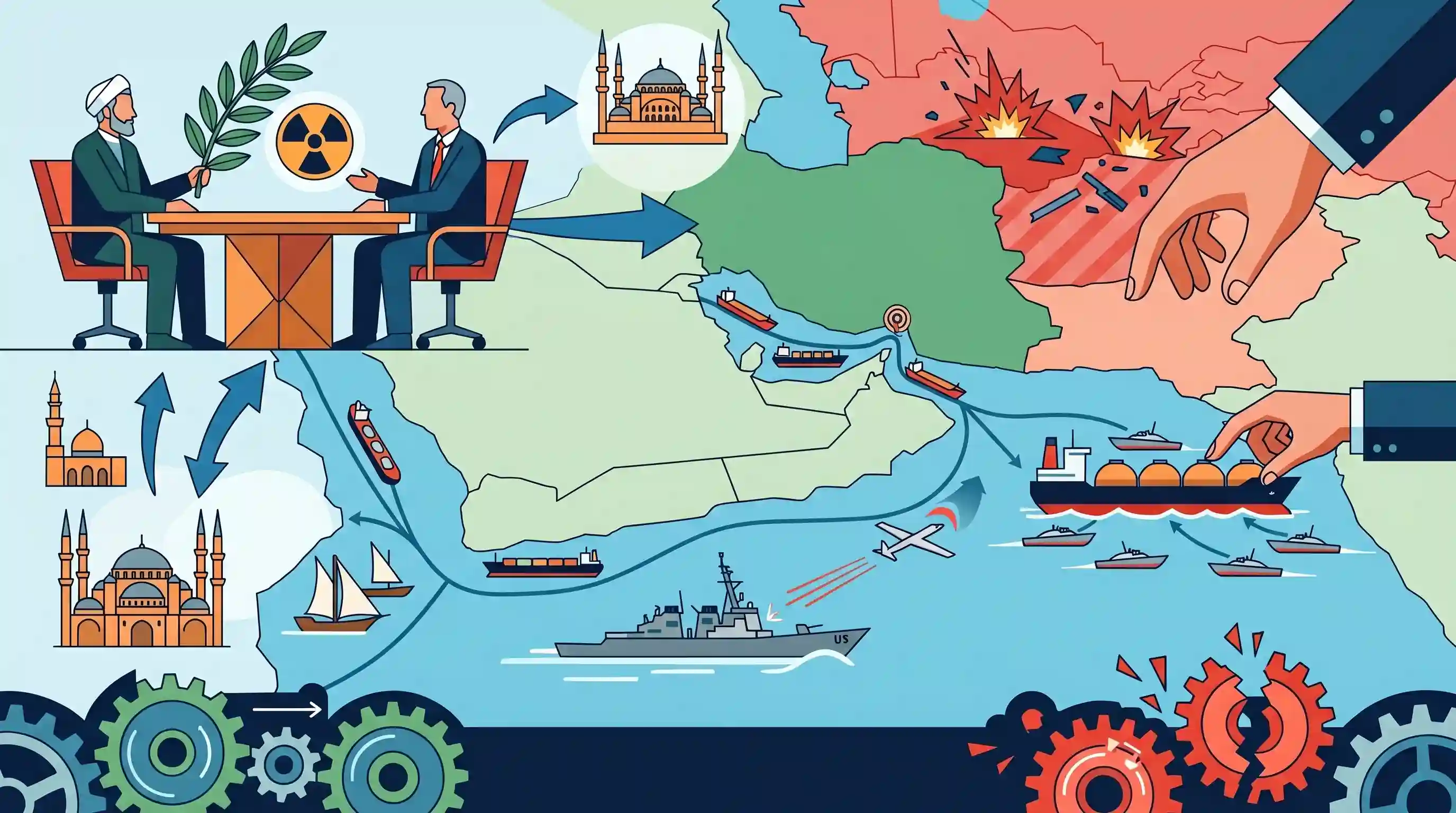
The United States and Iran are preparing to resume nuclear negotiations, potentially in Oman or Istanbul, aiming to de-escalate tensions following the severe June 2025 conflict known as 'Operation Midnight Hammer.' Despite diplomatic openings under Iranian President Masoud Pezeshkian and US envoy Steve Witkoff, regional security remains volatile. Recent incidents, including the US Navy intercepting an Iranian Shahed-139 drone in the Arabian Sea and an attempted seizure of a US tanker near the Strait of Hormuz by Iranian forces, highlight the continuing asymmetric threats to global Sea Lanes of Communication (SLOCs) and crucial energy chokepoints.
Key Points
- The US and Iran are exploring the resumption of nuclear talks mediated by regional partners like Oman, marking a critical diplomatic shift following recent escalations.
- Negotiations seek to stabilize West Asia after the severe June 2025 military confrontation ('Operation Midnight Hammer'), which targeted Iranian nuclear sites during an Iran-Israel conflict.
- Maritime security in vital chokepoints remains precarious, evidenced by a recent Iranian attempt to seize the US-flagged tanker M/V Stena Imperative near the Strait of Hormuz.
- Asymmetric warfare tactics, including the deployment of Shahed-139 and Mohajer drones by Iran in the Arabian Sea, pose continuous threats to naval assets and global sea lanes of communication (SLOCs).
Important Terms
Operation Midnight Hammer

A June 2025 US military operation targeting three Iranian nuclear facilities (Fordow, Natanz, Isfahan) using B-2 bombers to degrade Tehran's nuclear capabilities.
UPSC context
GS-II: International Relations; tests knowledge of West Asian conflicts and their impact on global security/energy.
Shahed-139 Drone
An advanced Iranian reconnaissance and strike drone, allegedly modeled after the US MQ-1 Predator, used in maritime provocations in the Arabian Sea.
UPSC context
GS-III: Security Challenges; focuses on asymmetric warfare and the role of UAVs in maritime security.
Sea Lanes of Communication (SLOCs)
Primary maritime routes between ports used for trade, logistics, and naval operations, essential for global energy security and commerce.
UPSC context
GS-III: Maritime Security; vital for India's energy imports and the principle of Freedom of Navigation.
Strait of Hormuz
A critical maritime chokepoint between the Persian Gulf and Gulf of Oman, through which approximately 20-25% of the world's seaborne oil passes.
UPSC context
GS-I/II: Geography and IR; significant for India’s energy security and regional stability.
Project Freedom
A 2026 US initiative led by President Trump to ensure the safe passage of commercial vessels through the Iranian-blockaded Strait of Hormuz.
UPSC context
GS-II: International Relations; tests understanding of US foreign policy and maritime interventionism.
Steve Witkoff
The US Special Envoy for the Middle East appointed to lead nuclear and security negotiations with Iran, often operating via Omani mediation.
UPSC context
GS-II: International Relations; relevant for tracking key diplomatic actors in the US-Iran peace process.
Prelims Trap
"The Strait of Hormuz connects the Red Sea and the Gulf of Aden."
Hormuz connects the Persian Gulf to the Gulf of Oman. Bab el-Mandeb connects the Red Sea to the Gulf of Aden. UPSC frequently swaps these.
Static Concepts Connected
Which water bodies do the major West Asian maritime chokepoints connect?
- Strait of Hormuz: Connects the Persian Gulf to the Gulf of Oman and the Arabian Sea, bordered by Iran and Oman/UAE.
- Bab el-Mandeb: Connects the Red Sea to the Gulf of Aden, acting as a crucial link to the Suez Canal.
- Suez Canal: An artificial sea-level waterway in Egypt connecting the Mediterranean Sea to the Red Sea.
How do disruptions in West Asian SLOCs impact India's macroeconomy?
- Current Account Deficit: Restricted oil flow spikes global crude prices, inflating India's massive import bill and widening the CAD.
- Imported Inflation: Elevated global freight insurance and fuel costs cascade into domestic retail inflation, complicating RBI monetary policy.
- Strategic Reserves: Prolonged disruption forces reliance on Indian Strategic Petroleum Reserves (ISPRL), testing India's energy resilience.
Cross-Topic Patterns
Asymmetric Warfare & IOR Security
The use of low-cost Shahed drones against conventional naval vessels connects West Asian IR to the Security syllabus on emerging asymmetric maritime threats in the Indian Ocean.
Oman's Diplomatic Exceptionalism
Oman's Ibadi Muslim demographic and non-aligned policy make it a unique mediator. This ties into India's 'Neighborhood First' strategy, leveraging Duqm port for naval logistics.

A 2026 Prelims map question will likely pair West Asian straits (Hormuz, Bab el-Mandeb) with bordering nations and adjacent water bodies.
Linked PYQs · 4
Linked PYQs · 4
- 2025MainsGS3
Why is maritime security vital to protect India's sea trade? Discuss maritime and coastal security challenges and the way forward.
- 2022MainsGS3
What are the maritime security challenges in India ? Discuss the organisational, technical and procedural initiatives taken to improve the maritime security.
- 2023MainsGS3
The use of unmanned aerial vehicles (UAVs) by our adversaries across the borders to ferry arms/ammunitions, drugs, etc., is a serious threat to the internal security. Comment on the measures being taken to tackle this threat.
- 2024PrelimsGS1
Consider the following statements : Statement-I : Sumed pipeline is a strategic route for Persian Gulf oil and natural gas shipments to Europe. Statement-II : Sumed pipeline connects the Red Sea with the Mediterranean Sea. Which one of the following is correct in respect of the above statements?
