Geneva Nuclear Talks and US Military Deterrence in West Asia
Source:Indian Express ↗
Why It Matters
The fluctuation between diplomacy and conflict in US-Iran relations profoundly impacts the stability of West Asia (Middle East), which is critical to global energy markets. For India, tensions in this region affect energy security, the diaspora in the Gulf, and strategic projects like the Chabahar port, requiring a delicate diplomatic balancing act.
Summary
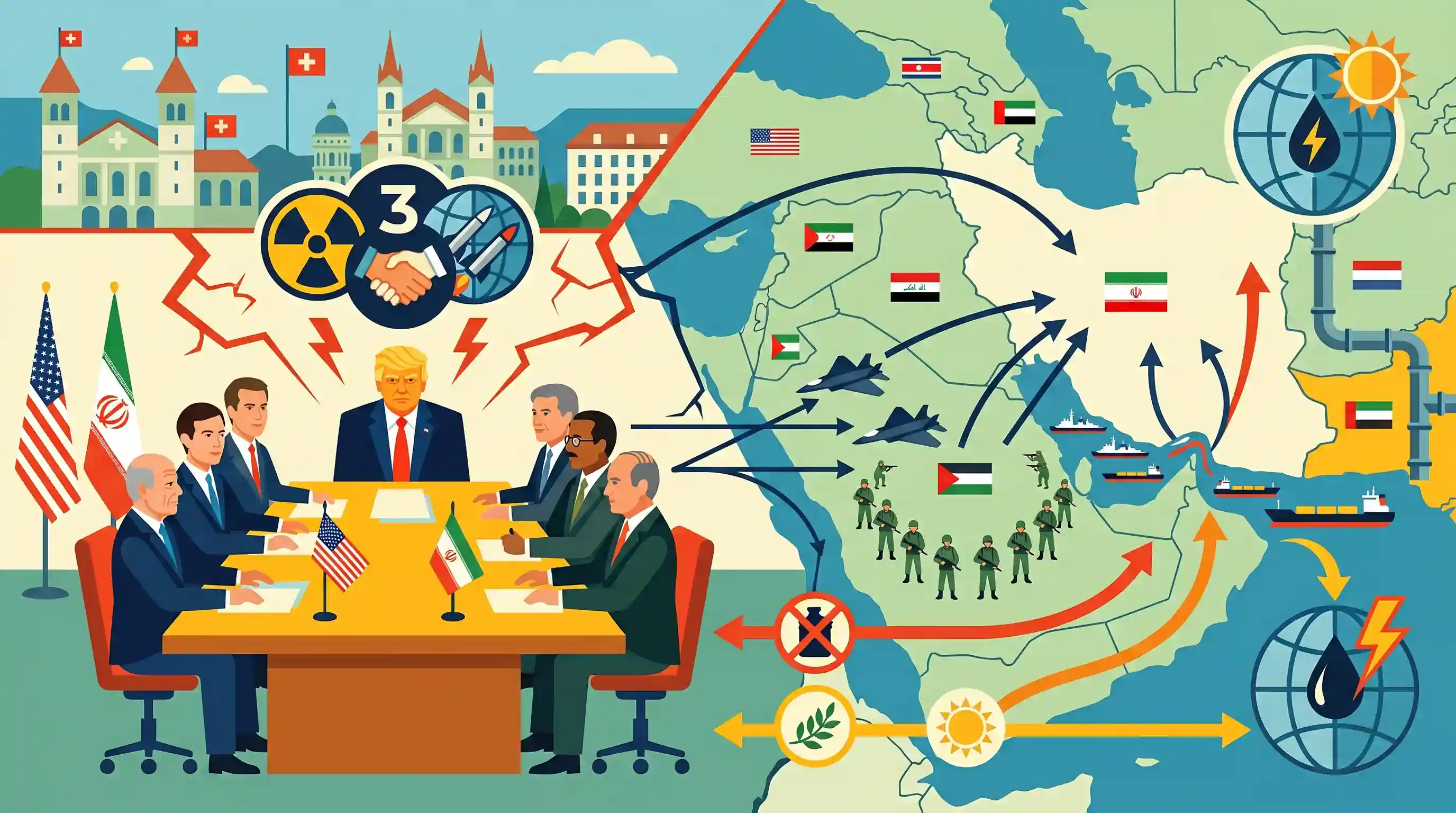
A crucial third round of nuclear talks has been held between the US and Iran in Geneva, amidst rising tensions and the deployment of additional American military forces to the Middle East. Key US figures, including Donald Trump and his advisors Jared Kushner and Steven Witkoff, face the complex challenge of balancing diplomatic engagement with military deterrence. These developments carry significant implications for the geopolitical stability of West Asia.
Key Points
- A crucial third round of nuclear talks between the US and Iran took place in Geneva.
- The diplomatic negotiations are juxtaposed against growing military threats and the deployment of additional US forces to the Middle East.
- Key US figures including Donald Trump, Jared Kushner, and Steven Witkoff are involved in navigating the delicate balance between diplomacy and military pressure in dealing with Iran's nuclear program.
Important Terms
JCPOA (Joint Comprehensive Plan of Action)

A 2015 multilateral deal (P5+1) limiting Iran's nuclear program for sanctions relief. By 2026, it is largely non-functional following 2025 UN 'snapback' sanctions and failed revival attempts.
UPSC context
GS II (International Relations); tests knowledge of nuclear non-proliferation, P5+1 dynamics, and Middle East security architecture.
Strait of Hormuz
The world's most strategic energy chokepoint between the Persian Gulf and Gulf of Oman. It handles ~20% of global oil trade, making its security vital for India's economy.
UPSC context
GS I (Geography) and GS III (Energy Security); tests understanding of maritime chokepoints and energy supply chains.
Snapback Mechanism
A provision in UNSC Resolution 2231 allowing signatories to unilaterally reimpose prior UN sanctions on Iran if it violates the JCPOA; triggered by the E3 (UK/France/Germany) in late 2025.
UPSC context
GS II (International Relations); tests understanding of UN Security Council procedures and treaty-based enforcement mechanisms.
Strategic Autonomy
India's foreign policy doctrine of maintaining independent decision-making by balancing relationships with competing global powers (e.g., US vs. Iran) to prioritize national interests.
UPSC context
GS II (International Relations); central to questions on India's 'Look West' policy and multi-alignment strategy.
US Central Command (CENTCOM)
The US Unified Combatant Command responsible for military operations in the Middle East, North Africa, and Central Asia, currently overseeing massive reinforcements near Iran.
UPSC context
GS III (Security); tests awareness of external military actors impacting India's extended neighborhood security.
Energy Security
Ensuring reliable and affordable energy access. In the US-Iran context, it involves safeguarding maritime routes to prevent oil price shocks and domestic inflation.
UPSC context
GS III (Economy/Security); tests understanding of India's crude import vulnerability and macroeconomic stability.
West Asia Geopolitics
Power dynamics in the Middle East involving state actors, proxies, and external powers (US/Russia/China) competing over influence, energy resources, and maritime chokepoints.
UPSC context
GS II (International Relations); basic conceptual framework for analyzing conflicts and India’s interests in the region.
Prelims Trap
"India enjoys a blanket waiver from CAATSA sanctions for all trade and infrastructure investments in Iran."
India received a narrow, project-specific exemption solely for the Chabahar port development to assist Afghanistan, not a blanket waiver for Iranian oil or other trade.
Static Concepts Connected
What distinguishes civilian from weapons-grade uranium enrichment?
- LEU (Civilian): Low-Enriched Uranium contains 3-5% U-235, which is sufficient to generate electricity in commercial nuclear power reactors.
- HEU (Research): Highly Enriched Uranium (around 20% U-235) is typically used for research reactors and the production of medical isotopes.
- Weapons-Grade: Requires enrichment of the U-235 isotope to 90% or higher to effectively sustain an explosive fission chain reaction.
How do US secondary sanctions under CAATSA operate?
- Secondary Sanctions: They penalize third-party countries or foreign entities for trading with a sanctioned nation, threatening them with exclusion from the US financial system.
- CAATSA Scope: Enacted in 2017, this US federal law mandates sanctions against adversaries, specifically targeting Iran, North Korea, and Russia.
- Indian Dilemma: It forces India to balance strategic autonomy, previously causing New Delhi to zero out Iranian oil imports while negotiating waivers for Chabahar and Russian S-400s.
Cross-Topic Patterns
INSTC viability and Iranian sanctions
The International North-South Transport Corridor's operational success relies on a sanctions-free Iran; US maximum pressure policies severely restrict private shipping insurance and banking lines for Chabahar.
Strait of Hormuz chokepoint vulnerability
Military build-ups near the Strait of Hormuz directly threaten India's macroeconomic stability, as a massive portion of its crude oil and LNG imports passes through this narrow maritime chokepoint.

Expect a 2026 Prelims question linking IAEA enrichment thresholds, CAATSA secondary sanctions, and India's Chabahar exemptions.
Linked PYQs · 2
Linked PYQs · 2
- 2018MainsGS2
In what ways would the ongoing US-Iran Nuclear Pact Controversy affect the national interest of India? How should India respond to this situation?
- 2025MainsGS2
"Energy security constitutes the dominant kingpin of India's foreign policy, and is linked with India's overarching influence in Middle Eastern countries.” How would you integrate energy security with India's foreign policy trajectories in the coming years?
