US and Iran Sign MoU for Sixty Day Strait of Hormuz Ceasefire
Source:Indian Express ↗
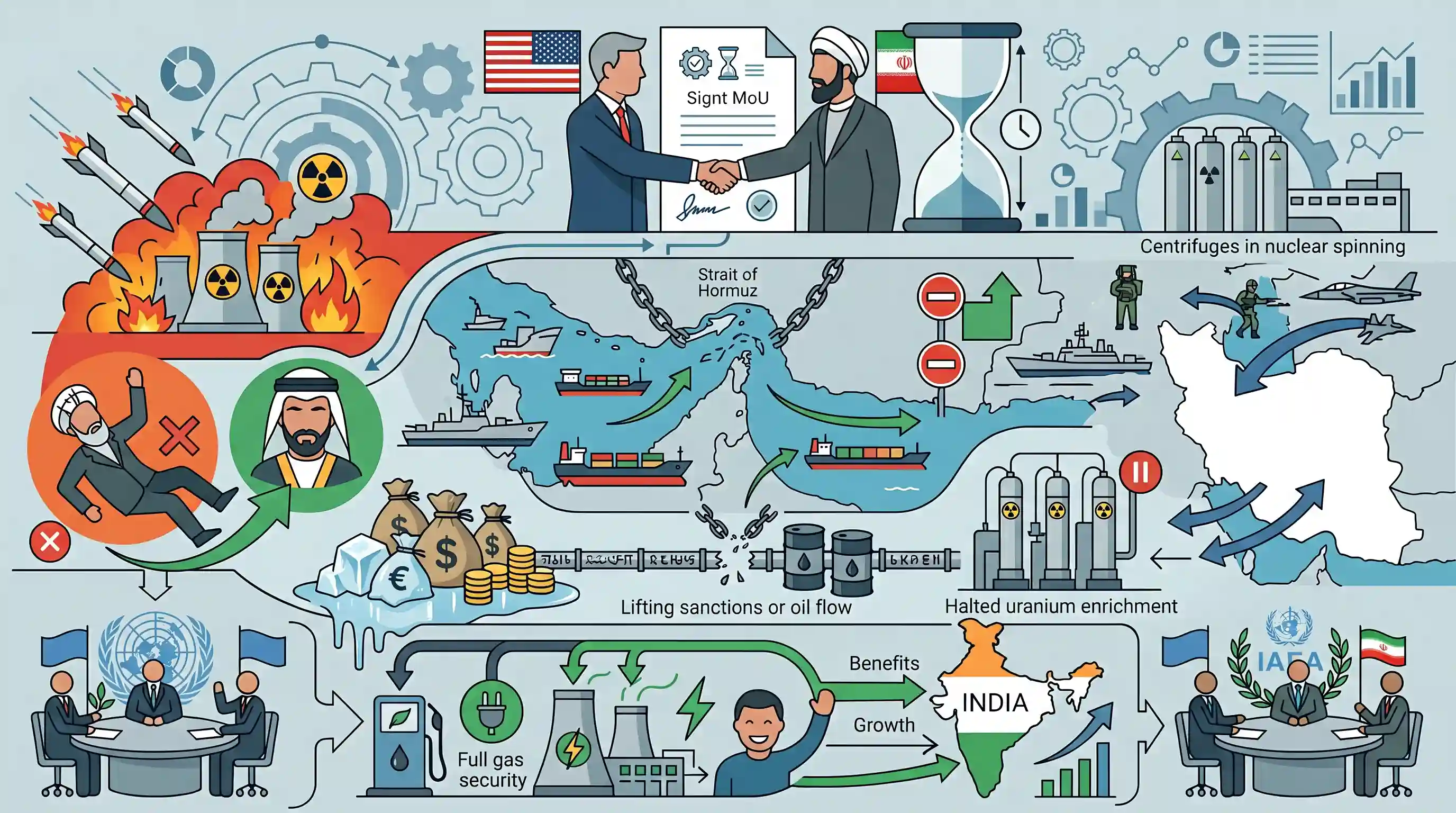
Why It Matters
The reopening of the Strait of Hormuz and the lifting of sanctions on Iranian oil are critical for global energy security and supply chain stability. For India, a stabilized Middle East and the potential resumption of oil imports from Iran offer significant economic relief and strategic advantages, making this a prime case study for GS-II (International Relations) and GS-III (Energy Security).
Summary
The United States and Iran have signed a Memorandum of Understanding (MoU) for a 60-day ceasefire, effectively deferring a comprehensive nuclear agreement (JCPOA) in favor of immediate geopolitical de-escalation. The deal focuses on reopening the Strait of Hormuz to commercial shipping and ending the US naval blockade on Iranian ports. Under the MoU, the US will waive crippling oil sanctions, release $24 billion in frozen Iranian assets, and initiate a US military pullback from regions surrounding Iran, while Iran halts further uranium enrichment. This diplomatic breakthrough follows intense regional conflict, including the destructive 'Operation Midnight Hammer' strikes on Iranian nuclear sites and the assassination of former Supreme Leader Ali Khamenei, leading to the rise of Mojtaba Khamenei.
Key Points
- The US and Iran signed an MoU establishing a 60-day ceasefire test period, deferring a comprehensive nuclear agreement to focus on immediate regional de-escalation.
- Iran agreed to reopen the strategically vital Strait of Hormuz to all commercial shipping, ending threats to global oil choke points.
- In exchange, the US Navy will lift its blockade of Iranian ports, and the US will waive strict oil sanctions, permitting Iranian oil to re-enter the global market.
- The deal unfreezes $24 billion in Iranian assets held by allies and introduces negotiations for a $300 billion reconstruction plan for Iran.
- The agreement follows severe military escalations, including 'Operation Midnight Hammer' which damaged Iranian nuclear facilities, and the transition of power to Supreme Leader Mojtaba Khamenei.
Important Terms
US-Iran Memorandum of Understanding (2026)

A 2026 diplomatic framework establishing a 60-day ceasefire, reopening the Strait of Hormuz to commercial shipping, and releasing $24 billion in frozen assets to de-escalate the US-Iran conflict.
UPSC context
GS Paper II: Effect of policies and politics of developed countries on India's interests; tests understanding of transitional diplomatic tools.
Joint Comprehensive Plan of Action (JCPOA)
The 2015 landmark nuclear agreement between Iran and the P5+1 aimed at restricting Iran's nuclear enrichment capabilities in exchange for international sanctions relief.
UPSC context
GS Paper II: Important International institutions and agreements; central to nuclear non-proliferation and West Asian stability.
Operation Midnight Hammer
A 2025 US military operation targeting Iranian nuclear facilities at Fordow, Natanz, and Isfahan using bunker-buster munitions to disable uranium enrichment infrastructure.
UPSC context
GS Paper III: Role of external state actors in regional security; tests knowledge of precision warfare and energy security risks.
Strait of Hormuz
The world's most critical maritime chokepoint between the Persian Gulf and Gulf of Oman, essential for global oil transit and Indian energy security.
UPSC context
GS Paper I: World Geography; GS Paper III: Infrastructure/Energy Security; vital for India's strategic petroleum reserves.
Mojtaba Khamenei
Appointed the third Supreme Leader of Iran in 2026 following the assassination of his father, Ali Khamenei; closely linked to the Revolutionary Guards.
UPSC context
GS Paper II: Political and constitutional structures of foreign countries; tests understanding of theocracy-to-dynasty transitions.
Assembly of Experts
The 88-member clerical body responsible for electing and supervising the Supreme Leader of Iran; instrumental in the 2026 leadership transition.
UPSC context
GS Paper II: International Relations; understanding internal political dynamics of key regional powers.
Prelims Trap
"The Strait of Hormuz is bordered by Iran to the north and the United Arab Emirates to the south."
The Strait of Hormuz is bordered by Iran to the north and Oman (specifically the Musandam Peninsula exclave) to the south, not the UAE. Classic UPSC map trap.
Static Concepts Connected
What is the geographical and strategic importance of the Strait of Hormuz?
- Connecting bodies: It serves as the critical maritime gateway linking the Persian Gulf to the Gulf of Oman and the broader Arabian Sea.
- Bordering nations: It is strategically bounded by Iran to the north and the Musandam Peninsula (an exclave of Oman) to the south.
- Oil transit: As the world's most critical energy chokepoint, it facilitates the transit of roughly 20% of global petroleum consumption.
How do US sanctions on Iran affect India's strategic autonomy?
- Energy Security: Sanctions historically forced India to halt cheap Iranian crude imports, increasing reliance on more expensive or volatile Middle Eastern and US suppliers.
- Chabahar & INSTC: Secondary sanctions create persistent diplomatic and financial hurdles for Indian investments in the Chabahar Port and the broader INSTC project.
- Financial sovereignty: The threat of exclusion from the US financial system (SWIFT) limits direct dollar transactions, necessitating complex and vulnerable barter or Rupee-Rial mechanisms.
Cross-Topic Patterns
INSTC revival vs IMEC corridor
A de-escalated Iran revitalizes the International North-South Transport Corridor (INSTC) via Chabahar port, offering India a viable strategic alternative while the US-backed IMEC route faces regional delays.
Sanctions and Rupee Internationalization
Resumption of Iranian oil imports will test whether India reverts to dollar payments or sustains the Rupee-Rial mechanism, directly linking energy security to the RBI's rupee internationalization agenda.

Expect a complex map-based question pairing Middle East chokepoints (Hormuz, Bab el-Mandeb) with recent conflict zones and regional ports.
Linked PYQs · 3
Linked PYQs · 3
- 2018MainsGS2
In what ways would the ongoing US-Iran Nuclear Pact Controversy affect the national interest of India? How should India respond to this situation?
- 2012MainsGS2
How have the US sanctions against Iran affected India's bilateral relations with Iran?
- 2024PrelimsGS1
Consider the following statements : Statement-I : Sumed pipeline is a strategic route for Persian Gulf oil and natural gas shipments to Europe. Statement-II : Sumed pipeline connects the Red Sea with the Mediterranean Sea. Which one of the following is correct in respect of the above statements?
