US-Iran memorandum of understanding and Middle East geopolitics
Source:Indian Express ↗
Why It Matters
The Middle East is paramount to India's energy security, diaspora welfare, and strategic connectivity. Shifts in US-Iran relations directly influence global oil prices, the feasibility of the Chabahar Port, and the International North-South Transport Corridor (INSTC), making it a high-yield topic for GS-2 International Relations.
Summary
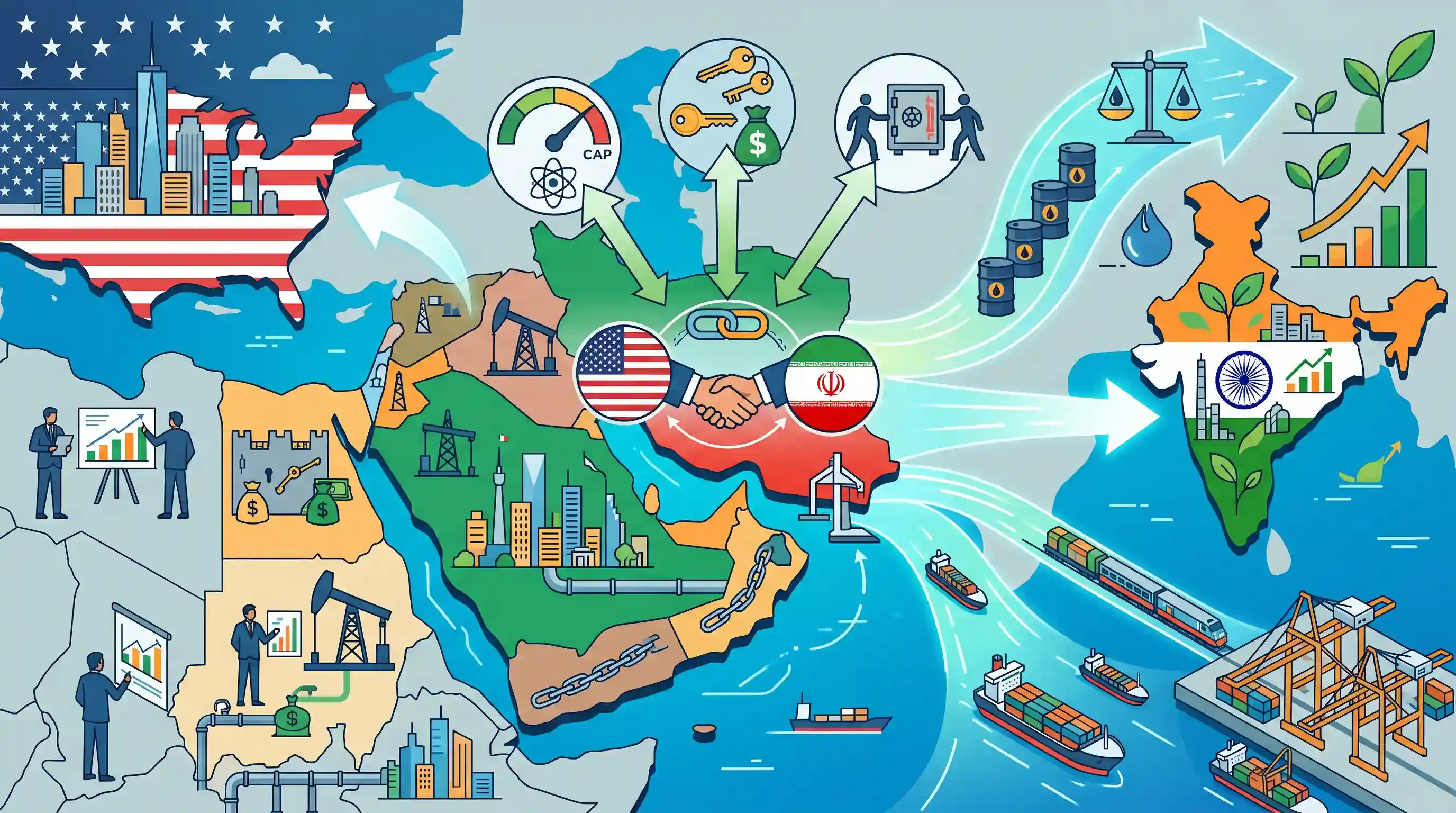
The article analyzes the geopolitical ramifications of a recent informal Memorandum of Understanding (MoU) between the United States and Iran. Focused on immediate de-escalation, capping nuclear enrichment, and unfreezing assets, this arrangement bypasses the complexities of a formal JCPOA revival. The diplomatic thaw significantly alters the Middle Eastern security landscape, affecting the strategic postures of Israel and Arab states. For India, reduced US-Iran hostility is highly beneficial, as it bolsters energy security, stabilizes global oil markets, and provides a more favorable environment for regional connectivity initiatives like the Chabahar port.
Key Points
- The US-Iran Memorandum of Understanding (MoU) represents an informal arrangement aimed at regional de-escalation rather than a formal return to the JCPOA.
- Key components of the understanding likely include capping Iran's nuclear enrichment levels, prisoner swaps, and the unfreezing of certain Iranian financial assets.
- The MoU shifts the geopolitical calculus in the Middle East, particularly for Israel and Arab nations that have recently sought to recalibrate their own ties with Tehran.
- For India, a reduction in US-Iran tensions enhances energy security and facilitates smoother progress on strategic connectivity projects like the Chabahar port.
Important Terms
JCPOA (Joint Comprehensive Plan of Action)

A 2015 landmark agreement between Iran and P5+1 nations to limit Iran's nuclear program in exchange for lifting international sanctions.
UPSC context
GS-II: International Relations. Essential for understanding non-proliferation, West Asian stability, and India’s energy-driven strategic interests.
Chabahar Port
A strategic Iranian deep-sea port in the Sistan-Baluchistan province, developed with Indian cooperation to provide a transit route to Afghanistan and Central Asia.
UPSC context
GS-II: India’s Interests/Regional Connectivity. A key pillar of India’s ‘Connect Central Asia’ policy and maritime strategy bypassing Pakistan.
Uranium Enrichment
The technical process of increasing the proportion of the U-235 isotope in uranium; low levels (3-5%) are for power, while 90%+ is weapons-grade.
UPSC context
GS-III: Science & Technology and GS-II: Non-proliferation. Frequently tested regarding nuclear energy and international safety regimes.
Strait of Hormuz
A vital maritime chokepoint between the Persian Gulf and the Gulf of Oman, through which approximately one-fifth of global oil consumption passes.
UPSC context
GS-I: Geography (World) and GS-II: IR. Critical for global energy security and India’s crude oil supply chain.
Energy Security
The uninterrupted availability of energy sources at an affordable price, particularly critical for India due to its 85% dependence on crude oil imports.
UPSC context
GS-III: Economic Development/Infrastructure. Central to India’s fiscal health, inflation control, and sustainable development goals.
International Atomic Energy Agency (IAEA)
The world's central intergovernmental forum for scientific and technical cooperation in the nuclear field, serving as the UN-affiliated nuclear watchdog.
UPSC context
GS-II: International Institutions. Key for questions on global governance and verification of nuclear non-proliferation treaties.
Prelims Trap
The recent MoU marks the formal US reentry into the JCPOA and lifts all secondary sanctions on Iran.
It is an informal, unwritten 'mini-agreement' aimed at immediate de-escalation and unfreezing specific assets, not a legally binding formal JCPOA revival.
Static Concepts Connected
What is India's strategic rationale for developing the Chabahar Port?
- Bypassing Pakistan: Provides a direct sea-road-rail gateway to landlocked Afghanistan and Central Asia, entirely circumventing Pakistan.
- INSTC Gateway: Serves as a critical southern node for the 7,200-km International North-South Transport Corridor (INSTC) to Russia and Europe.
- Counter-balancing China: Offsets the strategic depth of China's Belt and Road Initiative (BRI) and its development of the nearby Gwadar port.
What are the standard grades of Uranium enrichment?
- Low-Enriched (LEU): U-235 concentration below 20% (typically 3-5%), used primarily for commercial light-water power reactors.
- Highly-Enriched (HEU): U-235 concentration above 20%, often used in research reactors. Iran capping at 60% falls here (close to weapons-grade).
- Weapons-Grade: U-235 concentration of 90% or higher, which is the threshold required to manufacture nuclear weapons.
Cross-Topic Patterns
Chabahar and the Ashgabat Agreement
Developing Chabahar directly integrates with India’s 2018 accession to the Ashgabat Agreement, forming a cohesive multimodal transport strategy across the Persian Gulf and Central Asia.
Rise of informal diplomacy over treaties
The US bypassing a formal JCPOA revival for an informal 'understanding' reflects a broader global shift towards flexible, non-binding agreements to avoid domestic legislative blockades.

A map-based Prelims question combining Chabahar, INSTC nodes, and the Ashgabat Agreement with Iran's borders is highly probable in 2026.
Linked PYQs · 2
Linked PYQs · 2
- 2025MainsGS2
"Energy security constitutes the dominant kingpin of India's foreign policy, and is linked with India's overarching influence in Middle Eastern countries.” How would you integrate energy security with India's foreign policy trajectories in the coming years?
- 2022PrelimsGS1
The term "Levant" often heard in the news roughly corresponds to which of the following regions?
