US Iran informal nuclear understanding and West Asian security
Source:Indian Express ↗
Why It Matters
The shift from the formal JCPOA to informal understandings illustrates the evolving nature of global nuclear diplomacy. Furthermore, stability in the Strait of Hormuz is paramount for India's energy security, and Iran's growing influence alongside non-Western alliances significantly alters the geopolitical balance in West Asia.
Summary
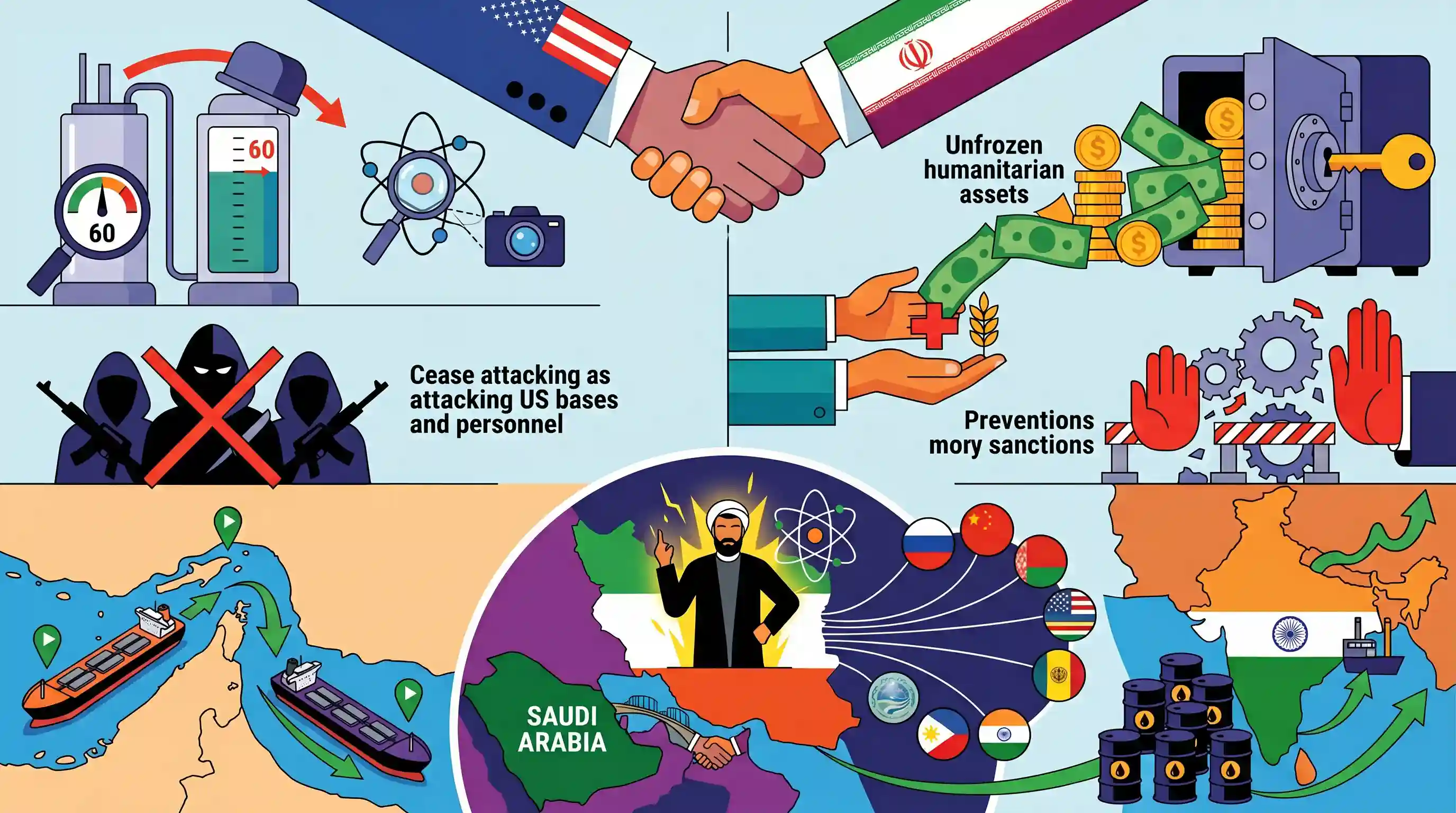
The United States and Iran have reached an informal, unwritten understanding to de-escalate tensions and manage Iran's nuclear program. Under this 'mini-agreement', Iran has committed to capping its uranium enrichment at 60%, cooperating with IAEA monitors, halting proxy attacks on US forces in the Middle East, and ensuring the safe passage of maritime traffic through the vital Strait of Hormuz. In return, the US has agreed to unfreeze billions in Iranian assets for humanitarian purposes and to hold off on new sanctions. Geopolitical experts suggest that despite years of 'maximum pressure' sanctions, Iran is currently in its strongest strategic position in years. It has advanced to nuclear threshold status, normalized relations with Saudi Arabia, and successfully integrated into multipolar frameworks like BRICS and the SCO by deepening ties with Russia and China. This de-escalation is significant for global energy markets and benefits India's strategic and energy interests in the region.
Key Points
- The US and Iran have opted for an informal de-escalation MoU (a 'mini-agreement') rather than a formal revival of the 2015 JCPOA to manage nuclear and regional tensions.
- Iran has agreed to cap uranium enrichment at 60%, increase cooperation with IAEA inspectors, and restrain its proxy groups from attacking US forces in Iraq and Syria.
- The understanding includes Iranian commitments to stop harassing foreign oil tankers in the Strait of Hormuz, a critical chokepoint for global energy transit.
- In exchange, the US has permitted the unfreezing of billions in Iranian assets held abroad for humanitarian use and refrained from pursuing new punitive sanctions.
- Experts note Iran is in its strongest geopolitical position in years, having achieved nuclear threshold status while countering US isolation through BRICS and SCO membership, strengthened ties with Russia and China, and a diplomatic normalization with Saudi Arabia.
- For India, de-escalation between Washington and Tehran provides relief regarding energy security, eases diplomatic balancing, and facilitates smoother operations for the Chabahar port project.
Important Terms
Joint Comprehensive Plan of Action (JCPOA)

A 2015 multilateral agreement between Iran and the P5+1 powers (US, UK, France, Russia, China, and Germany) aimed at limiting Iran's nuclear program in exchange for economic sanctions relief.
UPSC context
GS Paper II (International Relations). Crucial for understanding West Asia stability, nuclear non-proliferation, and the impact of US withdrawal on global diplomacy.
US-Iran informal understanding
A recent unwritten de-escalation framework where Iran limits uranium enrichment (e.g., to 60%) and halts proxy attacks, while the US unfreezes Iranian assets for humanitarian use without formal treaty obligations.
UPSC context
GS Paper II. Tests knowledge of 'back-channel' diplomacy and interim measures to manage regional security when formal agreements like JCPOA are stalled.
International Atomic Energy Agency (IAEA)
The UN's nuclear watchdog responsible for verifying that Iran's nuclear activities remain peaceful through inspections and monitoring under the Non-Proliferation Treaty (NPT) and specific agreements.
UPSC context
GS Paper II (International Institutions). Tests understanding of global governance bodies and their role in verifying sovereign compliance with international security standards.
BRICS
An intergovernmental organization (Brazil, Russia, India, China, South Africa) that Iran officially joined in 2024, representing a shift toward a multipolar world and reducing Western economic dominance.
UPSC context
GS Paper II. Important for India's role in South-South cooperation and the 'Look East' shift in West Asian foreign policies.
Shanghai Cooperation Organisation (SCO)
A Eurasian political, economic, and security alliance which Iran joined as a full member in 2023, focusing on regional security, counter-terrorism, and connectivity projects like the INSTC.
UPSC context
GS Paper II. Vital for India-Iran relations, the Chabahar Port's strategic utility, and balancing relations within a major regional security bloc.
Strait of Hormuz
A critical global chokepoint between the Persian Gulf and the Gulf of Oman through which approximately 20% of the world's petroleum liquids pass; central to regional security negotiations.
UPSC context
GS Paper I (Geography) and GS Paper II (Energy Security). Tests knowledge of global trade chokepoints and their impact on India's crude oil supply.
Prelims Trap
The new US-Iran deal officially revives the JCPOA and mandates a complete halt to Iran's uranium enrichment.
It is an informal, unwritten understanding ('mini-agreement'), not a formal JCPOA revival. Furthermore, Iran agreed to cap enrichment at 60%, not halt it entirely.
Static Concepts Connected
What is the significance of 60% uranium enrichment under IAEA monitoring?
- LEU vs HEU: Low Enriched Uranium (LEU) is enriched below 20% U-235 (used for power). Highly Enriched Uranium (HEU) is 20% and above.
- Weapons-grade: Uranium enriched to 90% or above is strictly considered weapons-grade material for nuclear warheads.
- Threshold status: Reaching 60% means the technical time and effort required to bridge the remaining gap to 90% weapons-grade is drastically shortened, achieving 'breakout' capability.
Why is the Strait of Hormuz critical for global energy security?
- Geographic location: It is a narrow maritime passage linking the Persian Gulf to the Gulf of Oman and the broader Arabian Sea.
- Bordering states: It separates Iran on the northern coast from the United Arab Emirates (UAE) and the Musandam Peninsula of Oman to the south.
- Trade chokepoint: It facilitates the transit of roughly one-fifth of total global oil consumption, making it one of the world's most vital energy chokepoints.
Cross-Topic Patterns
De-escalation de-risks INSTC and Chabahar
Reduced US-Iran friction directly secures India’s investments in the Chabahar port and the International North-South Transport Corridor, crucial for bypassing Pakistan to reach Central Asia.
Multilateral frameworks as sanctions shields
Iran’s entry into BRICS and SCO highlights a growing trend: sanctioned nations utilizing non-Western groupings to circumvent US financial isolation and build strategic depth.

Expect a multi-statement Prelims question mixing IAEA enrichment limits, Strait of Hormuz mapping, and Iran's SCO/BRICS memberships.
Linked PYQs · 5
Linked PYQs · 5
- 2018MainsGS2
In what ways would the ongoing US-Iran Nuclear Pact Controversy affect the national interest of India? How should India respond to this situation?
- 2012MainsGS2
How have the US sanctions against Iran affected India's bilateral relations with Iran?
- 2024PrelimsGS1
Consider the following statements : Statement-I : Sumed pipeline is a strategic route for Persian Gulf oil and natural gas shipments to Europe. Statement-II : Sumed pipeline connects the Red Sea with the Mediterranean Sea. Which one of the following is correct in respect of the above statements?
- 2017MainsGS2
The question of India's Energy Security constitutes the most important part of India's economic progress. Analyze India's energy policy cooperation with West Asian countries.
- 2025MainsGS2
"Energy security constitutes the dominant kingpin of India's foreign policy, and is linked with India's overarching influence in Middle Eastern countries.” How would you integrate energy security with India's foreign policy trajectories in the coming years?
