US and Iran Military Escalation Threatens West Asia Stability
Source:The Hindu ↗
આ શા માટે મહત્વનું છે
The escalation of the US-Iran conflict around the Strait of Hormuz directly threatens India's energy security and macroeconomic stability due to rising oil prices. Furthermore, the physical damage to infrastructure near Chabahar Port risks India's strategic connectivity to Central Asia and Afghanistan, while intensifying dangers for Indian seafarers in global shipping lanes.
સારાંશ
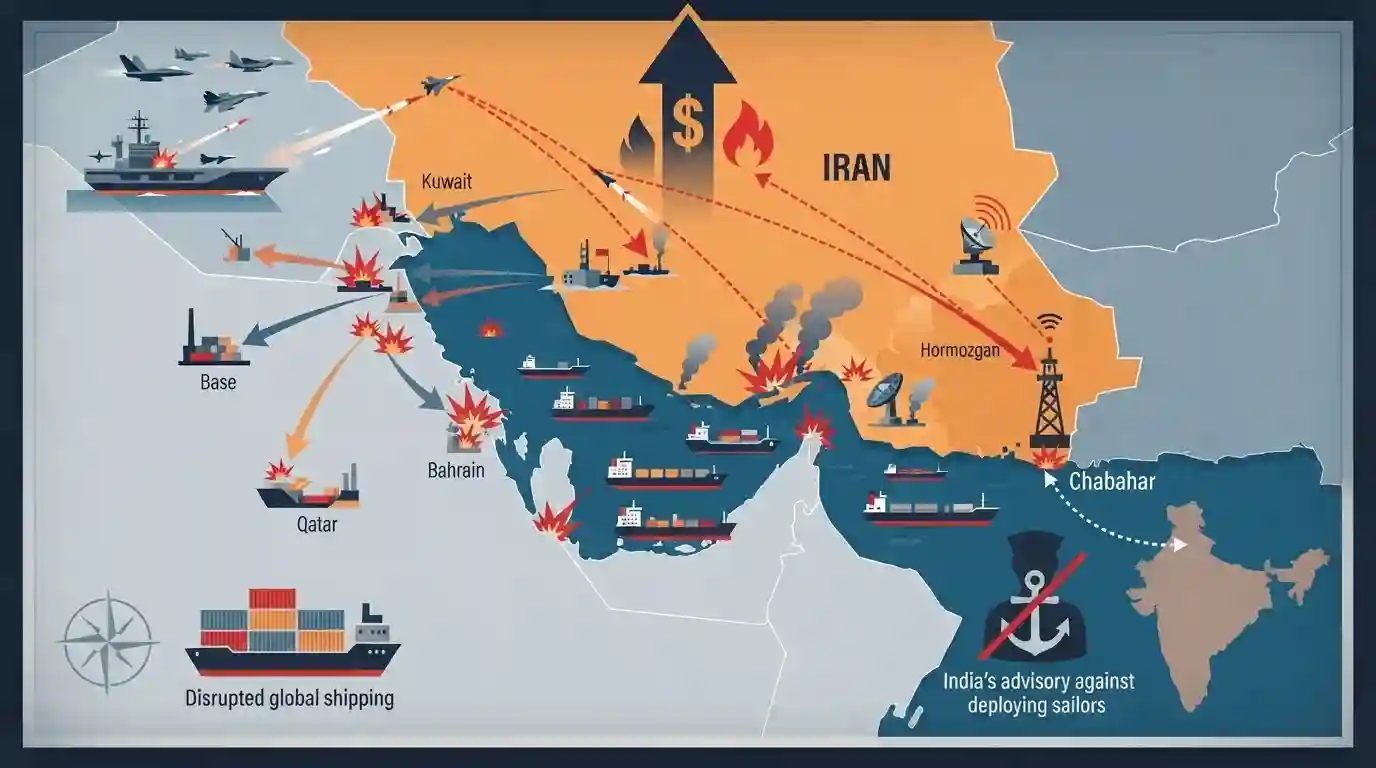
The US and Iran have drastically escalated military strikes across West Asia following the collapse of a ceasefire, primarily contesting control over the strategic Strait of Hormuz. US CENTCOM conducted widespread strikes on Iranian logistics and maritime surveillance infrastructure, including locations in Hormozgan and a surveillance tower at the India-operated Chabahar port. Iran retaliated with strikes on US-allied assets in Kuwait, Qatar, Bahrain, and northern Iraq. The conflict has severely disrupted global shipping, spiked crude oil prices, and threatened India's strategic connectivity to Central Asia via Chabahar. In response to the growing maritime threat, India has issued advisories against deploying its sailors in the Strait of Hormuz.
મુખ્ય મુદ્દા
- Military confrontation between the US and Iran has severely escalated following the collapse of a ceasefire, with strikes focused on securing or disrupting the Strait of Hormuz.
- US CENTCOM targeted Iranian logistics and maritime surveillance networks, collapsing a tower at the India-operated Chabahar port in the Gulf of Oman.
- Iran retaliated by striking assets in US-allied nations, including Kuwait (water desalination plant), Qatar, Bahrain, and Kurdish regions of northern Iraq.
- Global shipping through the Strait of Hormuz has plunged to a three-week low, causing global crude oil prices to surge above $86 a barrel.
- The conflict poses direct strategic threats to India by endangering its Central Asia connectivity via Chabahar and prompting DG Shipping to advise against deploying Indian sailors in the affected maritime chokepoints.
મહત્વપૂર્ણ શબ્દો
U.S. Central Command (CENTCOM)

A unified combatant command of the U.S. Department of Defense responsible for military operations and security cooperation across the Middle East, Central Asia, and parts of South Asia.
UPSC context
Relevant for GS Paper 2 (International Relations). Tests knowledge of US military presence in West Asia and regional security dynamics.
Islamic Revolutionary Guard Corps (IRGC)
Iran's primary, multi-branch military force established after the 1979 Islamic Revolution. It operates independently of the regular army to protect the theocratic system and supports allied militias across West Asia.
UPSC context
Important for GS Paper 2 (International Relations). Tests understanding of Middle East geopolitics, proxy warfare, and Iran's strategic military network.
Directorate General of Shipping
The apex maritime authority under India's Ministry of Ports, Shipping and Waterways. It implements national shipping policies, ensures vessel safety, regulates seafarer welfare, and enforces international maritime conventions.
UPSC context
Useful for GS Paper 2 (Statutory Bodies) and GS Paper 3 (Infrastructure). Highlights India's maritime administrative and regulatory framework.
Komala Group
An exiled, social-democratic Iranian Kurdish opposition group based in northern Iraq. It seeks Kurdish autonomy in Iran and has been frequently targeted by Iranian cross-border military strikes.
UPSC context
Relevant for Prelims (Places/Groups in News) and GS Paper 2 (IR). Tests awareness of sub-national conflicts and West Asian geopolitics.
Strait of Hormuz
A critical, narrow maritime chokepoint between Iran and the Musandam Peninsula (Oman). It connects the Persian Gulf to the Gulf of Oman, handling roughly 20% of the world's daily oil supply.
UPSC context
Highly relevant for Prelims mapping and GS Paper 2 (Energy Security). Tests knowledge of global trade routes and chokepoints.
Chabahar Port
A strategic deep-water seaport in southeastern Iran along the Gulf of Oman. Jointly developed with India, it bypasses Pakistan to provide direct trade and transit connectivity to Afghanistan and Central Asia.
UPSC context
Crucial for GS Paper 2 (IR). Tests India's strategic connectivity projects (INSTC), Act West policy, and regional geopolitical countermeasures.
પ્રિલિમ્સ ટ્રેપ
Chabahar port is located inside the Persian Gulf and requires transit through the Strait of Hormuz.
Chabahar is strategically located on the Gulf of Oman, deliberately outside the Persian Gulf, allowing India to bypass the volatile Strait of Hormuz chokepoint.
સંલગ્ન સ્થિર ખ્યાલો
Which countries border the strategic Strait of Hormuz?
- Iran: Forms the entire northern and eastern coastline of the strait.
- Oman: Forms the southern coastline via its Musandam Peninsula exclave, creating the narrowest point of the transit corridor.
- UAE (Misconception): While situated very close to the strait, the UAE does not form the immediate coastline of the narrowest chokepoint.
What is Chabahar's role in the International North-South Transport Corridor (INSTC)?
- Multimodal Network: A 7,200-km multi-mode (ship, rail, road) freight route connecting India, Iran, Azerbaijan, and Russia to bypass the Suez Canal.
- Bypassing Pakistan: Situated on the Gulf of Oman, it provides India a direct sea-land route to Afghanistan and Central Asia, entirely bypassing Pakistan.
- Strategic Operator: India Ports Global Limited (IPGL) operates the Shahid Beheshti terminal here, recently securing a 10-year operational agreement.
આંતર-વિષય પેટર્ન
Hormuz chokepoint & imported inflation
Disruption in the Strait of Hormuz directly threatens India's current account deficit and drives imported inflation, given 50% of India's crude and 60% of LNG transits here.
Maritime security & diaspora protection
DG Shipping's advisory highlights the recurring UPSC theme of securing maritime commerce and protecting Indian nationals in conflict zones, echoing past evacuation mandates.

Expect map-based pairs linking West Asian ports (Chabahar, Bandar Abbas, Duqm) to their respective gulfs (Oman vs. Persian) in 2026.
સંલગ્ન PYQ · 5
સંલગ્ન PYQ · 5
- 2026PrelimsGS1
Ships from which of the following countries have to cross the Strait of Hormuz to reach out to the Indian Ocean ? 1. Bahrain 2. Syria 3. Qatar 4. Egypt Select the answer using the code given below :
- 2025MainsGS3
Why is maritime security vital to protect India's sea trade? Discuss maritime and coastal security challenges and the way forward.
- 2025MainsGS2
"Energy security constitutes the dominant kingpin of India's foreign policy, and is linked with India's overarching influence in Middle Eastern countries.” How would you integrate energy security with India's foreign policy trajectories in the coming years?
- 2018MainsGS2
A number of outside powers have entrenched themselves in Central Asia, which is a zone of interest to India. Discuss the implications, in this context, of India's joining the Ashgabat Agreement, 2018.
- 2018MainsGS2
In what ways would the ongoing US-Iran Nuclear Pact Controversy affect the national interest of India? How should India respond to this situation?
