US and Iran diplomatic engagement and regional security framework
Source:Indian Express ↗
Why It Matters
Understanding US-Iran dynamics is crucial for UPSC aspirants as it directly impacts Middle East stability, global energy security (oil prices), and India's strategic interests (Chabahar port, energy imports, and diaspora in the Gulf).
Summary
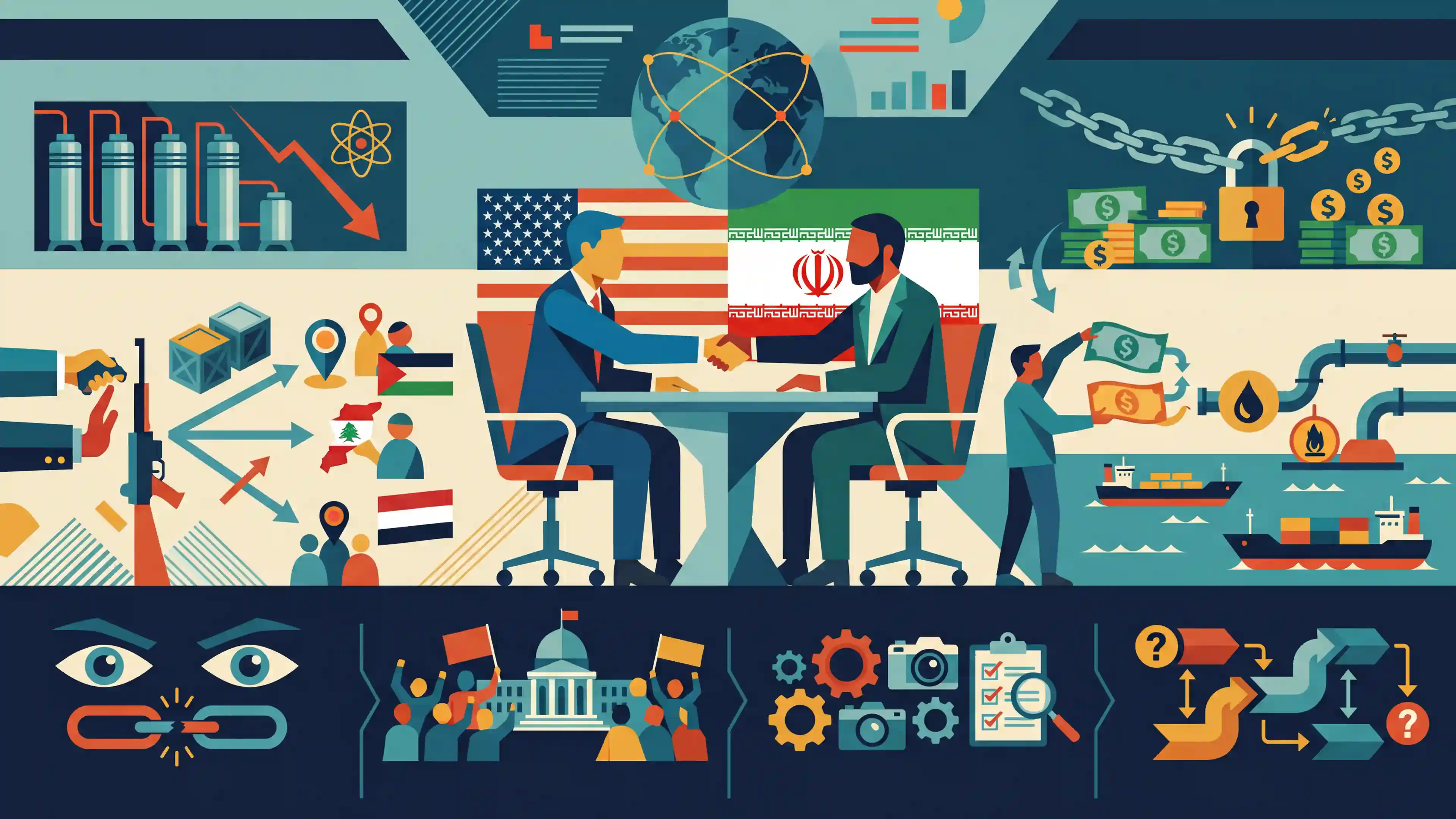
The article examines the prospects of a diplomatic "grand bargain" between the United States and Iran. Departing from the narrow scope of the 2015 JCPOA, this comprehensive settlement aims to address both Iran's nuclear ambitions and its regional geopolitical posture. The deal would require Iran to rollback nuclear enrichment and curtail support for non-state actors in the Middle East (including in Gaza, Lebanon, and Yemen) in exchange for the US lifting sanctions and allowing Iran's return to global energy and financial markets. However, the path to such a deal is fraught with challenges, including deep-seated mistrust, domestic political resistance, and the complex logistics of verifying regional behavioral changes and sequencing compliance.
Key Points
- The US and Iran are exploring a comprehensive "grand bargain" under the Trump administration, moving beyond the narrow focus of the 2015 JCPOA.
- The proposed settlement involves Iran accepting strict limits on its nuclear program (capping enrichment, tighter inspections) and reducing support for regional non-state armed groups.
- In exchange, the US would dismantle economic sanctions, unfreeze financial assets, and reintegrate Iran into global energy markets and financial networks.
- Significant challenges to the deal include deep mutual mistrust, domestic opposition in both countries, the difficulty of verifying Iran's reduced support for proxies, and the sequencing of sanctions relief.
Important Terms
JCPOA (Joint Comprehensive Plan of Action)

A 2015 landmark agreement between Iran and the P5+1 (plus EU) to limit Iran's nuclear program in exchange for lifting international sanctions.
UPSC context
GS II (International Relations); tests knowledge of global nuclear non-proliferation and India's strategic interests like Chabahar.
Grand Bargain
A proposed comprehensive diplomatic settlement between the US and Iran addressing nuclear issues, regional proxy activities, and missiles in exchange for full economic normalization.
UPSC context
GS II (International Relations); tests understanding of evolving diplomatic strategies and regional stability in West Asia.
Non-State Actors (Proxies)
Armed groups (e.g., Hezbollah, Houthis) that operate independently of a state but often receive external support to project regional influence.
UPSC context
GS II & III (IR & Internal Security); tests knowledge of asymmetric warfare and regional power dynamics.
Energy Security
The uninterrupted availability of energy sources at an affordable price, crucial for India due to high dependence on Middle Eastern oil and gas.
UPSC context
GS III (Economy); tests understanding of how West Asian instability impacts India’s inflation and trade deficit.
Economic Sanctions
Commercial and financial penalties applied by countries or international organizations against states to influence their behavior or policy.
UPSC context
GS II (IR); tests knowledge of coercive diplomacy and its extraterritorial impact on India's bilateral trade.
West Asia Geopolitics
The complex interplay of political, religious, and economic interests in the Middle East, involving regional powers like Iran, Israel, and Saudi Arabia.
UPSC context
GS II (IR); core syllabus area testing India’s 'Link West' policy and regional balancing.
Prelims Trap
"The 2015 JCPOA framework restricted Iran's nuclear enrichment and mandated the dismantling of its regional proxy networks."
The original 2015 JCPOA was strictly limited to capping nuclear enrichment. It deliberately excluded Iran's ballistic missile program and its regional proxy networks.
Static Concepts Connected
What are the geographical anchors of Iran's 'Axis of Resistance'?
- Levant Region: Hezbollah operates in Lebanon, while Hamas and Palestinian Islamic Jihad (PIJ) operate in Gaza and the West Bank.
- Red Sea/Gulf: The Houthis operate from Yemen, controlling key maritime choke points near the Bab-el-Mandeb strait and Red Sea.
- Mesopotamia: Various Shia militia groups, such as the Popular Mobilization Forces (PMF), operate within Iraq and Syria.
How do US 'secondary sanctions' impact Indian strategic interests?
- Extraterritorial reach: They penalize non-US entities (like Indian banks) for doing business with sanctioned countries by cutting them off from the US financial system and US dollar transactions.
- Energy disruption: India was forced to completely halt Iranian crude imports in 2019 after US waivers expired, disrupting its energy import diversification strategy.
- Connectivity bottlenecks: Despite narrow waivers, secondary sanctions create persistent financial hurdles for heavy equipment procurement at India's Chabahar port terminal.
Cross-Topic Patterns
Sanctions relief + INSTC viability
A US-Iran grand bargain would remove banking bottlenecks at Chabahar port, rapidly accelerating India's International North-South Transport Corridor (INSTC) access to Central Asia and bypassing Pakistan.
Energy Security + Import Diversification
Reintegrating Iran into global energy markets would allow India to resume cheap crude imports, reducing its current heavy reliance on Russian and Iraqi oil while stabilizing domestic inflation.

Expect a 2026 Prelims question mapping the 'Axis of Resistance' groups (Houthis, Hezbollah) to their respective operating countries.
Linked PYQs · 4
Linked PYQs · 4
- 2018MainsGS2
In what ways would the ongoing US-Iran Nuclear Pact Controversy affect the national interest of India? How should India respond to this situation?
- 2012MainsGS2
How have the US sanctions against Iran affected India's bilateral relations with Iran?
- 2025MainsGS2
"Energy security constitutes the dominant kingpin of India's foreign policy, and is linked with India's overarching influence in Middle Eastern countries.” How would you integrate energy security with India's foreign policy trajectories in the coming years?
- 2022PrelimsGS1
The term "Levant" often heard in the news roughly corresponds to which of the following regions?
