US Iran Conflict Escalation Threatens Global Oil Supply and Prices
Source:Indian Express ↗
Why It Matters
The disruption of the Strait of Hormuz directly threatens India's energy security and macroeconomic stability. It demonstrates the geopolitical vulnerability of oil-importing nations and underlines the importance of diversifying energy sources, securing sea lines of communication, and maintaining balanced foreign policy ties in West Asia.
Summary
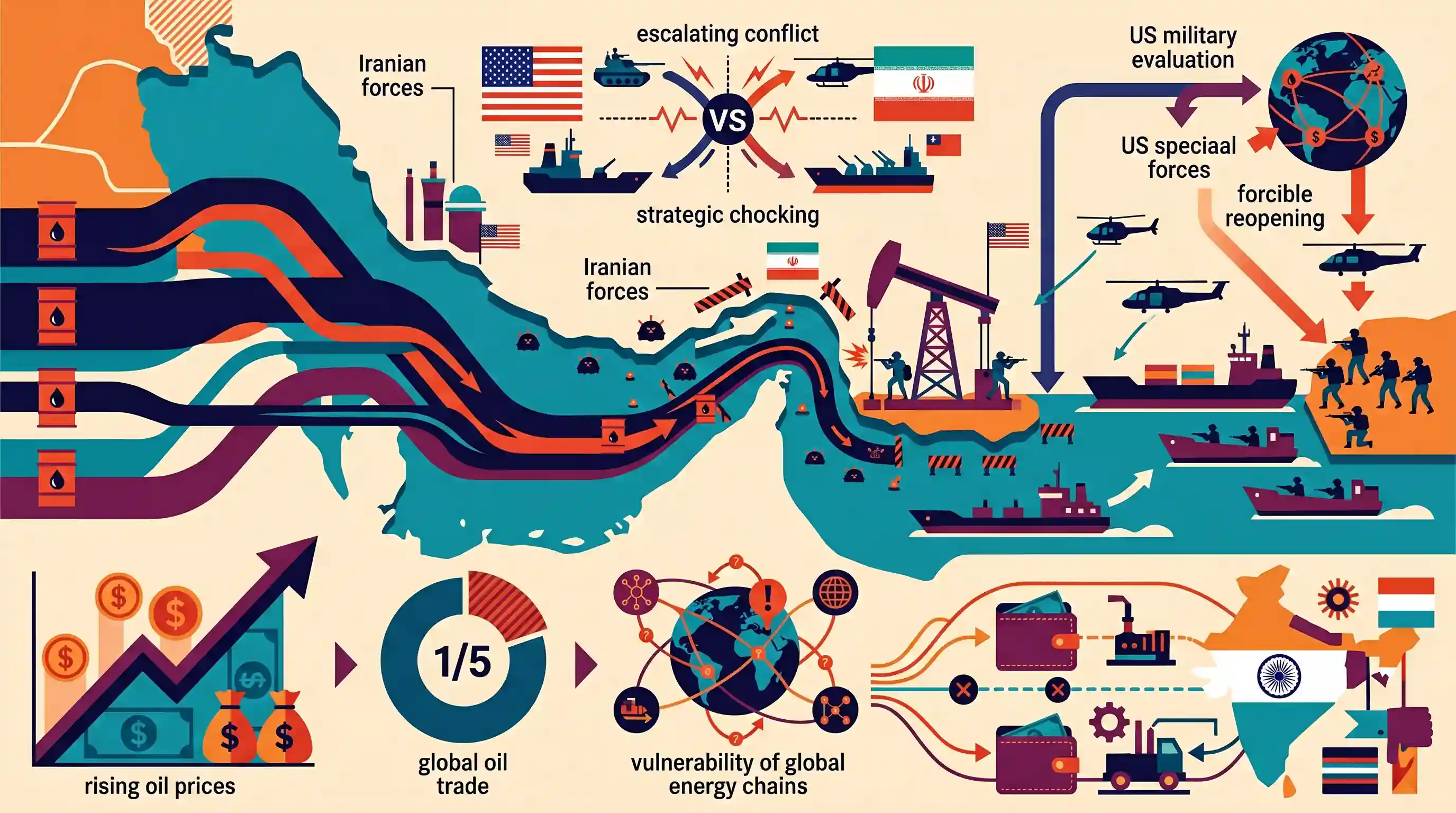
The escalating US-Iran conflict has brought the strategic Strait of Hormuz into sharp focus, as the US military evaluates options to forcibly reopen the waterway if Iran moves to block it. With one-fifth of global oil trade passing through the Strait, threats to its security have already driven oil prices to surge past $115 a barrel. US military strategies could involve deploying thousands of additional troops and potentially seizing Kharg Island, Iran's primary oil export hub in the Persian Gulf. The geopolitical standoff underscores the vulnerability of global energy supply chains and the severe economic repercussions a disruption would cause for major oil importers like India.
Key Points
- The Strait of Hormuz serves as the world's most critical chokepoint for energy trade, facilitating the passage of one-fifth of global oil consumption.
- Escalating tensions between the US and Iran have raised fears that Iran might blockade the Strait, causing oil prices to spike above $115 a barrel.
- The US has stationed over 50,000 troops in the Middle East and is deploying additional forces to deter Iranian aggression and secure maritime routes.
- To forcibly reopen the Strait, US military contingency plans may include capturing Kharg Island, a pivotal node for Iran's oil exports in the Persian Gulf.
- A prolonged blockade or military conflict in the Persian Gulf poses a severe threat to global energy security, profoundly impacting heavily import-dependent nations like India through inflation and widening current account deficits.
Important Terms
Strait of Hormuz

A 33km-wide waterway between Iran and Oman connecting the Persian Gulf to the Gulf of Oman; it handles 20-30% of global oil trade.
UPSC context
GS Paper 2 (International Relations) and GS Paper 3 (Energy Security); critical for India's 80% oil/LPG import dependency.
Kharg Island
Iran's primary oil export hub in the northern Persian Gulf, handling nearly 90-95% of the country’s seaborne crude exports and serving as a key economic lifeline.
UPSC context
GS Paper 3 (Geography/Economy); strategic vulnerability and potential target in West Asian geopolitical conflicts.
Strategic Chokepoints
A narrow maritime passage (strait or canal) through which large volumes of international shipping and energy supplies pass, essential for global trade.
UPSC context
GS Paper 1 (Geography) and GS Paper 2 (International Relations); tests understanding of global supply chain vulnerabilities.
Energy Security
The uninterrupted availability of energy sources at an affordable price, ensuring economic stability and industrial growth for energy-dependent nations.
UPSC context
GS Paper 3 (Economy/Infrastructure); central to India's development agenda and strategic petroleum reserves.
Maritime Security
The protection of maritime domains from threats like piracy, blockades, and interstate conflict to ensure freedom of navigation and trade.
UPSC context
GS Paper 3 (Security) and GS Paper 2 (IR); includes initiatives like India's SAGAR and MAHASAGAR.
US Fifth Fleet
A division of the U.S. Navy based in Bahrain, responsible for maritime security and protecting oil transit lanes in the Persian Gulf and Arabian Sea.
UPSC context
GS Paper 2 (International Relations); represents the permanent U.S. military footprint in West Asia's power balance.
Prelims Trap
The Strait of Hormuz is a strategic chokepoint bordered exclusively by Iran and the United Arab Emirates.
The Strait of Hormuz is actually bordered by Iran to the north and Oman (specifically the Musandam Peninsula exclave) to the south, not the UAE.
Static Concepts Connected
What are the key maritime chokepoints in West Asia and their connecting water bodies?
- Strait of Hormuz: Connects the Persian Gulf to the Gulf of Oman and the Arabian Sea. Bordered by Iran and Oman.
- Bab el-Mandeb: Connects the Red Sea to the Gulf of Aden and the Arabian Sea. Bordered by Yemen, Djibouti, and Eritrea.
- Suez Canal: Artificial waterway in Egypt connecting the Mediterranean Sea to the Red Sea, enabling direct Europe-Asia shipping.
How does a crude oil price shock impact India's macroeconomic indicators?
- CAD Widening: A higher import bill for crude oil directly widens the trade deficit and subsequently the Current Account Deficit (CAD).
- Imported Inflation: Increased fuel and freight costs cascade across sectors, resulting in broad-based cost-push inflation in the domestic economy.
- Currency Depreciation: Higher dollar demand from oil importers puts downward pressure on the Indian Rupee, leading to currency depreciation.
Cross-Topic Patterns
Strait disruptions & India's SPR
Supply chain threats in the Persian Gulf directly validate India's expansion of its Strategic Petroleum Reserves (ISPRL caverns at Mangalore, Padur, Visakhapatnam, Chandikhol) to buffer against global supply shocks.
Bypassing the Gulf via Chabahar
While Hormuz remains critical for oil, India's investment in Chabahar port (located on the Gulf of Oman, outside the Persian Gulf) serves as a strategic hedge to access Central Asia avoiding the chokepoint.

Expect a pairs-matching Prelims question in 2026 linking West Asian islands and chokepoints (Kharg, Hormuz, Musandam) to bordering seas.
Linked PYQs · 3
Linked PYQs · 3
- 2025MainsGS2
"Energy security constitutes the dominant kingpin of India's foreign policy, and is linked with India's overarching influence in Middle Eastern countries.” How would you integrate energy security with India's foreign policy trajectories in the coming years?
- 2017MainsGS2
The question of India's Energy Security constitutes the most important part of India's economic progress. Analyze India's energy policy cooperation with West Asian countries.
- 2024PrelimsGS1
Consider the following statements : Statement-I : Sumed pipeline is a strategic route for Persian Gulf oil and natural gas shipments to Europe. Statement-II : Sumed pipeline connects the Red Sea with the Mediterranean Sea. Which one of the following is correct in respect of the above statements?
