US Iran ceasefire faces collapse amid escalating Middle East conflict
Source:The Hindu ↗
Why It Matters
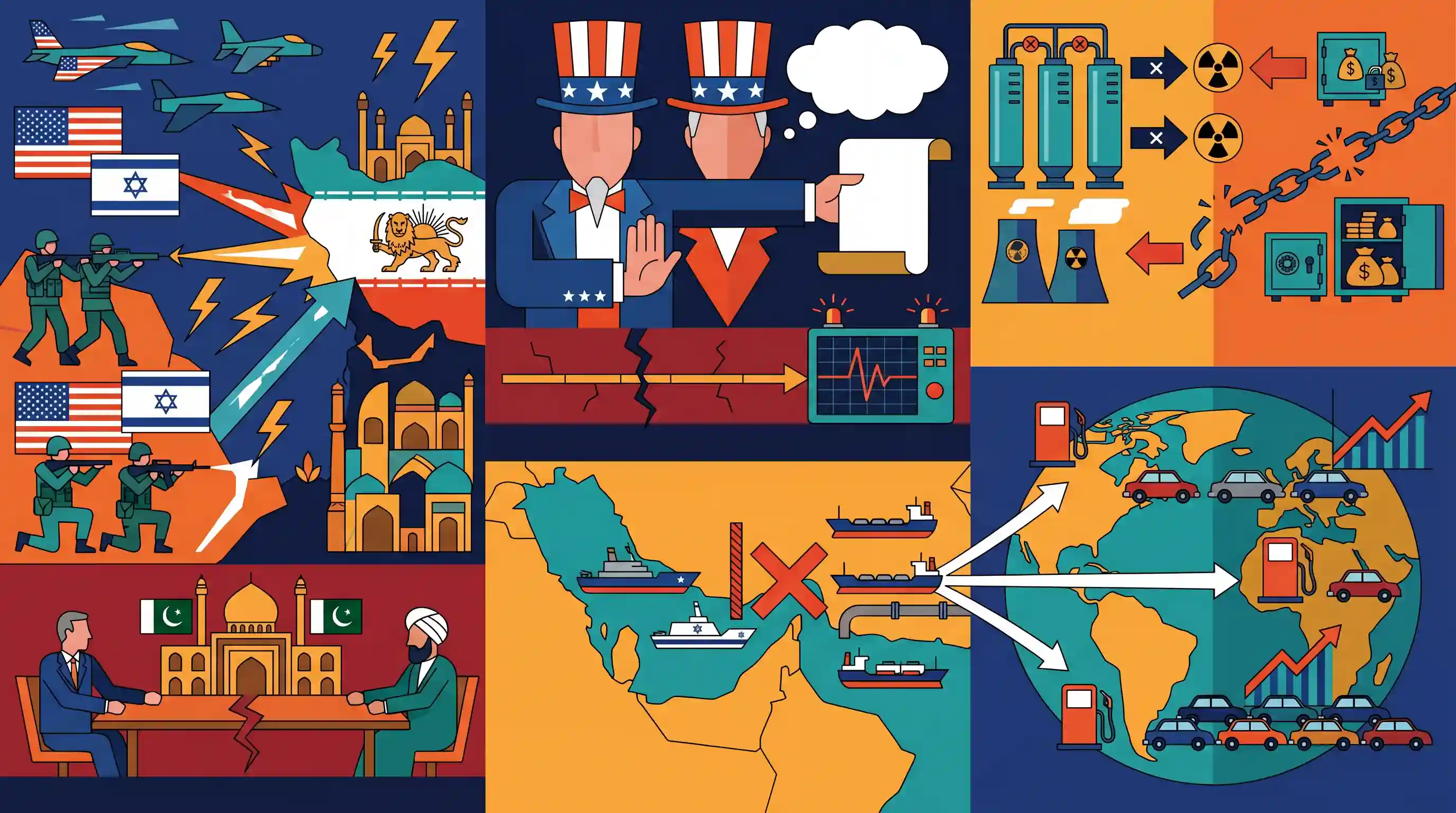
The conflict in the Middle East and the blockade of the Strait of Hormuz have direct and severe implications for global energy security and oil supplies, critically affecting import-dependent nations like India. The geopolitics of the US-Iran relationship, nuclear enrichment controversies, and the mediation roles played by countries like Pakistan highlight shifting diplomatic alignments essential for UPSC GS2 (International Relations).
Summary
US President Donald Trump declared the US-Iran ceasefire to be extremely fragile and on 'life support' following his rejection of a peace proposal from Tehran. The ongoing war, which involves the US and Israel against Iran, has triggered a blockade of the Strait of Hormuz, significantly disrupting global energy flows and leading to international fuel shortages. While direct talks were recently hosted by Pakistan, a resolution remains elusive. The US is demanding a complete halt to Iran's uranium enrichment, whereas Iran insists on sanctions relief and access to frozen assets.
Key Points
- US President Donald Trump stated that the US-Iran ceasefire is on 'massive life support' after rejecting Tehran's latest peace proposal.
- The conflict, involving the US and Israel against Iran, began in February 2026 and caused a blockade of the Strait of Hormuz, disrupting 20% of global oil supplies and causing fuel shortages.
- Direct peace talks hosted by Pakistan failed to break the deadlock ahead of Trump's scheduled visit to China.
- The main negotiation obstacles are the US demanding an end to Iran's uranium enrichment and Iran seeking the removal of sanctions and the release of frozen funds.
Important Terms
Strait of Hormuz

A strategic narrow waterway between Iran and Oman connecting the Persian Gulf to the Gulf of Oman; handles ~20% of global oil and LNG trade.
UPSC context
GS Paper II (International Relations/Geopolitics); GS Paper I (Geography). Tests understanding of maritime chokepoints and energy security.
Uranium Enrichment
The process of increasing the concentration of the fissile isotope Uranium-235 (U-235) in natural uranium to make it suitable for nuclear reactors or weapons.
UPSC context
GS Paper III (Science & Technology) and GS Paper II (Nuclear Policy). Tests knowledge of nuclear fuel cycle and dual-use technology.
Economic Sanctions
Financial and trade penalties (e.g., asset freezes, trade barriers) imposed by countries to pressure another state to alter its behavior or policies without military force.
UPSC context
GS Paper II (IR and Global Governance). Tests understanding of coercive diplomacy and its impact on India's energy trade.
Nuclear Proliferation
The spread of nuclear weapons, fissile material, and weapon-applicable technology to countries not recognized as 'Nuclear Weapon States' by the NPT.
UPSC context
GS Paper II (International Agreements). Tests knowledge of global security regimes and India's 'discriminatory' stance on NPT.
Joint Comprehensive Plan of Action (JCPOA)
A 2015 multilateral agreement where Iran agreed to limit its nuclear program and undergo inspections in exchange for the lifting of international economic sanctions.
UPSC context
GS Paper II (International Relations). Tests knowledge of West Asian geopolitics and the US-Iran nuclear deadlock.
International Atomic Energy Agency (IAEA)
An autonomous international organization within the UN system that promotes peaceful nuclear energy and verifies compliance with non-proliferation safeguards through inspections.
UPSC context
GS Paper II (International Organizations). Tests knowledge of global watchdog roles and nuclear safety standards.
Frozen Assets
State-owned economic resources or funds blocked by a foreign government or bank, preventing their transfer or use until specific diplomatic conditions are met.
UPSC context
GS Paper II (Economic Diplomacy). Tests understanding of international law and financial tools in conflict resolution.
Prelims Trap
The Strait of Hormuz is a strategic chokepoint bordered by Iran and the United Arab Emirates.
While the UAE is nearby, the actual strait is bordered by Iran to the north and Oman's Musandam Peninsula to the south. Aspirants often confuse Oman's exclave with the UAE.
Static Concepts Connected
What are the key maritime chokepoints in the Middle East?
- Strait of Hormuz: Connects the Persian Gulf to the Gulf of Oman and Arabian Sea. It is bordered by Iran to the north and Oman to the south.
- Bab-el-Mandeb: Connects the Red Sea to the Gulf of Aden and the Indian Ocean. It is bordered by Yemen, Djibouti, and Eritrea.
- Suez Canal: An artificial sea-level waterway in Egypt connecting the Mediterranean Sea to the Red Sea, separating the African continent from Asia.
How does uranium enrichment relate to weapons capability and international safeguards?
- Enrichment grades: Low-Enriched Uranium (LEU, 3-5% U-235) is used for commercial nuclear power, while Highly Enriched Uranium (HEU, 90%+ U-235) is required for weapons-grade material.
- IAEA Safeguards: Under the Non-Proliferation Treaty (NPT), the Additional Protocol allows the IAEA expanded physical access to ensure nuclear material is not diverted to weapons programs.
Cross-Topic Patterns
Iran sanctions & Chabahar's viability
Renewed US-Iran hostilities typically trigger CAATSA fears, directly complicating India's operationalization of the Chabahar Port and its strategic gateway to the INSTC.
Rupee-Rial trade & dedollarization
Past sanctions forced India into a Rupee-Rial mechanism, testing non-SWIFT alternatives. The current blockade context accelerates India's broader macroeconomic push for INR internationalization.

Mapping West Asian chokepoints (Hormuz, Bab-el-Mandeb) paired with global supply chain impacts is highly probable in 2026 Prelims.
Linked PYQs · 3
Linked PYQs · 3
- 2018MainsGS2
In what ways would the ongoing US-Iran Nuclear Pact Controversy affect the national interest of India? How should India respond to this situation?
- 2025MainsGS2
"Energy security constitutes the dominant kingpin of India's foreign policy, and is linked with India's overarching influence in Middle Eastern countries.” How would you integrate energy security with India's foreign policy trajectories in the coming years?
- 2024PrelimsGS1
Consider the following statements : Statement-I : Sumed pipeline is a strategic route for Persian Gulf oil and natural gas shipments to Europe. Statement-II : Sumed pipeline connects the Red Sea with the Mediterranean Sea. Which one of the following is correct in respect of the above statements?
