Middle East nuclear facilities assessment and intelligence divergences
Source:Indian Express ↗
Why It Matters
The status of Iran's nuclear program and escalating geopolitical tensions in the Middle East directly impact global energy security, which is a focal point of India's foreign policy. Furthermore, Iranian nuclear sites (Natanz, Fordow) frequently appear in Prelims as 'Places in News', and the oversight of such facilities relates directly to IAEA safeguards.
Summary
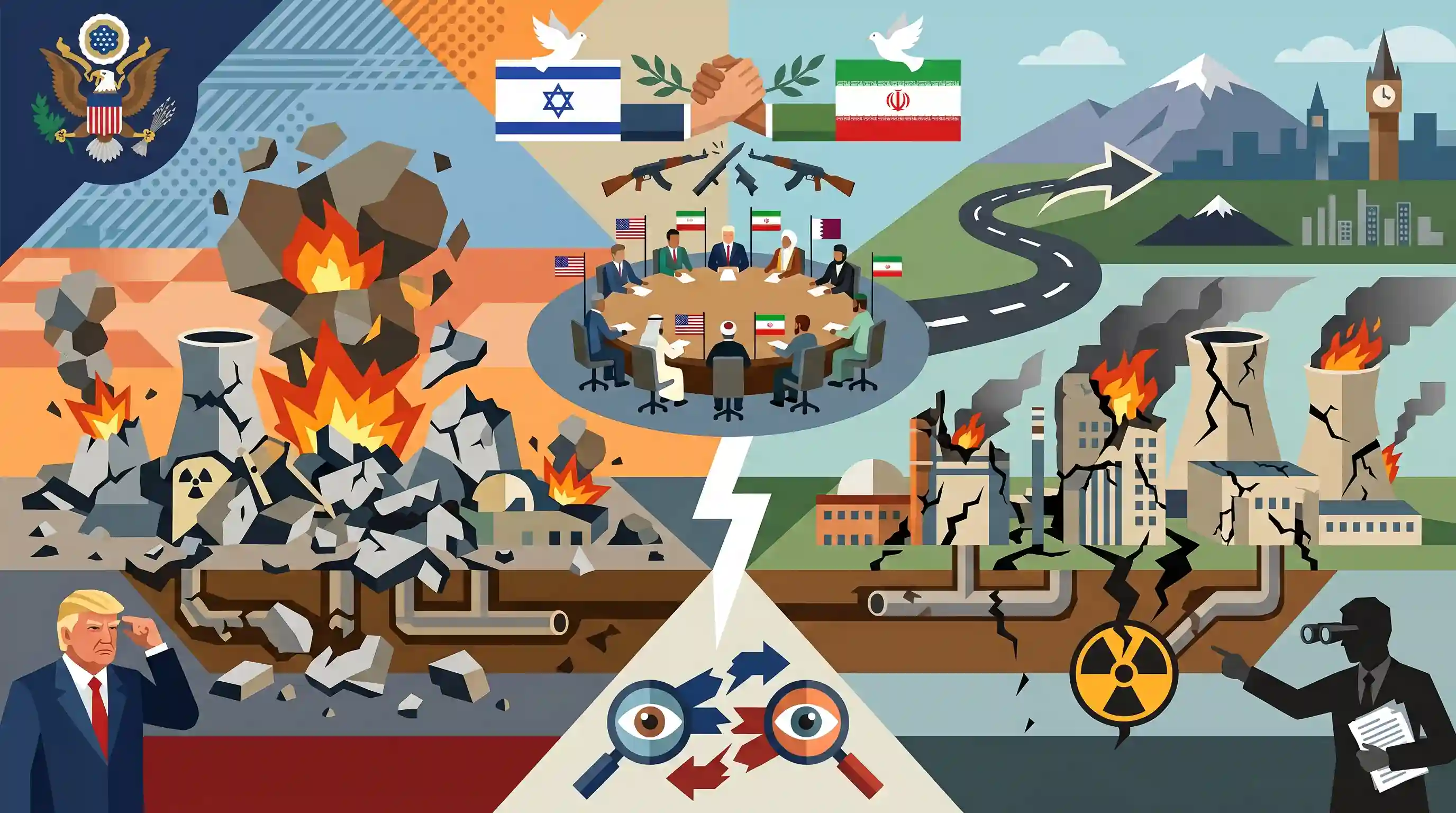
Top US intelligence officials, including DNI Tulsi Gabbard and CIA Director John Ratcliffe, have backed President Donald Trump's assertion that recent US strikes completely destroyed Iran's nuclear facilities. This stance contradicts a leaked Pentagon Defense Intelligence Agency assessment which concluded the sites at Natanz, Fordow, and Esfahan were severely damaged but not entirely eliminated. The internal US intelligence divergence comes at a critical geopolitical juncture, preceding prospective US-Iran nuclear negotiations in Geneva and occurring during an Israel-Iran ceasefire.
Key Points
- US President Donald Trump and top intelligence officials claim that recent US military strikes completely destroyed Iran's core nuclear facilities.
- This assertion contradicts a leaked Pentagon report from the Defense Intelligence Agency (DIA) which assessed that the facilities were set back by months but not entirely obliterated.
- The targeted Iranian nuclear sites include Natanz, Fordow (uranium enrichment), and Esfahan.
- The conflicting assessments emerge just ahead of scheduled US-Iran nuclear talks in Geneva and amid an ongoing ceasefire between Israel and Iran.
Important Terms
Natanz

Iran's primary uranium enrichment facility in Isfahan province, housing vast underground centrifuge halls. It is a focal point of global nuclear diplomacy and frequent target of kinetic and cyber-sabotage operations.
UPSC context
GS Paper II (International Relations) and Prelims (Places in News); tests knowledge of West Asian geopolitics and nuclear diplomacy.
Fordow
A heavily fortified Iranian underground fuel enrichment plant built deep into a mountain near Qom. Its design specifically aims to protect centrifuges from aerial bombardment, making it a critical strategic asset.
UPSC context
GS Paper II; significant for understanding nuclear deterrence strategies and map-based questions on strategic locations in the Middle East.
Nuclear Proliferation
The spread of nuclear weapons, fissionable material, and weapon-applicable technology to states not recognized as "Nuclear Weapon States." It is regulated by international frameworks like the Non-Proliferation Treaty (NPT).
UPSC context
GS Paper II and III (Security); core topic involving global disarmament treaties, India’s nuclear doctrine, and international security.
Defense Intelligence Agency (DIA)
A United States Department of Defense agency providing military intelligence on foreign capabilities and intentions. It specializes in combat support, threat analysis, and performing battle damage assessments after military strikes.
UPSC context
GS Paper II (Security); relevant for understanding the roles of global intelligence agencies and their impact on international conflict assessments.
Isfahan (Esfahan)
A central Iranian city containing a massive nuclear technology complex, including a Uranium Conversion Facility. It is essential for producing the gaseous feedstock required for enrichment at Natanz and Fordow.
UPSC context
GS Paper II and Prelims; important for identifying key industrial-nuclear sites within the context of Iran-Israel or US-Iran tensions.
Central Intelligence Agency (CIA)
An independent US civilian agency responsible for gathering and analyzing foreign intelligence relevant to national security. It conducts covert operations and provides strategic/political assessments to the President and Cabinet.
UPSC context
GS Paper II (Comparative Politics/Security); tests awareness of major international security actors and their roles in geopolitical maneuvering.
Prelims Trap
Iran is currently adhering to the IAEA Additional Protocol, allowing unannounced inspections of its nuclear sites.
Iran suspended its voluntary implementation of the Additional Protocol in 2021 after the US withdrew from the JCPOA, severely limiting the IAEA's ability to conduct snap inspections.
Static Concepts Connected
What is the difference between reactor-grade and weapons-grade uranium enrichment?
- Isotope concentration: Natural uranium contains 0.7% U-235. Reactor-grade requires 3-5% enrichment, while weapons-grade necessitates approximately 90% U-235 concentration.
- Centrifuge technology: Gas centrifuges spin uranium hexafluoride at high speeds to separate the lighter, fissile U-235 isotope from the heavier U-238.
What is the IAEA Additional Protocol?
- Expanded access: It is a voluntary, legal agreement that grants the IAEA expanded rights to inspect both declared and undeclared nuclear facilities on short notice.
- Iran context: While originally part of the 2015 JCPOA agreement, Iran suspended its implementation in 2021, restricting international verification of its nuclear program.
Cross-Topic Patterns
JCPOA collapse & NPT strains
The collapse of the JCPOA highlights the fragility of global non-proliferation frameworks when major powers unilaterally withdraw, increasing pressure on the NPT regime.
West Asia conflict & India's Economy
Military escalation involving Iran threatens global crude oil supply chains, potentially widening India's Current Account Deficit and endangering diaspora remittances.

Matching West Asian nuclear sites (Natanz, Fordow) or key straits to their countries will likely form a map-based Prelims question in 2026.
Linked PYQs · 5
Linked PYQs · 5
- 2023PrelimsGS1
Consider the following pairs: Regions often mentioned in news Reason for being in news 1. North Kivu and Ituri : War between Armenia and Azerbaijan 2. Nagorno-Karabakh : Insurgency in Mozambique 3. Kherson and Zaporizhzhia : Dispute between Israel and Lebanon How many of the above pairs are correctly matched?
- 2015PrelimsGS1
The area known as 'Golan Heights' sometimes appears in the news in the context of the events related to
- 2025MainsGS2
"Energy security constitutes the dominant kingpin of India's foreign policy, and is linked with India's overarching influence in Middle Eastern countries.” How would you integrate energy security with India's foreign policy trajectories in the coming years?
- 2018PrelimsGS1
In the Indian context, what is the implication of ratifying the 'Additional Protocol' with the 'International Atomic Energy Agency (IAEA)'?
- 2020PrelimsGS1
In India, why are some nuclear reactors kept under "IAEA Safeguards" while others are not?
