Bilateral Tariff Reductions and Export Competitiveness
Source:Indian Express ↗
Why It Matters
Understanding tariff dynamics and bilateral trade deals is crucial for analyzing India's export growth strategy. Favorable tariff rates directly impact the competitiveness of Indian manufacturing against nations like Vietnam and Bangladesh, aligning with "Make in India" goals and the push for higher merchandise exports.
Summary
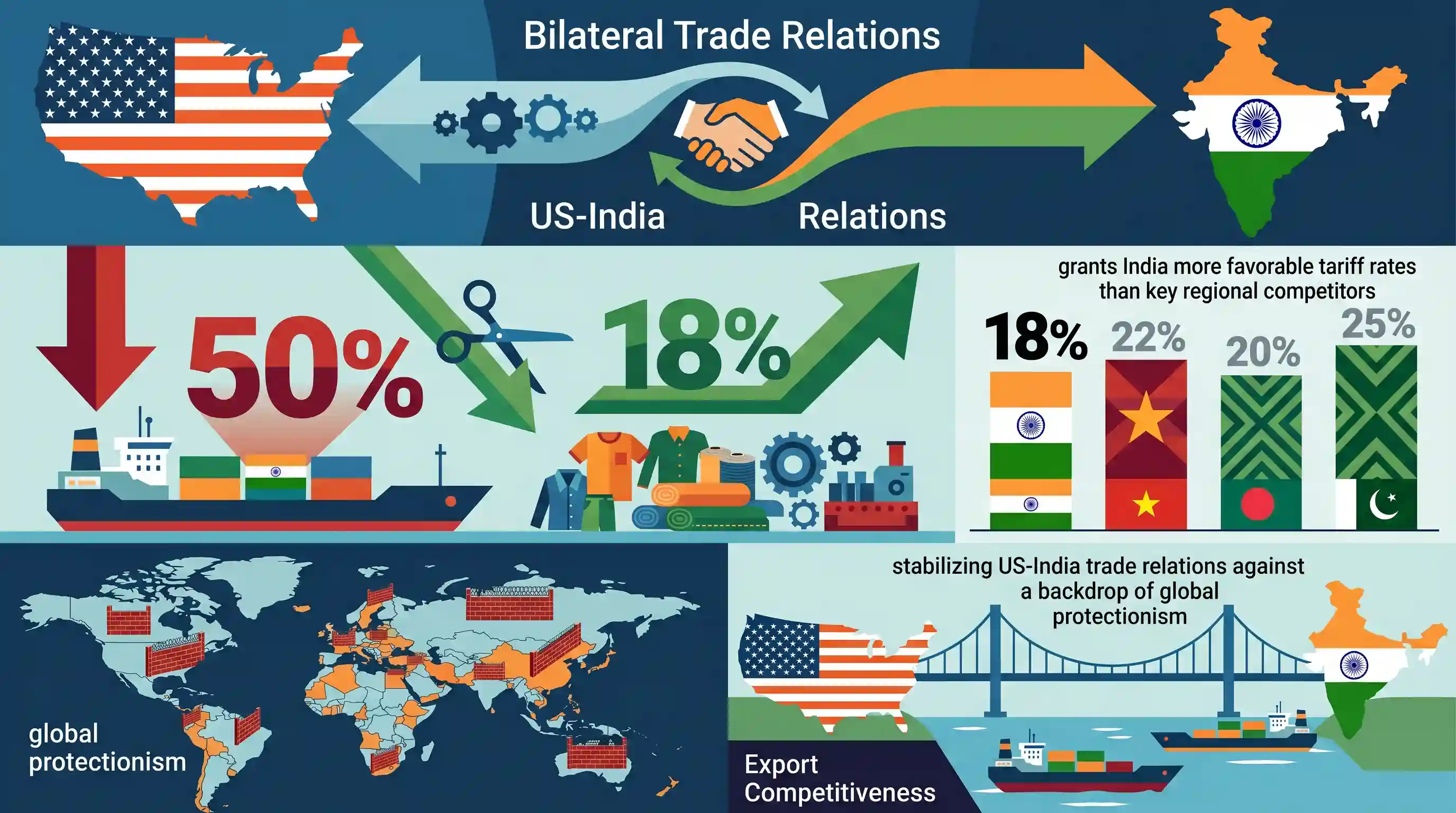
Under a new bilateral trade agreement, the United States has agreed to lower tariffs on Indian exports to 18%, a significant reduction from the initially proposed 50%. This deal, negotiated between US President Donald Trump and Prime Minister Narendra Modi, grants India more favorable tariff rates than key regional competitors, including Vietnam, Bangladesh, and Pakistan. The reduction is poised to greatly enhance the global competitiveness of Indian exports, particularly in labour-intensive manufacturing and textile sectors, while stabilizing US-India trade relations against a backdrop of global protectionism.
Key Points
- The United States has agreed to reduce proposed tariffs on Indian exports to 18%, down from an initially planned 50%, under a new bilateral trade deal negotiated by PM Modi and President Trump.
- This negotiated 18% tariff rate places India in a more advantageous position compared to regional manufacturing competitors like Vietnam, Bangladesh, and Pakistan.
- The tariff relief is expected to significantly boost the export competitiveness of India's labour-intensive sectors, such as textiles and manufacturing.
- The agreement marks a stabilization of US-India economic ties amid broader trends of US trade protectionism and resolves tensions over reciprocal tariffs.
Important Terms
US-India Interim Trade Agreement (2026)

A 2026 bilateral pact where the US reduced effective tariffs on Indian exports to 18% (down from ~50%) in exchange for India's reduced energy reliance on Russia and increased market access.
UPSC context
GS-II (Bilateral Agreements). Tests knowledge of trade diplomacy and the impact of geopolitical shifts (Russia-Ukraine) on India-US economic relations.
Tariff
A tax or duty imposed by a government on imported goods. It increases the cost of foreign products to protect domestic industries or generate revenue.
UPSC context
GS-III (Economy). Fundamental for understanding trade barriers, fiscal policy, and international trade disputes.
Export Competitiveness
The ability of a country's products to compete in global markets based on price and quality. The 18% tariff rate directly boosts India's edge over regional rivals like Vietnam.
UPSC context
GS-III (Economic Growth). Tests ability to analyze how trade policy affects India's export performance and manufacturing potential.
Protectionism
The practice of shielding domestic industries from foreign competition by imposing barriers like high tariffs, quotas, or subsidies.
UPSC context
GS-III (Effects of Liberalization). Key for discussing 'America First' policies and the resurgence of global trade barriers.
Reciprocal Tariff
A trade policy where a country imposes duties on imports at the same level as its trading partner imposes on its goods (a 'tit-for-tat' approach).
UPSC context
GS-II (Effect of policies of developed nations). Crucial for understanding transactional trade diplomacy and modern US-India trade tensions.
Labor-Intensive Sectors
Industries requiring a large workforce relative to capital (e.g., textiles, gems, leather). These sectors are highly sensitive to tariff fluctuations and vital for employment in India.
UPSC context
GS-III (Employment & Industrial Growth). Vital for questions on MSMEs, jobless growth, and the structural transformation of the Indian economy.
Prelims Trap
The new US-India trade deal grants India zero-duty access to US markets, restoring its GSP status.
The agreement lowers proposed tariffs to 18%, but it does not eliminate duties entirely or officially restore India's non-reciprocal Generalized System of Preferences (GSP) status.
Static Concepts Connected
What is the Generalized System of Preferences (GSP)?
- Definition: An umbrella of preferential tariff systems where developed countries grant reduced/zero tariffs to developing nations.
- Non-reciprocal: Unlike Free Trade Agreements, the developing country does not have to lower its own tariffs in return.
- India's Status: The US revoked India's GSP status in 2019, citing a lack of equitable and reasonable access to Indian markets.
How do bilateral tariff reductions interact with WTO's MFN principle?
- MFN Rule: Under WTO rules, a trade concession granted to one member must be extended to all, preventing discrimination.
- Article XXIV Exception: Countries can bypass MFN to form Free Trade Agreements (FTAs), provided they cover "substantially all trade" and don't raise barriers for others.
- Mini-deals: Partial scope agreements or ad-hoc bilateral tariff cuts often face WTO scrutiny if they don't meet the comprehensive FTA threshold.
Cross-Topic Patterns
China+1 and regional export rivalry
India's 18% tariff edge shifts the 'China Plus One' calculus, directly challenging Vietnam's dominance in electronics and Bangladesh's lead in readymade garments for US market share.
Weaponization of tariffs & geopolitics
The US is utilizing targeted tariff relief as a geopolitical lever, carving out exceptions for strategic partners like India despite an overarching 'America First' protectionist trade policy.

Expect a multi-statement question on US protectionism linking bilateral tariff exceptions, WTO's MFN rules, and India's textile exports.
Linked PYQs · 5
Linked PYQs · 5
- 2012MainsGS2
Discuss the likely negative impact of the protectionist measures proposed by the US on India's software industry.
- 2017MainsGS3
Account for the failure of manufacturing sector in achieving the goal of labour-intensive exports. Suggest measures for more labour-intensive rather than capital-intensive exports.
- 2023MainsGS3
Faster economic growth requires increased share of the manufacturing sector in GDP, particularly of MSMEs. Comment on the present policies of the Government in this regard.
- 2023PrelimsGS1
Consider the following statements: Statement-I: India accounts for 3.2% of global export of goods. Statement-II: Many local companies and some foreign companies operating in India have taken advantage of India's 'Production-linked Incentive' scheme. Which one of the following is correct in respect of the above statements?
- 2024PrelimsGS1
Consider the following statements : Statement-I : India does not import apples from the United States of America. Statement-II : In India, the law prohibits the import of Genetically Modified food without the approval of the competent authority. Which one of the following is correct in respect of the above statements ?
