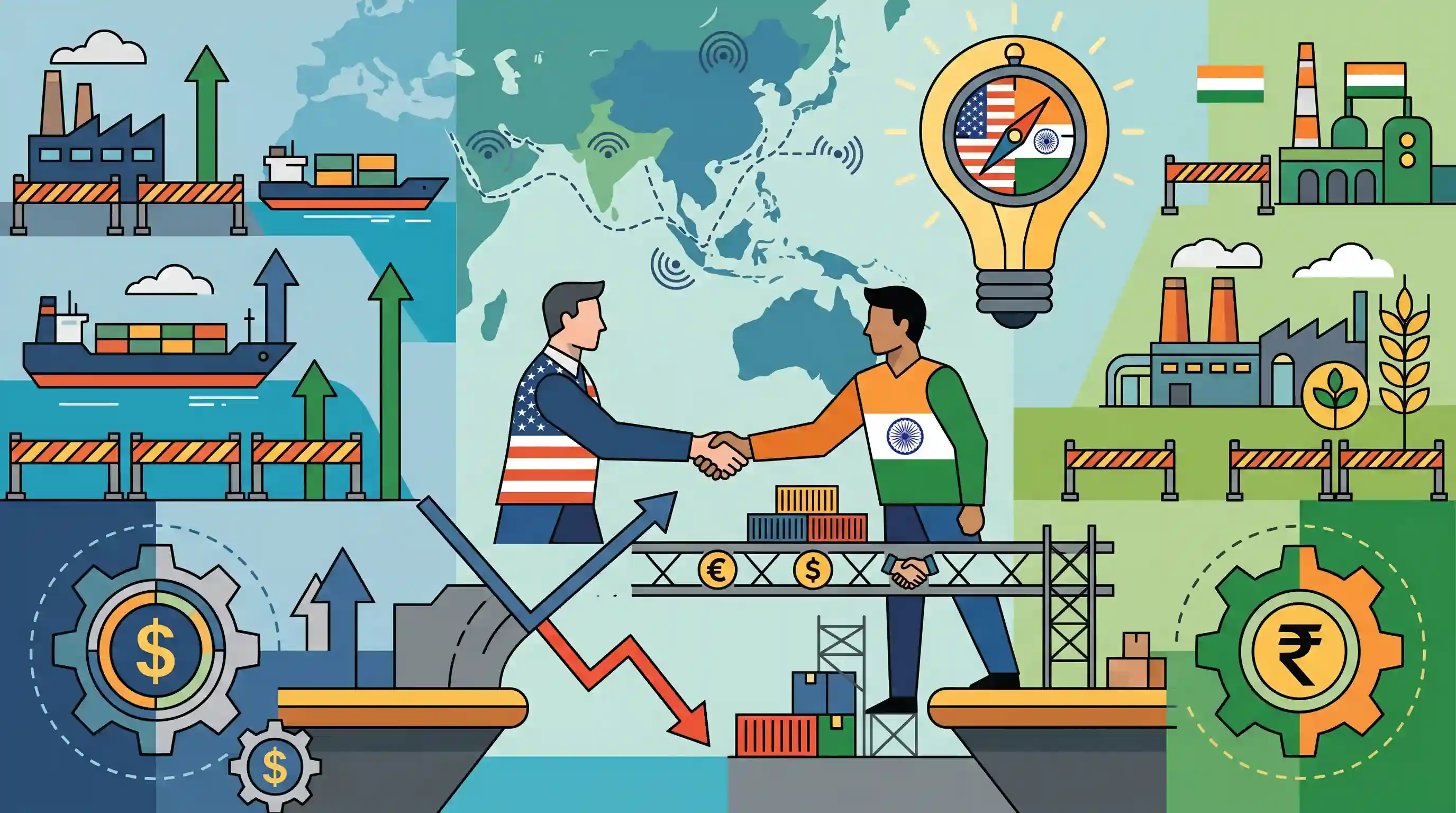
Bilateral Trade Negotiations and Economic Protectionism Challenges
Source:Indian Express ↗
Why It Matters
Offers a critical evaluation of the India-US economic partnership, highlighting the persistent trade frictions that complicate their growing strategic alignment. It provides valuable arguments for GS2 (Bilateral Relations) and GS3 (Economy/Protectionism) regarding how India navigates protectionist trends in developed economies.
Summary
The article analyzes the recent US-India trade deal, portraying it not as a comprehensive diplomatic resolution but as a necessary first step toward managing bilateral economic frictions. It argues that while the deal may avert immediate punitive tariffs and address surface-level trade imbalances, structural differences—driven by competing domestic priorities like 'Make in India' and American protectionism—persist. The author emphasizes that a durable economic framework is essential for both countries to fully realize their strategic and geopolitical potential, especially amid global supply chain realignments and Indo-Pacific security challenges.
Key Points
- The recent US-India trade deal serves as an initial, pragmatic step to manage immediate economic frictions, rather than a comprehensive diplomatic solution.
- While it addresses immediate tariff and trade-balance concerns, deeper structural issues such as intellectual property rights, data localization, and visa policies remain unresolved.
- The agreement highlights the ongoing balancing act between India's 'Make in India' aspirations and the increasingly protectionist trade policies of the US.
- Building a stable economic foundation is crucial to sustaining the broader strategic and geopolitical alignment between the two nations, particularly in the Indo-Pacific region.
Important Terms
US-India Trade Deal (2026)

A February 2026 interim framework reducing reciprocal tariffs between the US and India to 18%, intended as a precursor to a comprehensive Bilateral Trade Agreement (BTA).
UPSC context
GS II: Bilateral Relations. Tests understanding of transactional diplomacy and the resolution of trade frictions (like the 2025 Russian oil-related tariffs).
Make in India
A flagship national initiative launched in 2014 to transform India into a global manufacturing hub by boosting investment, innovation, and manufacturing infrastructure.
UPSC context
GS III: Indian Economy/Industry. Tests knowledge of manufacturing's targeted GDP share (25%) and its role in job creation and "Atmanirbhar Bharat."
World Trade Organization (WTO)
An intergovernmental organization (est. 1995) that regulates international trade, settles disputes, and operates a rules-based system of trade agreements between 164 member nations.
UPSC context
GS II/III: International Institutions/Trade. Tests understanding of multilateralism, MFN status, and the shift toward bilateral/plurilateral trade frameworks.
Protectionism
An economic policy of restricting imports through tariffs, quotas, or subsidies to shield domestic industries and workers from foreign competition.
UPSC context
GS III: Global Trade/Liberalization. Tests the ability to analyze "America First" policies versus "Vocal for Local" within the context of trade wars.
Generalised System of Preferences (GSP)
A US trade preference program offering duty-free entry for eligible products from developing countries to promote economic development through export growth.
UPSC context
GS II/III: International Trade. Tests knowledge of non-reciprocal trade benefits and the impact of the 2019 US withdrawal on Indian SMEs.
Prelims Trap
India and the United States recently signed a Comprehensive Free Trade Agreement (FTA) resolving all bilateral disputes.
UPSC often blurs interim deals with FTAs. This is a pragmatic 'mini-trade deal' to manage immediate tariffs; structural issues remain unresolved.
Static Concepts Connected
How do Data Localization mandates act as Non-Tariff Barriers (NTBs) in trade?
- Definition: Mandating that citizens' data collected within a country must be stored and processed on local domestic servers.
- Trade Barrier: It restricts cross-border data flows, heavily increasing compliance and local infrastructure costs for foreign multinational tech firms.
- Bilateral Friction: A core friction point where India prioritizes data sovereignty and security, while the US demands free digital trade.
What distinguishes a Preferential Trade Agreement (PTA) from a CECA/CEPA?
- PTA: A PTA reduces tariffs on a specific 'positive list' of agreed goods. It is the most basic level of trade integration.
- FTA: An FTA eliminates tariffs on most goods (using a negative list) but often excludes services or investments.
- CECA/CEPA: CECA/CEPA are comprehensive frameworks covering trade in goods, services, investments, intellectual property rights (IPR), and competition policies.
Cross-Topic Patterns
Indo-Pacific security vs. economic friction
India and the US show deep strategic alignment in the Quad, yet bilateral trade suffers from protectionist friction, illustrating a two-track relationship where security and economy move at different speeds.
Make in India vs. US Reshoring
India's PLI schemes clash with US industrial policies like the Inflation Reduction Act, highlighting how competing domestic manufacturing priorities often masquerade as bilateral trade disputes.

Expect a GS2 Mains question analyzing the paradox of deepening India-US defense ties alongside persistent friction over IPR and data.
Linked PYQs · 2
Linked PYQs · 2
- 2019MainsGS2
‘What introduces friction into the ties between India and the United States is that Washington is still unable to find for India a position in its global strategy, which would satisfy India's national self-esteem and ambitions.’ Explain with suitable examples.
- 2025MainsGS3
What are the challenges before the Indian economy when the world is moving away from free trade and multilateralism to protectionism and bilateralism? How can these challenges be met?
