Bilateral Trade Agreements and Impact on Domestic Agriculture
Source:Indian Express ↗
Why It Matters
Understanding the socio-economic costs of bilateral trade agreements on domestic agriculture is critical for answering questions regarding farm subsidies, WTO negotiations, agricultural pricing, and the challenges of globalization for smallholder Indian farmers.
Summary
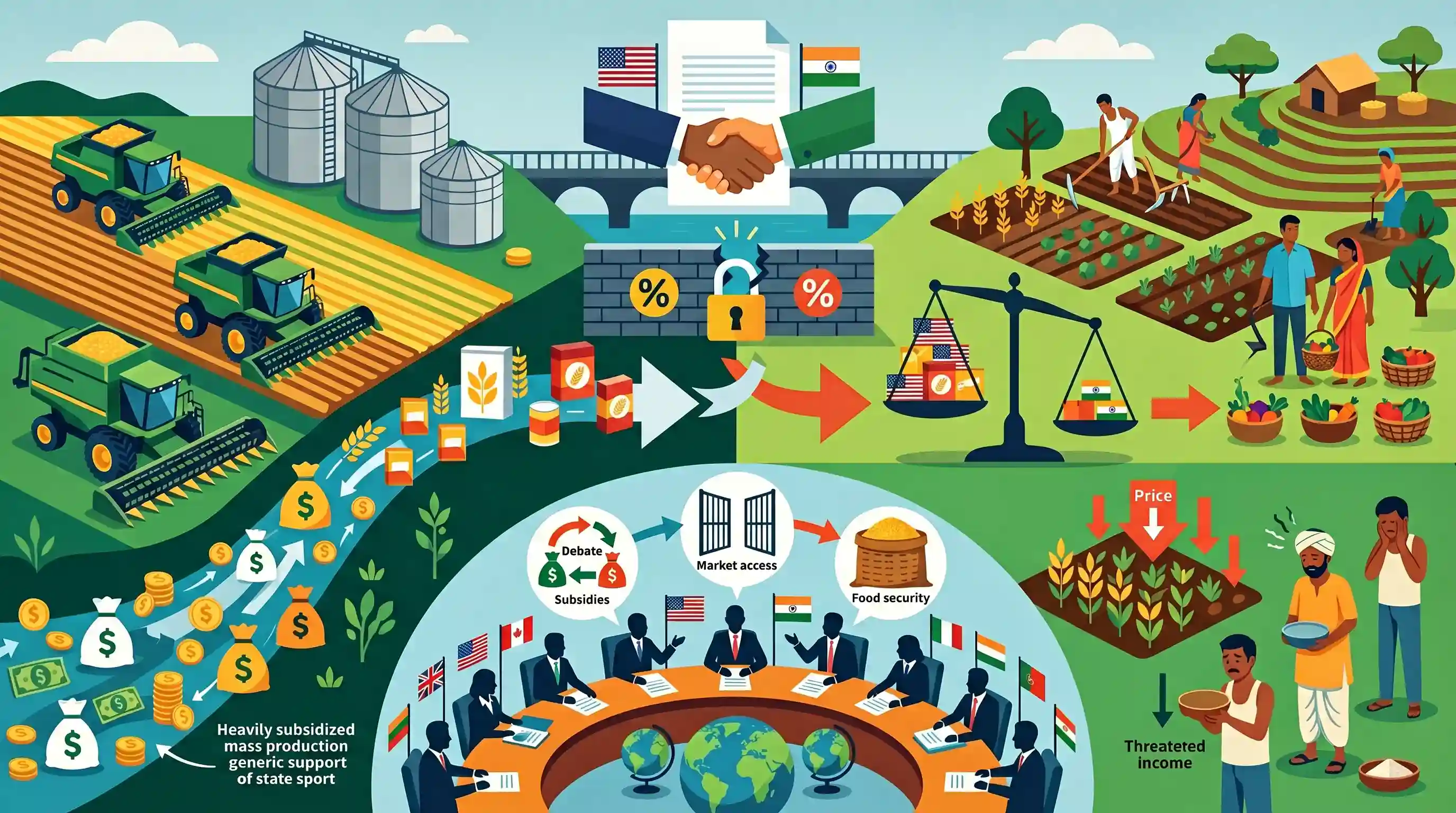
The article explores the potential economic repercussions of a US-India trade agreement that facilitates a surge in American agricultural exports to India. It highlights the tension between deepening Indo-US strategic economic ties and protecting India's vulnerable domestic agricultural sector. By lowering import tariffs, India risks exposing its smallholder farmers to unfair competition from heavily subsidized, mass-produced American farm goods. This influx threatens to artificially depress domestic prices, undermining agricultural livelihoods and spotlighting the ongoing global debates at the WTO over farm subsidies, market access, and food security.
Key Points
- Bilateral trade negotiations between India and the US frequently involve pressure on India to reduce import tariffs on American agricultural commodities like dairy, poultry, apples, and almonds.
- An influx of heavily subsidized, mass-produced US farm exports into the price-sensitive Indian market risks depressing domestic crop prices and squeezing farmers' profit margins.
- The structural disparity between heavily subsidized, large-scale American corporate farming and India's smallholder agrarian economy creates an uneven playing field in free trade scenarios.
- The debate over protecting domestic farmers from surges in agricultural imports reflects broader, persistent World Trade Organization (WTO) contentions regarding agricultural subsidies and food security between developed and developing nations.
Important Terms
US-India Bilateral Trade Agreement (BTA)

A multi-sector trade pact (negotiated circa 2025-26) reducing tariffs (e.g., from 50% to 18%) to expand bilateral trade toward a $500 billion target by 2030.
UPSC context
GS Paper 2 (Bilateral Relations) & GS Paper 3 (Economy); tests understanding of strategic trade-offs and impact on domestic sectors.
Agreement on Agriculture (AoA)
A WTO treaty established in 1995 to reform agricultural trade by reducing market protectionism and trade-distorting subsidies through three pillars: domestic support, market access, and export competition.
UPSC context
GS Paper 3 (International Trade/WTO); essential for understanding global rules governing farm subsidies and food security.
Amber Box Subsidies
WTO category for trade-distorting agricultural subsidies, such as India's Minimum Support Price (MSP), which are subject to reduction commitments and capped by de minimis limits.
UPSC context
GS Paper 3 (Economics/Agriculture); a frequently tested topic regarding India's friction with the WTO on farm support.
Green Box Subsidies
WTO category for agricultural subsidies that cause little or no trade distortion (e.g., research, infrastructure). These are uncapped and predominantly used by developed nations like the US.
UPSC context
GS Paper 3 (Economics); tests the ability to distinguish between types of support and their global economic implications.
Bali Peace Clause
A 2013 WTO mechanism allowing developing countries to exceed domestic support limits for public stockholding of food grains without legal challenge, pending a permanent solution.
UPSC context
GS Paper 3 (Food Security); critical for understanding India's legal defense for its public distribution system (PDS).
De Minimis Level
The minimum percentage of agricultural production value (10% for developing, 5% for developed countries) within which trade-distorting subsidies are permitted under WTO rules.
UPSC context
GS Paper 3 (Agriculture/Economy); technical term vital for analysis of WTO subsidy breaches and India's trade negotiations.
Minimum Support Price (MSP)
A guaranteed price at which the Indian government procures crops to protect farmers from market volatility, often criticized by the US as a trade-distorting Amber Box subsidy.
UPSC context
GS Paper 3 (Agricultural Pricing); central to debates on rural livelihoods, food security, and international trade compliance.
Prelims Trap
The WTO prohibits developing countries from offering any trade-distorting 'Amber Box' subsidies.
Developing nations are allowed trade-distorting (Amber Box) subsidies up to a 'de minimis' limit of 10% of their total agricultural production value.
Static Concepts Connected
How does the WTO classify agricultural subsidies under the Agreement on Agriculture?
- Amber Box: Trade-distorting subsidies (e.g., MSP, subsidized fertilizers) that directly affect production. Subject to reduction commitments and 'de minimis' limits.
- Green Box: Support that causes minimal to no trade distortion (e.g., agricultural R&D, environmental protection programs). Allowed without spending limits.
- Blue Box: Essentially 'Amber Box with conditions'. These are subsidies tied to programs that limit agricultural production. Currently no limit on spending.
What tools can India use to legitimately restrict agricultural imports under WTO rules?
- Special Safeguard Mechanism (SSM): A proposed WTO tool allowing developing countries to temporarily raise tariffs to counter sudden agricultural import surges or steep price falls.
- Sanitary and Phytosanitary (SPS): Non-tariff barriers permitted to ensure food safety and animal/plant health (e.g., India historically restricting US dairy over cattle feed norms).
Cross-Topic Patterns
PDS and WTO Peace Clause
US pressure on India's MSP highlights the persistent tension between the WTO's Agreement on Agriculture limits and India's domestic statutory mandates under the National Food Security Act.
Strategic alignment vs. Trade friction
While India and the US align deeply on strategic defense (Quad, iCET), agricultural market access and tariff disputes (like the 2019 GSP revocation) remain massive bilateral trade roadblocks.

Expect a 2026 Prelims multi-statement question linking WTO Agreement on Agriculture, Amber Box de minimis limits, and India's MSP defense.
Linked PYQs · 3
Linked PYQs · 3
- 2023MainsGS3
What are the direct and indirect subsidies provided to farm sector in India? Discuss the issues raised by the World Trade Organization (WTO) in relation to agricultural subsidies.
- 2014MainsGS2
WTO is an important international institution where decisions taken affect countries in a profound manner. What is the mandate of WTO and how binding are their decisions ? Critically analyse India's stand on the latest round of talks on Food security.
- 2019PrelimsGS1
Among the agricultural commodities imported by India, which one of the following accounts for the highest imports in terms of value in the last five years?
