India-US Interim Trade Agreement and Tariff Reductions Roadmap
Source:The Hindu ↗
Why It Matters
This development illustrates the integration of trade policies with strategic geopolitical goals. It highlights the impact of international pressure on India's energy sourcing (moving away from Russian oil) and domestic taxation strategies (scrapping the Equalisation Levy) in pursuit of improved market access.
Summary
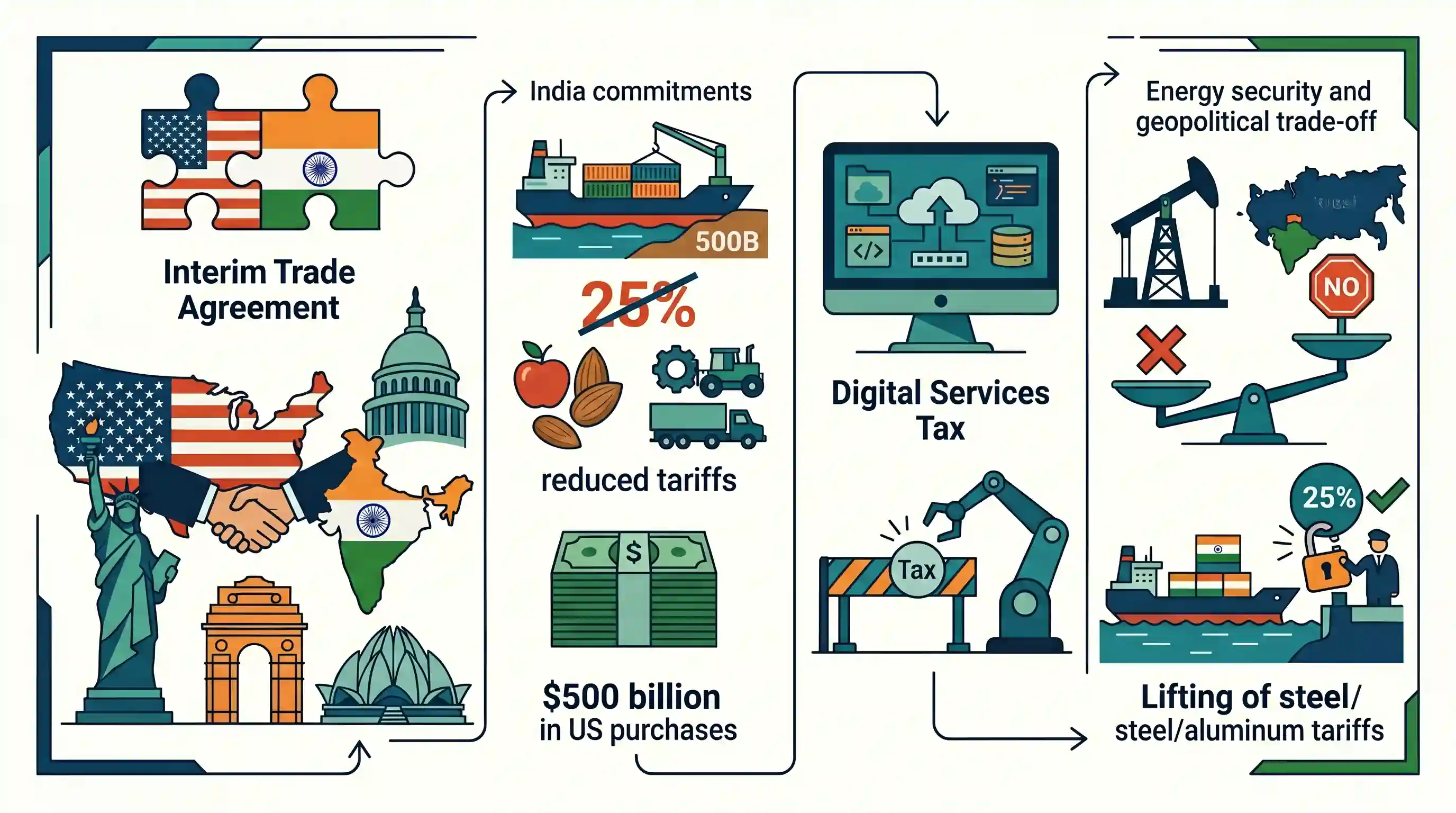
The US and India are moving towards finalizing an Interim Trade Agreement as a precursor to a comprehensive Bilateral Trade Agreement (BTA). Key commitments include India reducing tariffs on US agricultural and industrial goods, making $500 billion in US purchases, and eliminating its digital services tax. Crucially, the US agreed to remove its 25% tariff on Indian imports in exchange for India's commitment to stop buying Russian oil, highlighting the deep interlinkage between trade agreements, energy security, and global geopolitics.
Key Points
- The US and India are negotiating an Interim Trade Agreement to lay the groundwork for a comprehensive Bilateral Trade Agreement (BTA).
- India has committed to purchasing over $500 billion of US energy, ICT, agricultural, and coal products, while also reducing high tariffs on US industrial and agricultural goods.
- India agreed to eliminate its digital services taxes (such as the Equalisation Levy) and negotiate robust bilateral digital trade rules, including a ban on customs duties for electronic transmissions.
- In response to India's commitment to stop purchasing Russian oil, the US agreed to remove its 25% additional tariff on Indian imports and lower reciprocal tariffs to 18%.
Important Terms
Bilateral Trade Agreement (BTA)

A formal treaty between two nations aimed at reducing trade barriers, such as tariffs and quotas, to facilitate economic cooperation and market access.
UPSC context
GS Paper-II/III; tests understanding of trade diplomacy and economic integration in bilateral strategic partnerships.
Interim Trade Agreement
A preliminary 'early harvest' deal covering specific sectors to provide immediate commercial benefits while a comprehensive Free Trade Agreement is being negotiated.
UPSC context
GS Paper-III (Economy); crucial for understanding WTO-compliant phased negotiation strategies in international trade.
Digital Services Tax (DST)
A tax on revenues earned by multinational digital companies (e.g., Google, Amazon) within a country, often used to ensure fair taxation of cross-border digital activities.
UPSC context
GS Paper-III (Economy/Taxation); relevant to India's Equalisation Levy and global digital tax reform debates (OECD).
Geoeconomics
The strategic use of economic instruments, such as trade policies, investment, and sanctions, to achieve geopolitical objectives and project national power.
UPSC context
GS Paper-II (International Relations); tests ability to analyze the intersection of trade, national security, and foreign policy.
Energy Security
The reliable and affordable availability of energy sources, achieved through diversifying suppliers and managing geopolitical risks to ensure national stability.
UPSC context
GS Paper-II/III; critical for discussing India's strategic autonomy and its balancing of energy imports amid global conflicts.
Prelims Trap
"India supports a permanent global ban on customs duties for electronic transmissions at the WTO."
India opposes the permanent multilateral WTO moratorium on e-commerce duties to protect its domestic digital sector, even if it concedes to bilateral bans in specific trade pacts like with the US.
Static Concepts Connected
What is an Early Harvest Scheme (Interim Trade Agreement)?
- Definition: A precursor agreement where trading partners reduce or eliminate tariffs on a limited, select list of goods before concluding a full comprehensive FTA.
- Strategic Purpose: Acts as a confidence-building measure to generate momentum and resolve easier issues before tackling complex non-tariff barriers and sensitive sectors.
- WTO Compliance: Must eventually lead to a comprehensive FTA covering 'substantially all trade' to remain compliant with the rules of GATT Article XXIV.
What is the Equalisation Levy (Digital Services Tax)?
- Origin & Scope: Introduced in 2016 (and expanded in 2020) to tax digital advertising and e-commerce revenues of non-resident tech giants lacking a permanent physical establishment in India.
- OECD Phase-out: India has committed to withdrawing this unilateral DST in favor of the OECD/G20 Two-Pillar framework (Pillar One) for taxing digital multinationals, or via bilateral concessions.
Cross-Topic Patterns
Geoeconomics dictating energy & trade
Linking US tariff removal to India halting Russian oil purchases demonstrates how geopolitical alliances and energy security are directly restructuring bilateral trade outside traditional WTO dispute mechanisms.
Bilateral concessions vs WTO stances
India agreeing to ban customs duties on electronic transmissions bilaterally with the US sharply contrasts with its aggressive defense against making the WTO global e-commerce moratorium permanent.

The WTO e-commerce moratorium, OECD Pillar One tax, and Early Harvest Scheme mechanisms are prime candidates for a linked 2026 Prelims MCQ.
Linked PYQs · 4
Linked PYQs · 4
- 2018PrelimsGS1
With reference to India's decision to levy an equalization tax of 6% on online advertisement services offered by non-resident entities, which of the following statements is/are correct? 1. It is introduced as a part of the Income Tax Act. 2. Non-resident entities that offer advertisement services in India can claim a tax credit in their home country under the "Double Taxation Avoidance Agreements". Select the correct answer using the code given below:
- 2025MainsGS2
"Energy security constitutes the dominant kingpin of India's foreign policy, and is linked with India's overarching influence in Middle Eastern countries.” How would you integrate energy security with India's foreign policy trajectories in the coming years?
- 2020MainsGS2
What is the significance of Indo-US defence deals over Indo-Russian defence deals? Discuss with reference to stability in the Indo-Pacific region.
- 2018MainsGS2
India and USA are two large democracies. Examine the basic tenets on which the two political systems are based.
