US India Space Forum Focuses on Commercial Sector Growth
Source:Indian Express ↗
Why It Matters
This topic bridges International Relations (GS2) and Space Technology (GS3). It is crucial for understanding the practical execution of India-US strategic partnerships (like iCET and the TRUST initiative), the commercialization and privatization trends in the Indian space sector, and the geopolitical challenges posed by multilateral export control regimes.
Summary
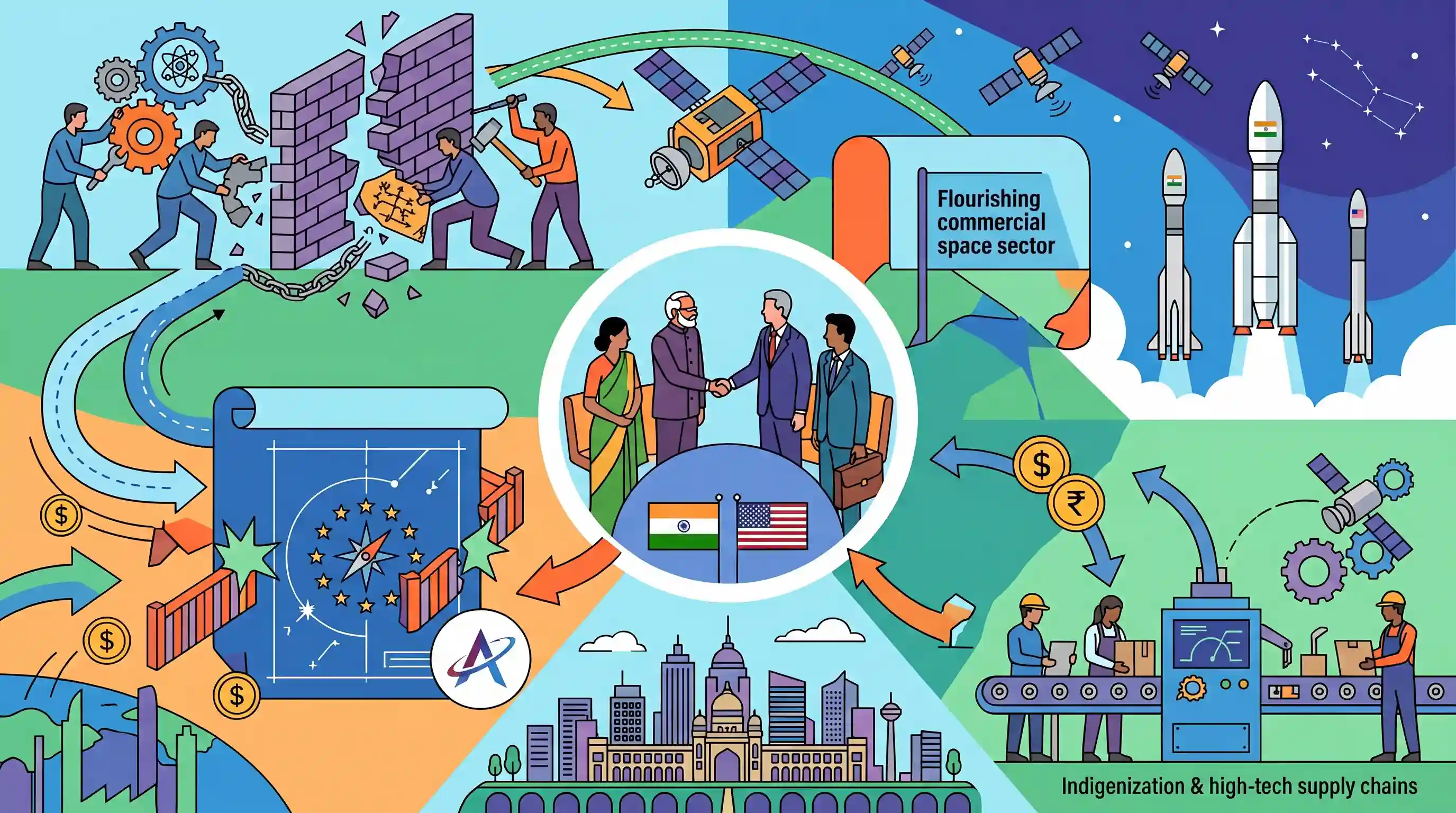
The article highlights a recent US-India space forum in Bengaluru aimed at deepening bilateral cooperation in the commercial space sector under the 2025 TRUST initiative. A major focus of the discussions was overcoming regulatory bottlenecks caused by US export control frameworks like ITAR, EAR, and MTCR, which restrict the transfer of dual-use technologies. The forum also showcased the liberalization of India's space industry, spurred by the Indian Space Policy 2023 and relaxed FDI norms, creating new opportunities for public-private partnerships and high-tech supply chain integration between the two nations.
Key Points
- A US-India space forum was held in Bengaluru to leverage the momentum from the 2025 TRUST (Transforming the Relationship Utilizing Strategic Technology) initiative and the 2026 trade agreement.
- Discussions focused on navigating regulatory hurdles posed by US export control regimes, such as ITAR, EAR, and MTCR, which govern dual-use technology transfers.
- India's evolving space ecosystem was highlighted, emphasizing the Indian Space Policy 2023, 100% FDI allowances, and the push for public-private partnerships.
- The strategic partnership aims to integrate the commercial space sectors of both countries, fostering deep-tech innovation and resilient supply chains.
Important Terms
2025 TRUST initiative

The 'Transforming the Relationship Utilizing Strategic Technology' initiative is a bilateral framework to catalyze cooperation in critical technologies like AI, space, and semiconductors while securing high-tech supply chains.
UPSC context
GS Paper 2 (Bilateral Relations). Tests knowledge of emerging strategic and technology frameworks between India and the U.S.
Indian Space Policy 2023
A policy defining the roles of ISRO (R&D), IN-SPACe (regulator), and NSIL (commercial arm) to increase private sector participation and India's global market share in space.
UPSC context
GS Paper 3 (Science & Tech). Essential for understanding the liberalization and indigenization of India's space sector.
International Traffic in Arms Regulations (ITAR)
U.S. Department of State regulations that control the export of defense-related articles and services on the U.S. Munitions List (USML) to safeguard national security.
UPSC context
GS Paper 2 (IR). Relevant for understanding regulatory hurdles in high-tech transfers and defense indigenization.
Export Administration Regulations (EAR)
U.S. Department of Commerce regulations governing the export of 'dual-use' items—technologies like semiconductors and encryption that have both commercial and military applications.
UPSC context
GS Paper 3 (S&T). Important for understanding international technology controls and their impact on private-sector innovation.
Missile Technology Control Regime (MTCR)
A 35-member multilateral export control regime (India joined 2016) aimed at preventing the proliferation of missile and unmanned aerial vehicle technology capable of delivering WMDs.
UPSC context
GS Paper 2 (Global Groupings). Tests India's membership in and adherence to international non-proliferation and export control regimes.
US-India Strategic Partnership Forum (USISPF)
A non-profit organization that facilitates public-private collaboration and strategic business ties between the U.S. and India to strengthen bilateral economic and security cooperation.
UPSC context
GS Paper 2 (IR). Demonstrates the role of non-state actors and business forums in shaping bilateral diplomatic and trade relations.
Prelims Trap
100% FDI is allowed under the automatic route for all commercial space sector activities, including launch vehicles.
100% automatic FDI applies only to satellite components. Satellite manufacturing is capped at 74%, and launch vehicles/spaceports at 49% under the automatic route.
Static Concepts Connected
What are the four Multilateral Export Control Regimes (MECRs)?
- MTCR: Controls missiles and UAVs capable of a 500kg payload over a 300km range; India is a member.
- Wassenaar Arrangement: Controls conventional arms and dual-use goods and technologies; India is a member.
- Australia Group: Controls chemical and biological weapons; India is a member.
- Nuclear Suppliers Group: Controls nuclear materials and technology; India is NOT a member due to its NPT non-signatory status.
What are the primary institutional roles defined in the Indian Space Policy 2023?
- IN-SPACe: Acts as the single-window nodal agency for authorizing, promoting, and regulating private sector space activities.
- NSIL: Serves as the commercial arm, responsible for commercializing space technologies and operationalizing platforms created by ISRO.
- ISRO: Transitions away from routine manufacturing to focus primarily on advanced R&D, new technologies, and deep-space missions.
Cross-Topic Patterns
Space Privatization + Investment Models
Linking the Indian Space Policy 2023 with graded FDI norms connects GS3 Space Tech with GS3 Investment Models, highlighting the shift from a state monopoly to active public-private partnerships.
iCET/TRUST + Dual-Use Technology
Indo-US deep-tech cooperation in space intersects with stringent US domestic export controls (ITAR/EAR), showcasing the regulatory and geopolitical hurdles in GS2 Bilateral agreements.

Expect a multi-statement Prelims question in 2026 linking India's graded space FDI caps with its MTCR/Wassenaar membership status.
Linked PYQs · 3
Linked PYQs · 3
- 2011PrelimsGS1
Recently, the USA decided to support India's membership in multi-lateral export control regimes called the "Australia Group" and the "Wassenaar Arrangement". What is the difference between them? 1. The Australia Group is an informal arrangement which aims to allow exporting countries to minimize the risk of assisting chemical and biological weapons proliferation, whereas the Wassenaar Arrangement is a formal group under the OECD holding identical objectives. 2. The Australia Group comprises predominantly of Asian, African and North American countries, whereas the member countries of Wassenaar Arrangement are predominantly from the European Union and American continents. Which of the statements given above is/are correct?
- 2020MainsGS2
What is the significance of Indo-US defence deals over Indo-Russian defence deals? Discuss with reference to stability in the Indo-Pacific region.
- 2016MainsGS3
Discuss India's achievements in the field of Space Science and Technology. How the application of this technology has helped India in its socio-economic development?
