US India Interim Trade Agreement Joint White House Statement
Source:The Hindu ↗
Why It Matters
The article offers a real-world case study on how India balances international economic integration with the protection of domestic sensitive sectors, highlighting the shift from multilateralism to bilateralism in global trade policy.
Summary
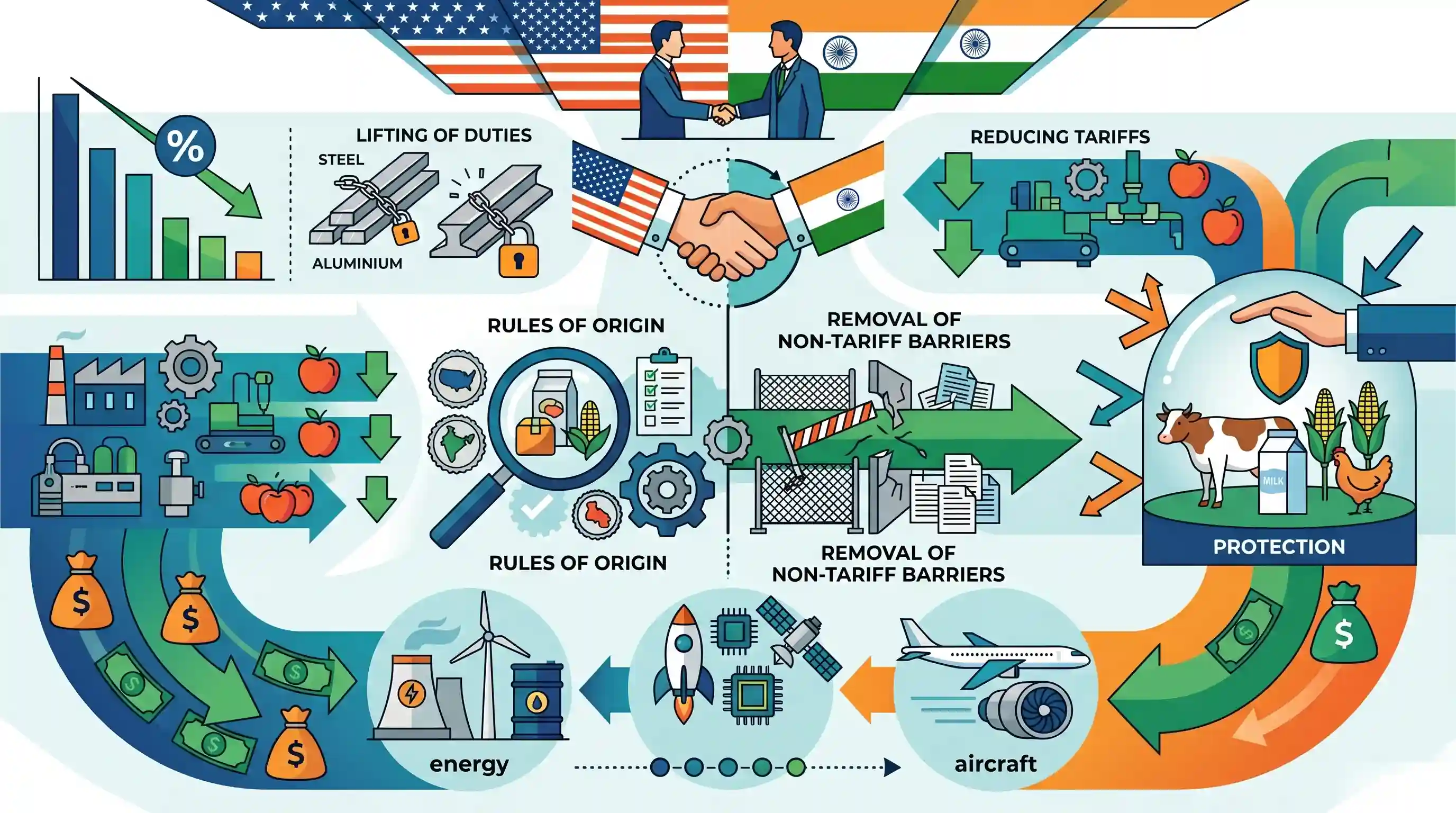
The United States and India have reached an interim trade agreement, paving the way for a comprehensive Bilateral Trade Agreement (BTA). Under the pact, the US will cut tariffs on Indian imports from 50% to 18% and lift duties on key metals like steel and aluminium. In return, India will reduce tariffs on US industrial and specific agricultural goods, though it successfully negotiated to protect sensitive domestic sectors such as dairy, maize, and poultry. The agreement also emphasizes strict "rules of origin," the removal of non-tariff barriers, and includes India's commitment to purchase $500 billion in US energy, tech, and aircraft over the next five years.
Key Points
- An interim trade pact will lower US tariffs on Indian goods from 50% to 18% and remove duties on Indian steel, aluminium, and copper.
- India will eliminate or reduce tariffs on US industrial goods and specific agricultural imports while shielding sensitive domestic sectors like dairy, maize, and poultry.
- The nations will enforce strict "rules of origin" to ensure trade benefits stay bilateral and address long-standing non-tariff barriers in medical devices and ICT.
- The interim deal serves as a stepping stone toward a comprehensive Bilateral Trade Agreement (BTA) to enhance supply chain resilience.
- India intends to purchase $500 billion worth of US energy, aircraft, tech products, and coking coal over five years, though the joint statement omitted any mandate to halt Russian oil purchases.
Important Terms
Interim Trade Agreement

A preliminary trade pact (often called an 'early harvest' deal) that reduces tariffs on specific goods before a comprehensive Free Trade Agreement is finalized.
UPSC context
GS Paper II/III; tests knowledge of trade diplomacy and the 'early harvest' approach in bilateral negotiations.
Bilateral Trade Agreement (BTA)
A treaty between two nations aimed at reducing or eliminating tariffs, quotas, and other trade barriers to encourage mutual economic cooperation and investment.
UPSC context
GS Paper II (International Relations); evaluates understanding of India's strategic economic partnerships and bilateral trade architecture.
Rules of Origin
Criteria used to determine the 'economic nationality' of a product, ensuring trade benefits apply only to goods from signatory nations and preventing third-country transshipment.
UPSC context
GS Paper III (Economy); essential for understanding WTO compliance and domestic regulations like CAROTAR 2020.
Non-Tariff Barriers (NTBs)
Trade restrictions—such as quotas, technical standards, or licensing—that hinder imports without using direct taxes or tariffs, often acting as forms of protectionism.
UPSC context
GS Paper III (Economy); tests ability to analyze modern trade hurdles and their impact on export competitiveness.
Sensitive Sectors
Domestic industries (e.g., dairy, poultry) protected from trade concessions to shield local livelihoods, rural economies, and food security from foreign competition.
UPSC context
GS Paper III (Agriculture); focuses on the socio-economic balance between trade liberalization and protecting vulnerable domestic producers.
Prelims Trap
The interim trade pact eliminates Indian import tariffs on all US agricultural goods.
India successfully negotiated to exclude sensitive domestic agricultural sectors, such as dairy, maize, and poultry, from tariff reductions to protect local farmers.
Static Concepts Connected
What are 'Rules of Origin' (RoO) in international trade agreements?
- Definition: The criteria needed to determine the national source of a product, acting as the 'economic nationality' of goods.
- Purpose: They prevent 'trade deflection', ensuring third-party countries (like China) cannot route goods through an FTA partner to wrongfully claim lower tariffs.
- Value Addition Rules: Typically requires a minimum percentage of domestic value addition or a substantial transformation of the product within the exporting country.
What is an 'Early Harvest Scheme' or Interim Trade Agreement?
- Precursor Framework: A precursor agreement where trading partners mutually reduce tariffs on a limited, agreed-upon list of goods before concluding a Comprehensive Economic Partnership Agreement (CEPA) or FTA.
- Confidence Building: It serves as a confidence-building measure, resolving immediate trade frictions while leaving complex negotiations (like services or intellectual property) for later.
Cross-Topic Patterns
Agriculture as the FTA dealbreaker
India's protection of dairy and poultry in the US deal directly mirrors its reason for withdrawing from the RCEP in 2019 to shield domestic farmers from subsidized imports.
Energy security and strategic autonomy
Committing to $500B in US energy purchases while retaining the right to buy Russian oil showcases India's classic multi-aligned energy diplomacy and strategic autonomy.

Expect a 2026 Prelims question linking 'Rules of Origin' concepts to recent interim trade agreements and agricultural sector exclusions.
Linked PYQs · 4
Linked PYQs · 4
- 2025MainsGS3
What are the challenges before the Indian economy when the world is moving away from free trade and multilateralism to protectionism and bilateralism? How can these challenges be met?
- 2018MainsGS3
How would the recent phenomena of protectionism and currency manipulations in world trade affect macroeconomic stability of India?
- 2014MainsGS2
The aim of Information Technology Agreements (ITAs) is to lower all taxes and tariffs on information technology products by signatories to zero. What impact would such agreements have on India's interests?
- 2018PrelimsGS1
Consider the following countries: 1. Australia 2. Canada 3. China 4. India 5. Japan 6. USA Which of the above are among the 'free-trade partners' of ASEAN?
