Indus Waters Treaty Suspension and Bilateral Security Tensions
Source:The Hindu ↗
Why It Matters
The event highlights the fragile nature of India-Pakistan ties, the strategic use of international water agreements (Indus Waters Treaty) as a tool for diplomatic coercion, and the evolving role of the US in South Asian geopolitics amid shifting global alignments.
Summary
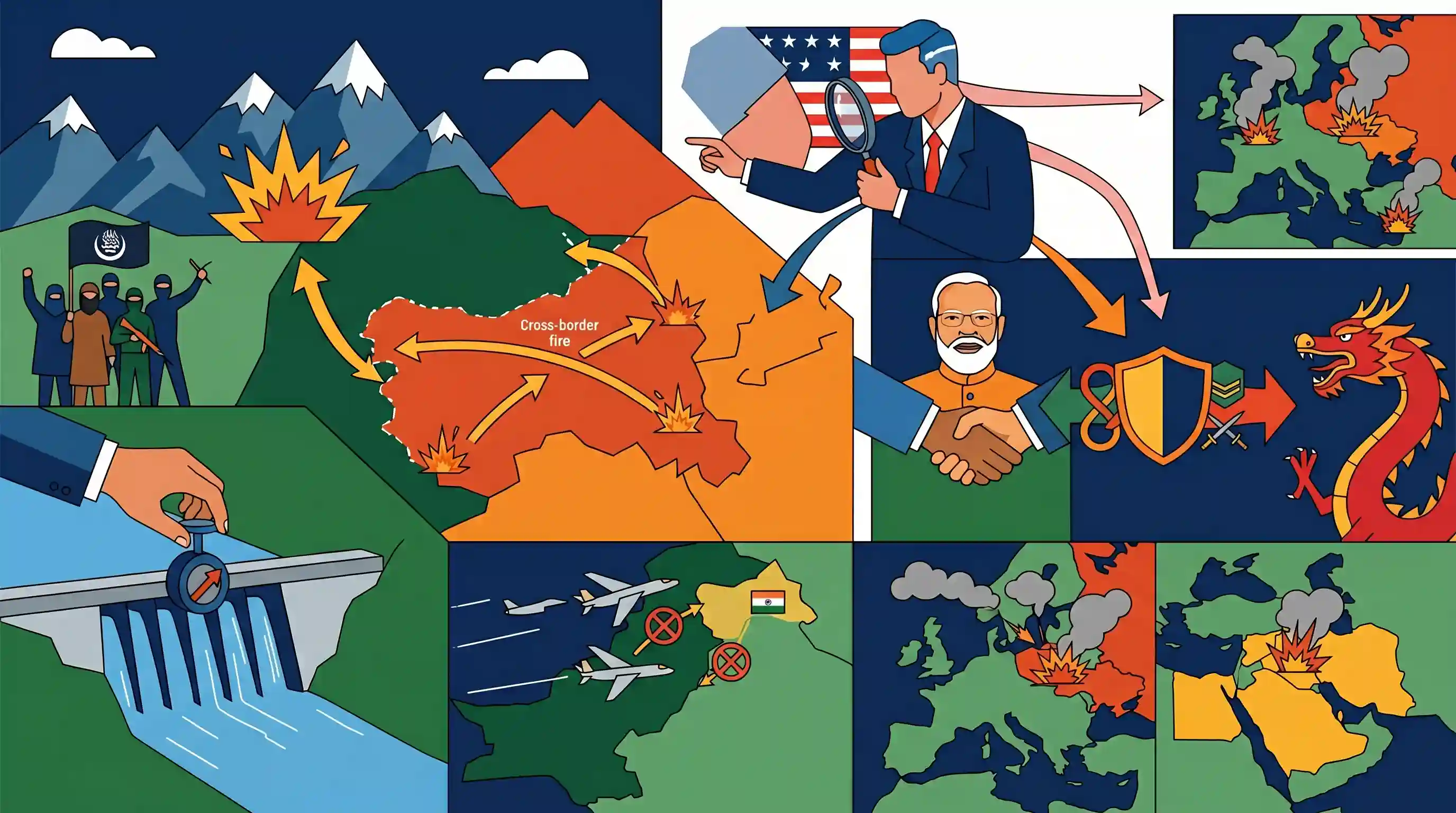
The United States is monitoring escalating tensions between India and Pakistan following a deadly terrorist attack in Pahalgam, Kashmir, which was claimed by the militant group 'Kashmir Resistance'. The diplomatic fallout has been severe, with India suspending the 1960 Indus Waters Treaty and Pakistan closing its airspace to Indian airlines, alongside renewed cross-border firing along the Line of Control. While the US State Department condemned the attack and urged a responsible resolution, experts note that Washington's shifting geopolitical priorities—favoring a strategic partnership with India to counter China and its preoccupation with conflicts in Ukraine and Gaza—may result in limited American intervention to de-escalate the crisis.
Key Points
- The US has urged India and Pakistan to find a 'responsible solution' following a deadly terrorist attack in Pahalgam, Kashmir that killed 26 tourists.
- In response to the attack, India suspended the 1960 Indus Waters Treaty and Pakistan closed its airspace to Indian flights, escalating bilateral tensions.
- Both nations have exchanged fire along the Line of Control (LoC), ending a four-year period of relative calm.
- The attack was claimed by 'Kashmir Resistance', a group Indian security agencies identify as a front for Pakistan-based Lashkar-e-Taiba and Hizbul Mujahideen.
- Geopolitical analysts suggest the US may take a hands-off approach due to its deepened strategic partnership with India to counter China, as well as its ongoing involvement in other global conflicts.
Important Terms
Indus Waters Treaty

A 1960 World Bank-brokered water-sharing pact. In April 2025, India placed it in "abeyance" following a terror attack in Pahalgam, citing Pakistan's support for cross-border militancy and "fundamental changes in circumstances."
UPSC context
GS Paper II (International Relations). Tests knowledge of transboundary water treaties, hydro-diplomacy, and their vulnerability to bilateral security tensions.
The Resistance Front (TRF)
An Islamist militant group (also called "Kashmir Resistance") that emerged in 2019. It claimed the 2025 Pahalgam attack and was designated a Foreign Terrorist Organization by the US in July 2025.
UPSC context
GS Paper III (Internal Security). Concerns proxy warfare, "hybrid" terrorist groups, and internal security challenges in Jammu & Kashmir.
Lashkar-e-Taiba (LeT)
A Pakistan-based, UN-designated terrorist organization responsible for the 2008 Mumbai attacks. Security agencies identify it as the parent entity and primary sponsor of proxies like The Resistance Front (TRF).
UPSC context
GS Paper III (Internal Security). Examines state-sponsored terrorism, the role of designated terror groups, and regional security in South Asia.
U.S. State Department
The American executive department for foreign policy. In 2025, it mediated between India and Pakistan during the Pahalgam crisis while designating the TRF as a terrorist entity to combat regional instability.
UPSC context
GS Paper II (International Relations). Analyzes US mediation roles, South Asian geopolitics, and the "US-India strategic partnership" vs. Pakistan.
Hudson Institute
A Washington D.C.-based think tank. Its 2025 "New India Conference" analyzed the "transactional" shift in US-India ties and India's potential as a strategic counterweight to Chinese regional dominance.
UPSC context
GS Paper II (International Relations). Tests the influence of think tanks on global foreign policy and the evolving strategic alignment between India and the US.
Hizbul Mujahideen
One of the oldest militant groups in Jammu & Kashmir. Following the 2019 abrogation of special status, its cadres reportedly integrated into newer proxy fronts like TRF to continue regional insurgency.
UPSC context
GS Paper III (Internal Security). Focuses on the history of militancy in Kashmir and the transition from indigenous to proxy-led terrorist activities.
Prelims Trap
India invoked the national security exit clause within the Indus Waters Treaty to unilaterally suspend it.
The 1960 IWT has no unilateral exit or suspension clause. Any suspension relies on the 'material breach' doctrine under the Vienna Convention (due to terrorism), not a provision within the treaty itself.
Static Concepts Connected
What are the core water-sharing provisions of the 1960 Indus Waters Treaty (IWT)?
- Eastern Rivers: India has unrestricted use of the three Eastern Rivers (Ravi, Beas, Sutlej).
- Western Rivers: Pakistan receives the Western Rivers (Indus, Jhelum, Chenab), but India is permitted limited agricultural use and run-of-the-river hydroelectric projects.
- World Bank role: The World Bank acts as a procedural broker to appoint a Neutral Expert or Court of Arbitration for disputes, not as a guarantor of the treaty.
What is the US policy of 'de-hyphenation' regarding South Asia?
- Independent tracks: Treating bilateral relations with India and Pakistan as independent tracks, rather than viewing them through a zero-sum, parity-driven Cold War lens.
- Strategic tilt: The US prioritizes a deep strategic partnership with India for its Indo-Pacific strategy to counter China, while limiting engagement with Pakistan to specific security concerns.
Cross-Topic Patterns
Hydro-diplomacy as a strategic tool
India's IWT suspension mirrors debates on China's dam-building on the Brahmaputra. Both highlight how upper riparian states weaponize transboundary rivers, testing the limits of international water sharing frameworks.
Rebranding terror to bypass FATF
Creating groups like 'Kashmir Resistance' allows state sponsors to maintain plausible deniability, avoiding FATF sanctions while portraying cross-border terrorism as an indigenous insurgency.

Expect a GS-2 Mains question on coercive hydro-diplomacy, or a Prelims pairing of Indus tributaries to India's run-of-the-river projects.
Linked PYQs · 3
Linked PYQs · 3
- 2015MainsGS2
Terrorist activities and mutual distrust have clouded India-Pakistan relations. To what extent the use of soft power like sports and cultural exchanges could help generate goodwill between the two countries? Discuss with suitable examples.
- 2012MainsGS2
The situation today is far different to that prevalent fifty years back when the Indus Water Treaty was signed." Highlight the complexity of the current challenges on both sides of the border in this regard. Do you think that a review of the Treaty is in India's best interests?
- 2025MainsGS3
Terrorism is a global scourge. How has it manifested in India? Elaborate with contemporary examples. What are the counter measures adopted by the State? Explain.
