US Urges Responsible Solution Amid India Pakistan Escalation
Source:The Hindu ↗
Why It Matters
This development is crucial for understanding the current geopolitical dynamics in South Asia, particularly the shifting US-India-Pakistan triangle. It also touches on significant bilateral mechanisms like the Indus Waters Treaty and underscores the persistent challenge of cross-border terrorism as a determinant of Indian foreign policy and national security.
Summary
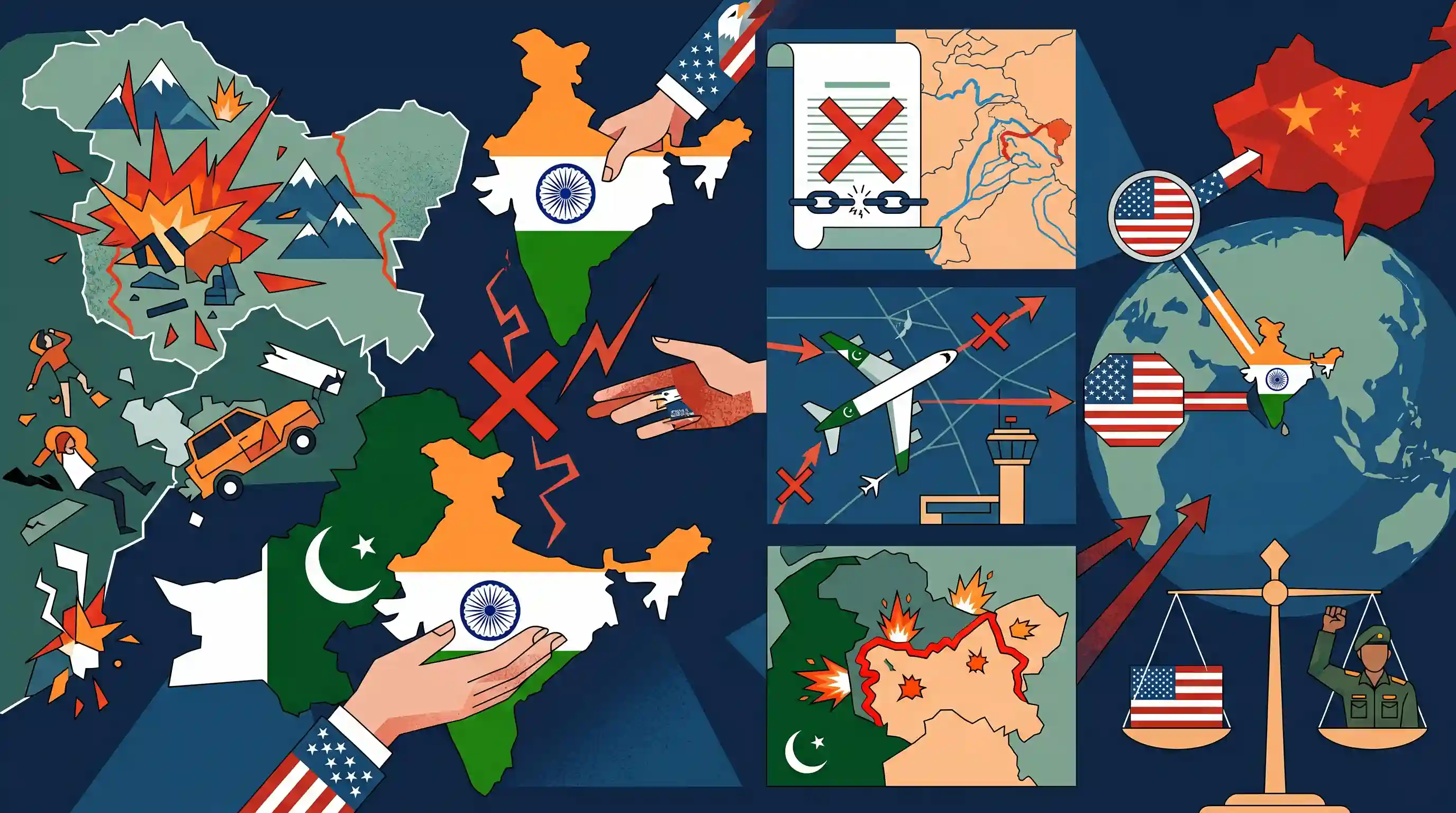
Following a devastating terror attack in Pahalgam, Kashmir, the United States has reached out to both India and Pakistan, urging a "responsible solution." While Washington condemned the attack and supported India, tensions have escalated sharply, leading to India's suspension of the 1960 Indus Waters Treaty, Pakistan closing its airspace to Indian airlines, and resumed firing along the Line of Control (LoC). Analysts highlight a shift in US strategic priorities, suggesting that due to Washington's reliance on India to counter China in the Indo-Pacific, the US might not intervene to prevent a potential Indian military retaliation against Pakistan.
Key Points
- The US State Department is urging India and Pakistan to work toward a responsible resolution following the Pahalgam terror attack in Kashmir that killed 26 tourists.
- In response to the attack, India has suspended the 1960 Indus Waters Treaty and Pakistan has closed its airspace to Indian airlines, with renewed firing along the Line of Control.
- Geopolitical experts suggest that because India is a crucial partner for the US in countering China, Washington may tacitly support Indian counter-terrorism actions and not actively intervene to calm tensions.
- The attack was claimed by the 'Kashmir Resistance', which Indian security agencies identify as a front for Pakistan-based militant organizations like Lashkar-e-Taiba and Hizbul Mujahideen.
Important Terms
Indus Waters Treaty (1960)

A World Bank-brokered water-sharing agreement (1960) assigning the Ravi, Beas, and Sutlej to India, and the Indus, Jhelum, and Chenab to Pakistan.
UPSC context
GS-2: International Relations; critical for transboundary water diplomacy and India-Pakistan bilateral leverage.
The Resistance Front (TRF)
A Lashkar-e-Taiba proxy founded in 2019 to project an "indigenous" secular face for Kashmiri insurgency; known for targeted killings of civilians and minorities.
UPSC context
GS-3: Internal Security; tests knowledge of evolving terror tactics and rebranding of proscribed groups.
Line of Control (LoC)
The 740-km de facto border separating Indian and Pakistan-administered Jammu and Kashmir, established following the 1971 war and Simla Agreement.
UPSC context
GS-3: Border Management; central to discussions on ceasefire violations, infiltration, and regional security.
Lashkar-e-Taiba (LeT)
A Pakistan-based terrorist group responsible for the 2008 Mumbai attacks; designated as a Foreign Terrorist Organization by the UN, US, and India.
UPSC context
GS-3: Internal Security; essential for understanding state-sponsored proxy warfare and global counter-terrorism regimes.
Hizbul Mujahideen
One of the oldest Islamist militant groups in Kashmir (founded 1989), seeking the region's merger with Pakistan; designated as a terrorist group by India and the US.
UPSC context
GS-3: Internal Security; relates to the history of insurgency and the role of the United Jihad Council.
Indo-Pacific Strategy
A US geopolitical framework prioritizing India as a core security partner to balance China's influence, often leading to shifted stances on India-Pakistan friction.
UPSC context
GS-2: Global Groupings; explains the strategic shift in US-India relations and Washington's regional priorities.
Prelims Trap
The Indus Waters Treaty contains a formal exit clause allowing either party to unilaterally withdraw during hostilities.
The Indus Waters Treaty (1960) has no unilateral exit or suspension clause. It can only be modified or abrogated by mutual agreement, making India's suspension a strategic geopolitical maneuver rather than a legal right.
Static Concepts Connected
What is the dispute resolution mechanism under the Indus Waters Treaty?
- Permanent Indus Commission: The first step to resolve questions regarding treaty implementation, requiring commissioners from both countries to meet regularly.
- Neutral Expert: Appointed by the World Bank to address technical 'differences' (e.g., engineering design of run-of-the-river projects).
- Court of Arbitration: A formal legal body set up to adjudicate serious 'disputes' if they cannot be resolved by the Neutral Expert.
How do terror 'front organizations' function in cross-border insurgency?
- Plausible Deniability: Proxies like the 'Kashmir Resistance' allow state sponsors to shield parent organizations (e.g., Lashkar-e-Taiba) from FATF scrutiny and international sanctions.
- Resource Mobilization: They often masquerade as local charities or NGOs to evade financial tracking, raising and laundering funds for active militancy.
Cross-Topic Patterns
IWT Suspension + Run-of-the-River hydro projects
The suspension of the treaty links IR directly to Indian Geography. Expect map-based Prelims questions on the western rivers (Indus, Jhelum, Chenab) and run-of-the-river projects like Kishanganga and Ratle.
Indo-Pacific Tilt + US-Pakistan De-hyphenation
US reluctance to restrain India reflects Washington's broader 'de-hyphenation' policy, prioritizing India as a strategic partner to counter China over its historical reliance on Pakistan.

The unprecedented IWT suspension + US Indo-Pacific reliance makes a combined Geography (Indus system) & IR question highly probable in 2026.
Linked PYQs · 3
Linked PYQs · 3
- 2015MainsGS2
Terrorist activities and mutual distrust have clouded India-Pakistan relations. To what extent the use of soft power like sports and cultural exchanges could help generate goodwill between the two countries? Discuss with suitable examples.
- 2012MainsGS2
The situation today is far different to that prevalent fifty years back when the Indus Water Treaty was signed." Highlight the complexity of the current challenges on both sides of the border in this regard. Do you think that a review of the Treaty is in India's best interests?
- 2020MainsGS2
What is the significance of Indo-US defence deals over Indo-Russian defence deals? Discuss with reference to stability in the Indo-Pacific region.
