US House passes youth digital safety legislation for online platforms
Source:The Hindu ↗
Why It Matters
The legislative efforts in the U.S. to regulate social media for child safety provide a comparative global context for India's own debates on digital regulation, data protection (like the DPDP Act), and the role of bodies like NCPCR in safeguarding youth in the digital era.
Summary
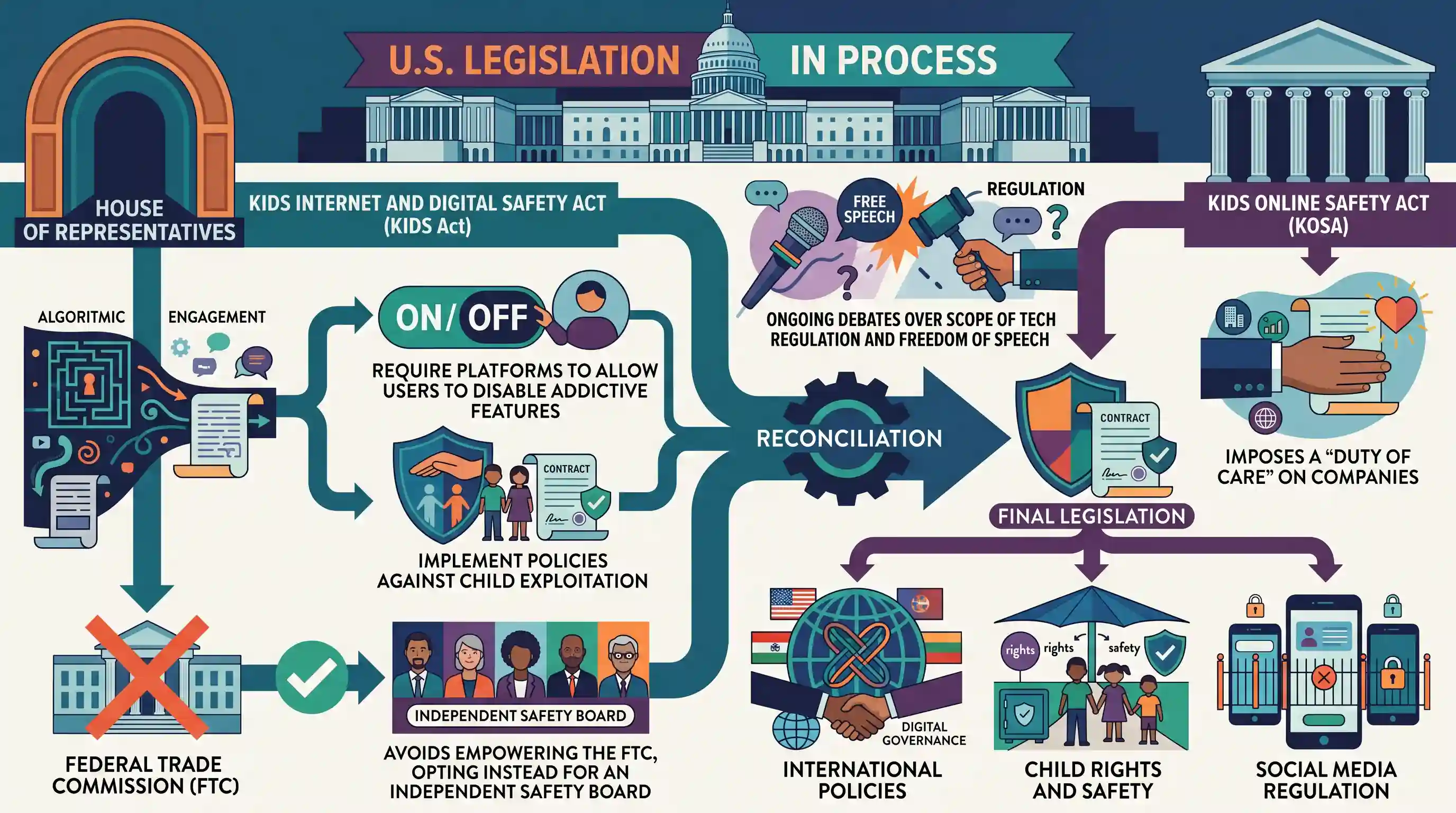
The U.S. House of Representatives has passed the 'Kids Internet and Digital Safety Act', a significant piece of legislation aimed at protecting youth online by requiring platforms to allow users to disable addictive features and implement policies against child exploitation. The bill must now be reconciled with the Senate's 'Kids Online Safety Act' (KOSA), which took a different approach by imposing a 'duty of care' on companies. The House version avoids empowering the Federal Trade Commission (FTC), opting instead for an independent safety board, reflecting ongoing debates over the scope of tech regulation and freedom of speech.
Key Points
- The U.S. House passed the 'Kids Internet and Digital Safety Act' to mandate online platforms to offer ways to disable addictive features and set policies against child sexual exploitation.
- The House bill differs from the Senate's 'Kids Online Safety Act' (KOSA) passed earlier, which imposes a 'duty of care' on tech platforms to actively mitigate harm to minors.
- Instead of giving enforcement power to the FTC, the House bill creates an independent board to manage safety standards, addressing concerns of potential overreach.
- The two bills must be reconciled and passed again before becoming law, highlighting the global regulatory push for youth online safety against Big Tech's business models.
Important Terms
Kids Online Safety Act (KOSA)

A U.S. Senate-passed bill mandating social media platforms to protect minors from harmful content (e.g., self-harm) through a 'duty of care,' parental controls, and algorithmic opt-outs.
UPSC context
GS Paper II (Global Governance); relevant for comparative analysis of international digital safety laws and child protection policies.
Duty of Care
A legal obligation requiring digital platforms to proactively mitigate and prevent foreseeable harms to users, shifting responsibility from individuals to service providers' design and moderation systems.
UPSC context
GS Paper II/III; central to 'safety by design' debates and the evolution of intermediary liability in the digital age.
Federal Trade Commission (FTC)
An independent U.S. government agency focused on consumer protection and antitrust. It serves as the primary federal regulator for digital privacy and platform safety enforcement.
UPSC context
GS Paper II; useful for comparing Indian regulatory bodies like CCI/MeitY with international counterparts in digital regulation.
Kids Internet and Digital Safety Act (KIDS Act)
A U.S. House-passed legislative package that mandates default safety settings for minors but avoids the 'duty of care' standard to protect free speech from potential government overreach.
UPSC context
GS Paper II; illustrates legislative variations in digital governance and the balancing of safety with fundamental free expression.
American Civil Liberties Union (ACLU)
A prominent U.S. civil liberties organization that opposes online safety bills, arguing they may lead to government censorship of 'lawful but harmful' content and jeopardize user privacy.
UPSC context
GS Paper II (Social Justice/Rights); highlights the tension between state-led digital regulations and fundamental rights like privacy.
Prelims Trap
Under the DPDP Act 2023, platforms require verifiable parental consent only for users under 14 years of age.
The DPDP Act 2023 uniformly defines a 'child' as an individual under 18 years of age, requiring verifiable parental consent and banning behavioral ads for all minors.
Static Concepts Connected
How does India's DPDP Act, 2023 protect children online?
- Parental Consent: Mandates tech platforms to obtain verifiable consent from a parent or lawful guardian before processing a child's personal data.
- Behavioral Ads Ban: Explicitly prohibits tracking, behavioral monitoring, and targeted advertising directed at children.
- Safe Exemptions: The Central Government can exempt certain classes of platforms from these restrictions if they are deemed 'verifiably safe'.
What is the 'duty of care' concept in digital regulation?
- Safety-by-Design: A legal obligation requiring tech platforms to actively design systems that prevent or mitigate foreseeable harms to users (especially minors).
- Proactive Accountability: It shifts the burden from post-facto content moderation (removing bad posts) to proactive algorithmic safety and minimizing addictive features.
- Indian Equivalent: India's IT Rules 2021 employ a parallel concept through 'due diligence', requiring intermediaries to prevent the hosting of child-harming content.
Cross-Topic Patterns
Child Privacy vs. Right to Information
Blanket age-gating and social media restrictions for minors often clash with a child's right to information and expression guaranteed under Article 13 of the UN Convention on the Rights of the Child (UNCRC).
Overlapping Cyber Jurisdictions
India's regulatory framework bifurcates child online safety between the NCPCR (tracking abuse/guidelines) and the Data Protection Board (privacy breaches), unlike unified global models.

Expect a GS2 Mains question comparing India's DPDP Act child-safety provisions with global 'safety-by-design' regulatory models.
Linked PYQs · 3
Linked PYQs · 3
- 2025MainsGS2
The National Commission for Protection of Child Rights has to address the challenges faced by children in the digital era. Examine the existing policies and suggest measures the Commission can initiate to tackle the issue.
- 2023MainsGS1
Child cuddling is now being replaced by mobile phones. Discuss its impact on the socialization of children.
- 2024MainsGS3
Social media and encrypting messaging services pose a serious security challenge. What measures have been adopted at various levels to address the security implications of social media? Also suggest any other remedies to address the problem.
