Daylight Saving Legislation and Standard Time Policy Debates
Source:The Hindu ↗
Why It Matters
Understanding standard times, daylight saving practices, and latitude-based variations in day length is core to physical and human geography (GS1). Furthermore, the debate on DST offers rich analytical perspectives for GS1/GS2/GS3 regarding India's own long-standing demands for multiple time zones (like Chaibagaan time in the Northeast) to enhance energy efficiency, productivity, and circadian health.
Summary
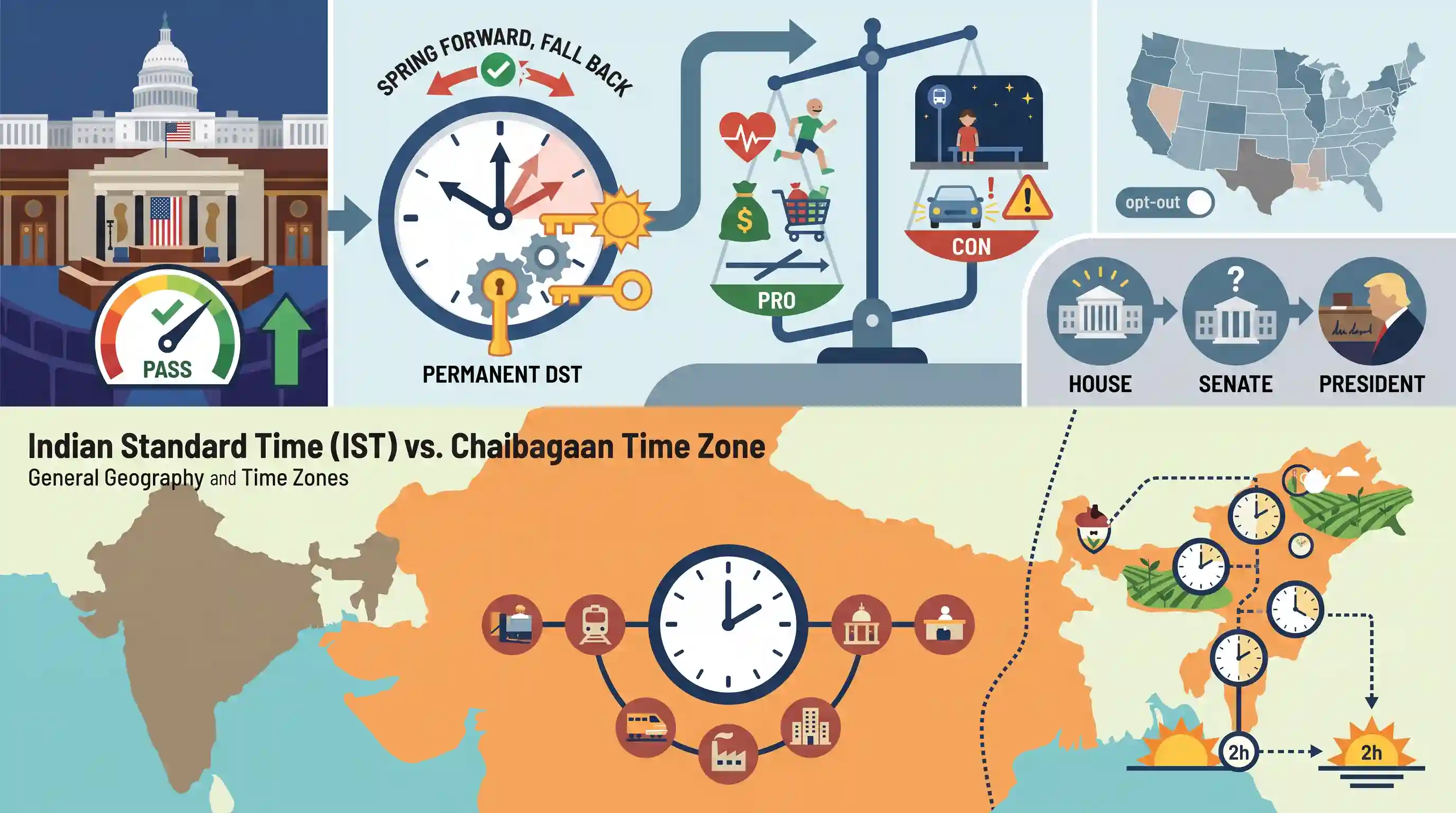
The U.S. House of Representatives passed the Sunshine Protection Act, a bill aiming to make Daylight Saving Time (DST) permanent across the United States and eliminate the twice-yearly clock changes. While proponents emphasize health benefits, increased economic activity, and reduced disruption, opponents raise concerns about safety hazards associated with much darker winter mornings. Individual states are permitted to opt-out. To become law, the bill must still clear the Senate and be signed by President Donald Trump.
Key Points
- The U.S. House of Representatives passed a bill (308-117) on July 14, 2026, to make Daylight Saving Time (DST) permanent across the nation.
- DST is the practice of advancing clocks by one hour during the warmer months (spring to autumn) to extend evening daylight, reverting to Standard Time in the winter.
- Proponents argue that 'ditching the switch' twice a year eliminates health/circadian disruptions, encourages outdoor family activities, and boosts local economic productivity by keeping evenings bright.
- Opponents argue that permanent DST would result in extremely dark winter mornings, raising safety concerns for children waiting for school buses and commuters driving to work in the dark.
- The bill allows individual states to opt out and remain on Standard Time if their state legislatures act before the law's enactment. It requires Senate approval and the President's signature to become law.
- The development holds relevance for global time zone management and mirrors domestic discussions in India regarding the feasibility of dual time zones or 'Chaibagaan time' in Northeast India to optimize daylight hours.
Important Terms
Daylight Saving Time (DST)

The practice of advancing clocks by one hour during warmer months to extend evening daylight and potentially reduce energy consumption, reversing the shift in autumn.
UPSC context
GS Paper I (Physical Geography) and GS Paper III (Energy). Tests Earth's rotation, seasons, and resource efficiency.
Sunshine Protection Act
A proposed U.S. federal law designed to make Daylight Saving Time permanent nationwide, eliminating twice-yearly clock changes while allowing states to opt out.
UPSC context
GS Paper II (Comparative Polity). Tests comparative legislative processes and administrative management of geographic standard times.
Indian Standard Time (IST)
The single uniform time zone observed throughout India, calculated based on the 82°30' E standard meridian passing through Mirzapur, Uttar Pradesh.
UPSC context
GS Paper I (Indian Geography). Tests concepts of India's longitudinal extent and debates surrounding a single national time zone.
Chaibagaan Time Zone
An informal standard time observed in Assam's tea gardens, set one hour ahead of IST to optimize daylight use and enhance agricultural productivity.
UPSC context
GS Paper I (Indian Geography). Tests the debate over multiple time zones in India and regional energy efficiency.
U.S. House of Representatives
The lower chamber of the United States Congress, representing congressional districts proportionally by population, responsible for introducing and passing federal legislation.
UPSC context
GS Paper II (Comparative Polity). Tests differences in legislative structures and processes between India and other democracies.
Prelims Trap
Daylight Saving Time (DST) is an effective tool for energy conservation across all latitudinal zones, including tropical and equatorial regions.
Equatorial and tropical regions experience nearly constant day-night lengths year-round, rendering seasonal DST adjustments redundant. DST is only effective in mid-to-high latitudes.
Static Concepts Connected
What is the geographical basis of Indian Standard Time (IST) and its state coverage?
- Standard Meridian: Based on 82°30' E longitude, which is exactly 5 hours and 30 minutes ahead of UTC (UTC+5:30).
- State Transit: Passes through exactly five Indian states: Uttar Pradesh, Madhya Pradesh, Chhattisgarh, Odisha, and Andhra Pradesh.
How do Earth's movements cause seasonal variation in day length, affecting DST utility?
- Axial Tilt: The Earth's 23.5-degree tilt and orbital revolution cause variations in day length across different seasons.
- Latitudinal Variance: Daylight variation is negligible at the equator but highly pronounced in mid-to-high latitudes, where DST is useful.
Cross-Topic Patterns
Dual time zones and labor productivity
Aligning administrative time with biological circadian rhythms in Northeast India (like Chaibagaan time) reduces electricity consumption and enhances workforce productivity, linking physical geography with resource economics.
Time zone division and national integration
The debate over a dual time zone for India (IST-I & IST-II) reflects federal tensions, balancing regional economic demands of the Northeast with national integration and aviation safety concerns.

UPSC may contrast the geographic utility of DST in high latitudes with India's 'Chaibagaan' time and NPL's dual-time zone proposal.
Linked PYQs · 2
Linked PYQs · 2
- 2025PrelimsGS1
Consider the following countries : I. United Kingdom II. Denmark III. New Zealand IV. Australia V. Brazil How many of the above countries have more than four time zones?
- 2024PrelimsGS1
On June 21 every year, which of the following latitude(s) experience(s) a sunlight of more than 12 hours? 1. Equator 2. Tropic of Cancer 3. Tropic of Capricorn 4. Arctic Circle Select the correct answer using the code given below:
