US Iran Tensions and Implications for India Strategic Autonomy
Source:Indian Express ↗
Why It Matters
Highlights the direct impact of US-Iran geopolitical friction on India's strategic autonomy and economic well-being, a recurring theme in UPSC Mains examinations emphasizing energy security and diplomacy.
Summary
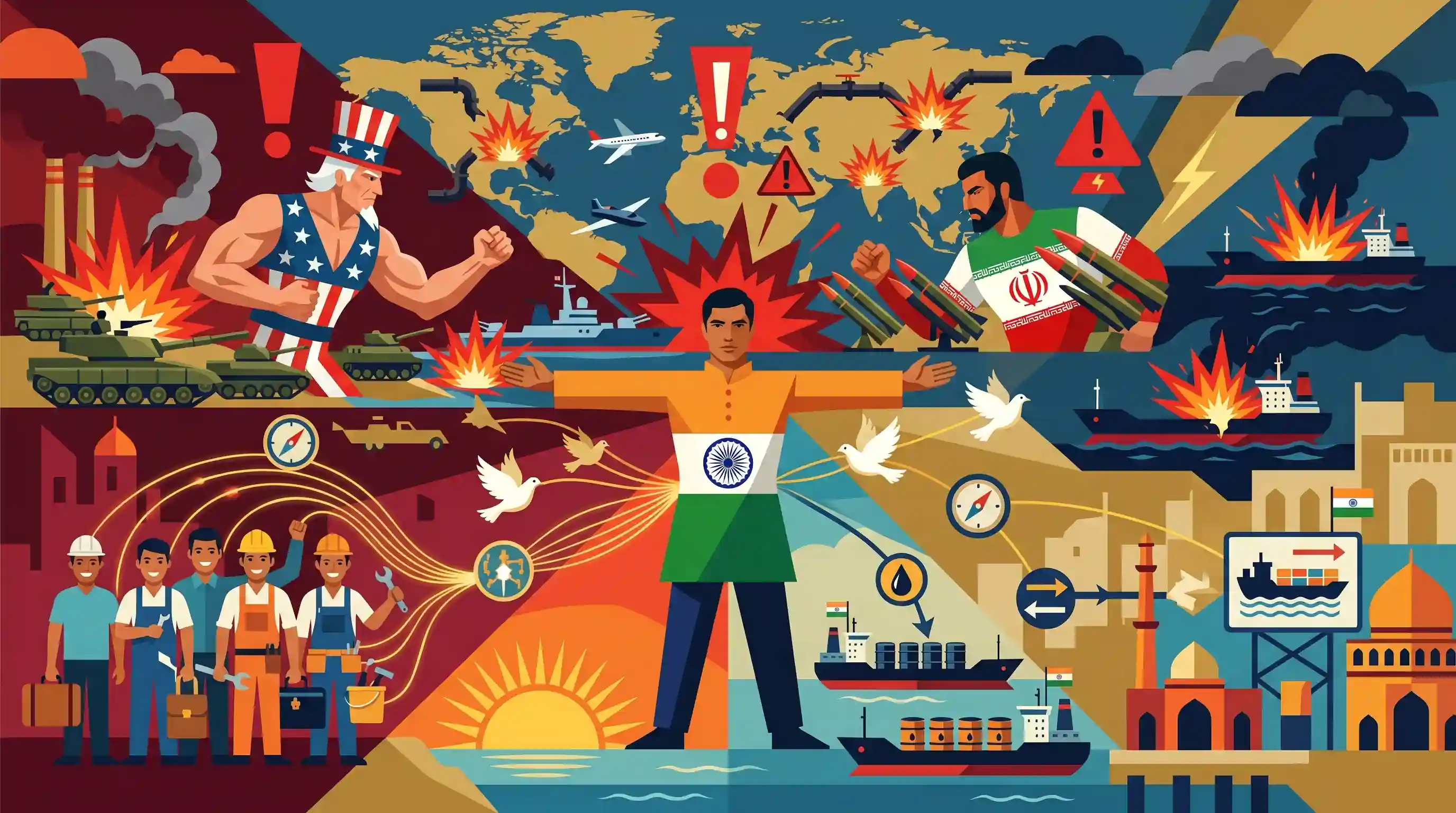
The article warns of escalating tensions between the United States and Iran, suggesting that preparations for a potential military conflict are underway. Such a confrontation would have devastating consequences for regional stability in the Middle East and global energy markets. Given its massive stakes in the region—ranging from crucial oil imports and a vast diaspora to strategic connectivity investments like Chabahar Port—India cannot afford to be a passive bystander. The author argues that New Delhi must leverage its diplomatic ties with both nations to actively mediate and push for de-escalation, thereby protecting its national interests and asserting its geopolitical influence in West Asia.
Key Points
- Rising tensions and the possibility of a direct military confrontation between the US and Iran pose significant threats to regional stability.
- A US-Iran conflict would severely disrupt global energy markets, trade routes, and supply chains, heavily impacting import-dependent economies.
- India has massive stakes in West Asia, including critical energy imports, the safety of a large expatriate diaspora, and strategic connectivity projects like the Chabahar Port.
- The situation demands proactive diplomacy from New Delhi; leveraging its strong relationships with both Washington and Tehran to advocate for de-escalation.
- Taking an active role in conflict mitigation will not only safeguard India's national interests but also reinforce its position as a responsible global power and key stakeholder in Middle Eastern security.
Important Terms
International North-South Transport Corridor (INSTC)

A 7,200-km multi-modal transport network (ship, rail, road) connecting India to Russia and Europe via Iran. It reduces transit time by 40% and costs by 30% compared to the Suez Canal route.
UPSC context
GS Paper II: International Relations. Crucial for connectivity, bypassing Pakistan, and trade diversification with Eurasia. Tests understanding of regional infrastructure projects.
Chabahar Port
A strategic deep-water port in Iran developed by India. It provides a trade gateway to landlocked Afghanistan and Central Asia, bypassing Pakistan, and serves as a key node in the INSTC.
UPSC context
GS Paper II: Strategic importance in West Asia. Tests knowledge of India's neighborhood policy and counter-balancing foreign influence (e.g., China's Gwadar Port).
Strategic Autonomy
The policy principle that India makes independent foreign policy decisions based on national interest, avoiding formal military alliances while engaging with multiple competing global powers (multi-alignment).
UPSC context
GS Paper II: Foreign Policy. Tests understanding of India's diplomatic evolution from Non-Alignment and its pragmatic engagement in a multipolar world.
West Asia
The geopolitical region comprising the Middle East, vital to India due to oil imports, millions of expatriates, and its role as a bridge to Africa and Europe.
UPSC context
GS Paper II: Regional geopolitics. Tests ability to analyze how regional conflicts (e.g., US-Iran) affect India’s energy and diaspora interests.
Energy Security
The reliable availability of energy sources at an affordable price. India imports over 80% of its crude oil, with a significant portion originating from the West Asian region.
UPSC context
GS Paper III: Economy/Infrastructure. Tests understanding of import dependence, price volatility, and the strategic necessity of diversifying energy sources.
Indian Diaspora
The community of over 30 million people of Indian origin living abroad. The ~9 million in West Asia are critical for remittances and India’s soft power influence.
UPSC context
GS Paper II: International Relations. Tests knowledge of the diaspora's role in the economy (remittances) and as a diplomatic pressure group.
Joint Comprehensive Plan of Action (JCPOA)
The 2015 nuclear agreement between Iran and world powers (P5+1) intended to limit Iran's nuclear program in exchange for lifting economic sanctions. Its collapse has fueled regional tensions.
UPSC context
GS Paper II: Global groupings and agreements. Tests understanding of nuclear non-proliferation and its impact on India's energy and investment ties with Iran.
Prelims Trap
"US sanctions completely prohibit all Indian infrastructure investments in Iran, including the Chabahar port."
India historically secured a specific waiver from US sanctions for developing the Chabahar port due to its strategic role in Afghan aid and reconstruction.
Static Concepts Connected
What is the status of India's Strategic Petroleum Reserves (SPR)?
- Phase I Locations: Visakhapatnam, Mangaluru, and Padur, holding a combined capacity of 5.33 MMT of crude oil.
- Strategic Buffer: The SPR provides ~9.5 days of crude coverage, while total commercial and SPR stocks combined cover roughly 74 days of national demand.
- Management: Administered by Indian Strategic Petroleum Reserves Limited (ISPRL), a wholly owned subsidiary of OIDB under the Petroleum Ministry.
What makes the Strait of Hormuz a critical maritime chokepoint?
- Geographic Location: It connects the Persian Gulf to the Gulf of Oman and the Arabian Sea, bordered by Iran, Oman, and the UAE.
- Transit Volume: It handles about a fifth of global oil consumption and roughly 40-50% of India's crude oil imports, alongside 60% of LNG.
- Vulnerability: Because it is narrow, Iran frequently threatens to close the strait during conflicts, which would directly paralyze global energy supply chains.
Cross-Topic Patterns
Energy shocks + Remittance economics
A West Asian conflict impacts India twofold: spiking the crude import bill (widening CAD), while simultaneously threatening the crucial remittance buffer provided by the 9-million-strong diaspora.
De-hyphenation + INSTC connectivity
Geopolitical tensions test India's 'de-hyphenated' policy, forcing a delicate balance between its strategic partnership with the US and operationalizing the INSTC via Iran to access Central Asia.

Expect a multi-statement question mapping West Asian maritime chokepoints (Hormuz, Bab-el-Mandeb) alongside India's SPR capacities in 2026.
Linked PYQs · 4
Linked PYQs · 4
- 2025MainsGS2
"Energy security constitutes the dominant kingpin of India's foreign policy, and is linked with India's overarching influence in Middle Eastern countries.” How would you integrate energy security with India's foreign policy trajectories in the coming years?
- 2018MainsGS2
In what ways would the ongoing US-Iran Nuclear Pact Controversy affect the national interest of India? How should India respond to this situation?
- 2012MainsGS2
How have the US sanctions against Iran affected India's bilateral relations with Iran?
- 2017MainsGS2
The question of India's Energy Security constitutes the most important part of India's economic progress. Analyze India's energy policy cooperation with West Asian countries.
