US Green Card Rule Change Impacts Indian Diaspora and H1B Visa Holders
Source:Indian Express ↗
Why It Matters
The article is crucial for understanding the precarious legal position of the Indian diaspora in the US. Changes in US immigration policy directly impact the livelihoods of highly skilled Indian professionals, demonstrating how the domestic political climate of developed nations affects India's socio-economic interests and its diaspora.
Summary
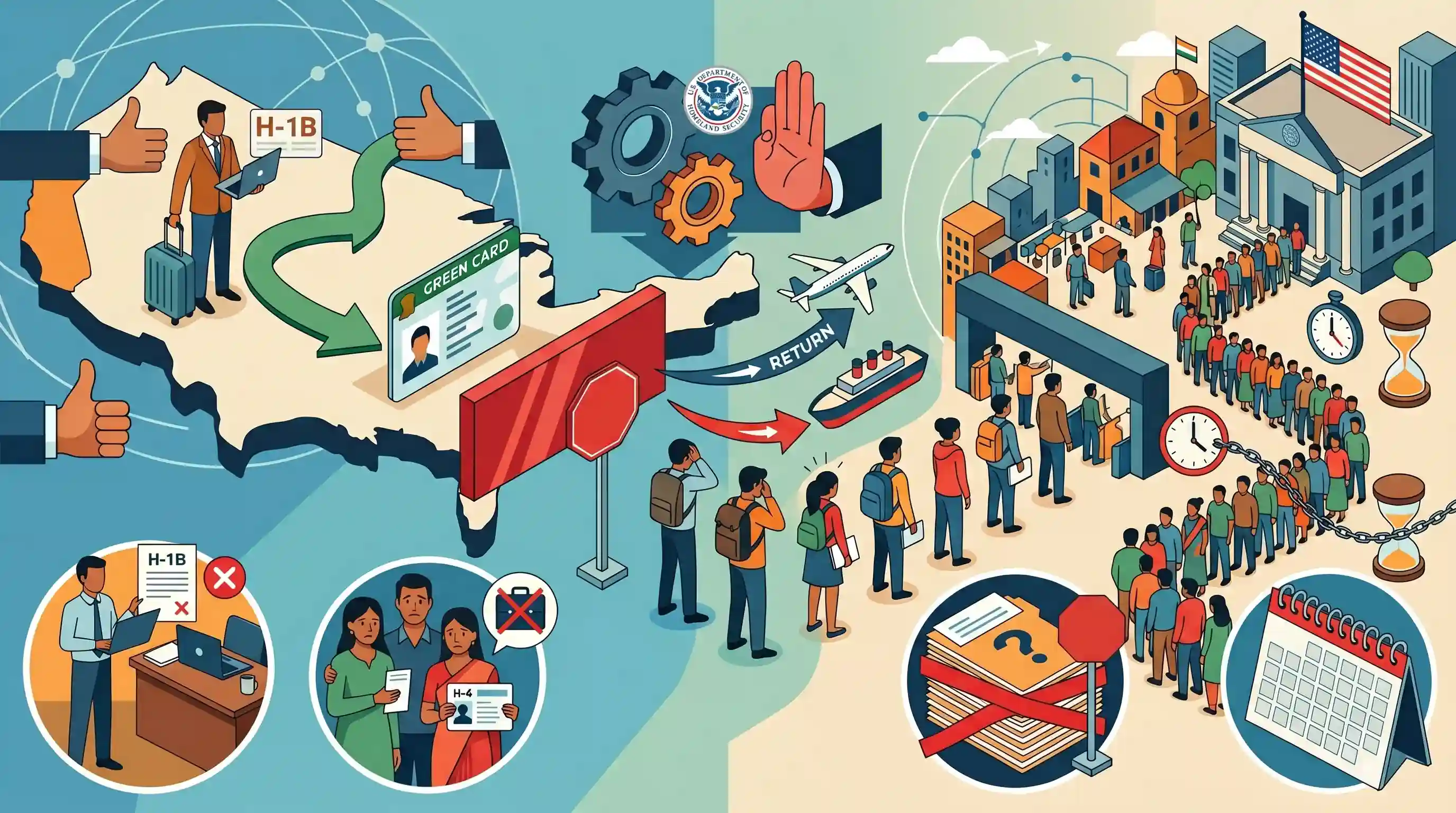
The United States has abruptly tightened its permanent residency process, severely curtailing the 'adjustment of status' route that allowed immigrants to apply for Green Cards while residing in the US. Under the new USCIS guidelines, this process is now considered an 'extraordinary act of administrative grace', compelling many applicants to return to their home countries for consular processing. This policy shift disproportionately threatens lakhs of Indian professionals and students on H-1B and F-1 visas who are trapped in decades-long wait times under the EB-2 and EB-3 categories. Returning to India for processing exposes them to massive appointment backlogs, the risk of indefinite administrative delays, loss of H-4 spousal work authorization, and potential job termination.
Key Points
- The US Department of Homeland Security has introduced a policy requiring Green Card applicants to apply from their home countries instead of using the 'adjustment of status' route from within the US.
- The USCIS memo dictates that the 'adjustment of status' process will now be treated as an 'extraordinary act of administrative grace', placing the burden on applicants to prove exceptional merit.
- The policy change disproportionately affects Indian professionals, who currently dominate the decades-long backlog in the EB-2 and EB-3 employment-based Green Card categories.
- Redirecting cases to consular processing in India threatens to overwhelm the State Department, leading to severe delays, administrative processing hurdles, and potential employer withdrawals.
- If pushed into consular processing, dependent spouses on H-4 visas could lose their Employment Authorization Documents (EAD), cutting off crucial household income.
Important Terms
H-1B Visa

A non-immigrant visa allowing U.S. companies to employ foreign workers in specialty occupations (IT, engineering, medicine). Indian nationals receive approximately 70% of these annually.
UPSC context
GS II: Effect of policies of developed countries; vital for India's high-skilled labor exports and remittances.
Green Card
An official document (Lawful Permanent Residency) granting non-citizens the right to live and work permanently in the United States. Indian professionals face decades-long wait times.
UPSC context
GS II: Indian Diaspora; central to the socio-economic stability and integration of Indian professionals abroad.
Adjustment of Status
The process allowing eligible individuals already present in the U.S. to apply for permanent resident status without returning to their home country for consular processing.
UPSC context
GS II: International Relations; recent restrictive policy shifts create legal and job uncertainty for Indians.
USCIS (U.S. Citizenship and Immigration Services)
A U.S. government agency under the Department of Homeland Security that oversees lawful immigration, adjudicates visa petitions, and manages the naturalization process.
UPSC context
GS II: Important regulatory body whose administrative memos directly affect India-U.S. people-to-people ties.
EB-2 and EB-3 Categories
U.S. employment-based green card categories for professionals with advanced degrees (EB-2) or skilled workers/professionals (EB-3). Indians dominate the massive backlogs in these categories.
UPSC context
GS II: Indian Diaspora; backlogs highlight systemic hurdles in global labor mobility and human capital.
H-4 Visa
A dependent visa issued to the spouse and children of H-1B visa holders. Certain H-4 spouses are eligible for work authorization (EAD).
UPSC context
GS II: Social issues/Diaspora; work permits for dependents are a recurring theme in bilateral trade dialogues.
Prelims Trap
The United Arab Emirates (UAE) is the single largest country-source of inward remittances to India.
The US is actually the single largest country contributing to India's inward remittances (approx. 28% in FY24), having surpassed the UAE in recent years.
Static Concepts Connected
How are inward remittances classified in India's Balance of Payments (BoP)?
- Current Account: Remittances are recorded under the 'Current Account' as part of invisibles, specifically categorized as 'Current Transfers'.
- No Quid Pro Quo: They are unilateral transfers, meaning they are one-way payments without any expectation of a return or corresponding claim.
- Forex Buffer: High inward remittances are crucial for offsetting India's structural merchandise trade deficit, thereby stabilizing the Current Account Deficit (CAD) and the Rupee.
What is the constitutional and legal framework governing Overseas Indians?
- Single Citizenship: Article 9 of the Indian Constitution bars dual citizenship. Acquiring foreign citizenship (like a US passport) automatically results in the loss of Indian citizenship.
- OCI Scheme: Introduced under the Citizenship Act of 1955, the OCI scheme grants a lifelong visa and economic parity with NRIs, but strictly denies voting or political rights.
Cross-Topic Patterns
US Visa norms + WTO GATS Mode 4
Restrictive US visa policies directly impact India's IT services exports, specifically Mode 4 of WTO's GATS (movement of natural persons), pushing Indian IT giants towards nearshoring or domestic capability expansion.
Immigration hurdles + Reverse Brain Drain
Decades-long Green Card backlogs and H-4 work authorization revocations could inadvertently fuel a 'reverse brain drain', funneling highly skilled tech talent back into India's growing startup and AI ecosystem.

GS2 Mains is highly likely to pair US immigration tightening with its impact on India's remittance economy and IT sector exports in 2026.
Linked PYQs · 2
Linked PYQs · 2
- 2020MainsGS2
Indian diaspora has a decisive role to play in the politics and economy of America and European Countries'. Comment with examples.
- 2023MainsGS2
Indian diaspora has scaled new heights in the West. Describe its economic and political benefits for India.
