US Government Shutdown and Comparative Legislative Budget Deadlocks
Source:The Hindu ↗
Why It Matters
Understanding the mechanisms of a 'government shutdown' in the US provides a crucial comparative perspective for UPSC aspirants when studying the Indian parliamentary system, where a failure to pass the budget typically results in the fall of the government rather than a funding halt.
Summary
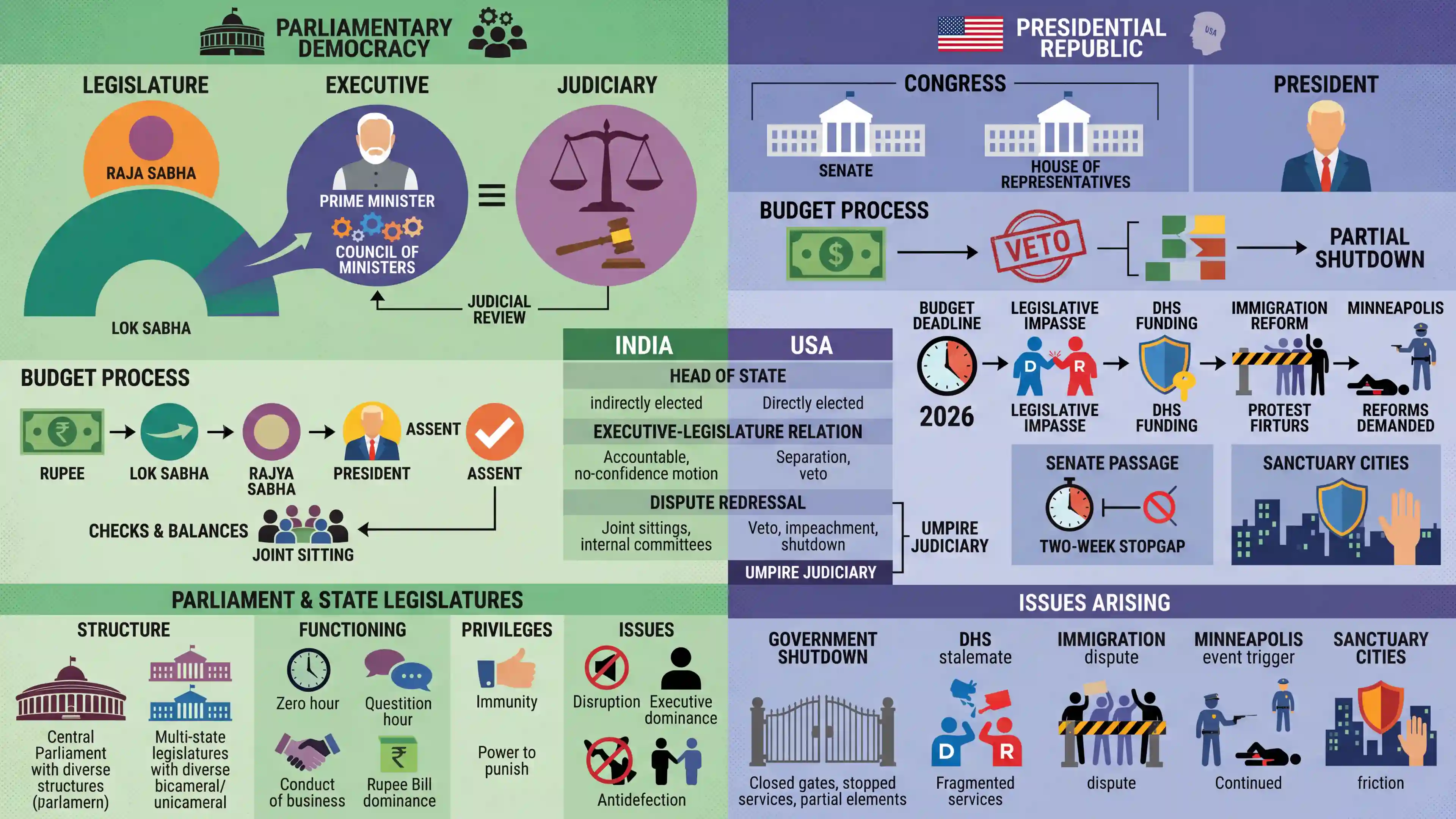
The United States faces a partial government shutdown after Congress failed to pass a 2026 budget before the midnight funding deadline. The legislative impasse is primarily driven by Democratic opposition to funding the Department of Homeland Security (DHS) without significant reforms to immigration enforcement, a demand triggered by the recent killing of two protesters by federal agents in Minneapolis. Although the Senate approved a partial funding package and a two-week stopgap for the DHS, disagreements over issues such as "sanctuary cities" persist, highlighting systemic friction in the US budget process.
Key Points
- A partial US government shutdown occurred due to the passage of the midnight funding deadline without an approved 2026 budget.
- The primary deadlock stems from disagreements over Department of Homeland Security (DHS) funding.
- Democrats demand changes to immigration enforcement following the deaths of two protesters involving federal immigration agents in Minneapolis.
- The Senate passed a package for five outstanding bills alongside a two-week stopgap for the DHS, though provisions concerning 'sanctuary cities' caused friction.
- The scenario illustrates the friction and legislative deadlocks typical in the US Presidential system involving separation of powers.
Important Terms
Government Shutdown

A cessation of non-essential federal operations occurring when the US Congress fails to pass funding legislation, requiring a legislative consensus to resume services.
UPSC context
Relevant for GS Paper II—Comparison of Indian constitutional scheme with other countries, specifically budget stability and executive-legislature relations.
US Congress
The bicameral federal legislature of the US, comprising the House of Representatives and the Senate, characterized by a strict separation of powers from the Executive.
UPSC context
Tested under GS II—Parliament and State Legislatures, and comparative analysis of global legislative structures.
US Senate
The upper house of the US Congress, where states are equally represented; it holds unique powers such as confirming presidential appointments and ratifying treaties.
UPSC context
GS II topic: Comparative study of Upper Houses (Rajya Sabha vs. US Senate) regarding powers and representation.
Department of Homeland Security (DHS)
A US federal cabinet department responsible for public security, immigration enforcement, and border protection, similar in scope to India’s Ministry of Home Affairs.
UPSC context
Relevant for Internal Security (GS III) and bilateral security cooperation (GS II—International Relations).
Continuing Resolution
A short-term 'stopgap' funding bill passed by the US Congress to maintain government operations when regular annual appropriations have not been enacted.
UPSC context
Compared with India's 'Vote on Account' in GS II—Government Budgeting and legislative procedure.
Sanctuary Cities
US local jurisdictions that limit cooperation with federal immigration authorities, often refusing to detain undocumented immigrants without a criminal warrant.
UPSC context
Tests understanding of Federalism and Separation of Powers disputes in developed democracies (GS II).
Vote on Account
A provision under Article 116 of the Indian Constitution allowing the Lok Sabha to grant funds in advance for essential expenditures before the full budget is passed.
UPSC context
A core GS II concept used to contrast Indian budget continuity with the risk of US shutdowns.
Prelims Trap
"If the Union Budget is not passed by Parliament, it triggers a partial government shutdown."
In India's parliamentary system, a defeated budget implies a loss of majority. The Prime Minister must resign, dissolving the cabinet, rather than halting operations.
Static Concepts Connected
What mechanisms prevent a US-style budgetary deadlock in India?
- Vote on Account: Under Article 116, Lok Sabha grants advance funds for estimated expenditure for part of the year pending the regular budget's enactment.
- Rajya Sabha Limits: Under Article 109, Rajya Sabha can only delay a Money Bill by 14 days, preventing US-style upper-house budgetary deadlocks.
Can Indian states refuse to enforce Union laws like US "sanctuary cities"?
- Article 256: Mandates that state executive power must ensure compliance with laws made by Parliament, barring local defiance seen in US dual federalism.
- Coercive Sanctions: Failure of a state to comply allows the Union to invoke Article 365, potentially leading to President's Rule under Article 356.
Cross-Topic Patterns
Executive-Legislative Fusions
The US Presidential shutdown contrasts sharply with India’s parliamentary confidence principle, where budget failure dissolves the government rather than pausing civil services.
Federalism and Law Enforcement
US 'sanctuary cities' reflect local autonomy in enforcement. India's constitutional scheme strictly prevents this via Article 256, giving the Centre coercive tools to ensure compliance.

Expect a comparative Prelims statement contrasting the US Senate's co-equal budgetary powers with the Rajya Sabha's limits under Art 109.
Linked PYQs · 3
Linked PYQs · 3
- 2023MainsGS2
Compare and contrast the British and Indian approaches to Parliamentary sovereignty.
- 2019MainsGS2
Do you think that Constitution of India does not accept principle of strict separation of powers rather it is based on the principle of 'checks and balance'? Explain.
- 2021MainsGS2
To what extent, in your view, the Parliament is able to ensure accountability of the executive in India?
