United States Federal Reserve Monetary Policy and Inflation
Source:The Hindu ↗
Why It Matters
US Federal Reserve rate decisions and global geopolitical conflicts directly influence global capital flows, exchange rates, and commodity prices (like crude oil). These factors significantly impact India's macroeconomic stability, imported inflation, and RBI's monetary policy responses.
Summary
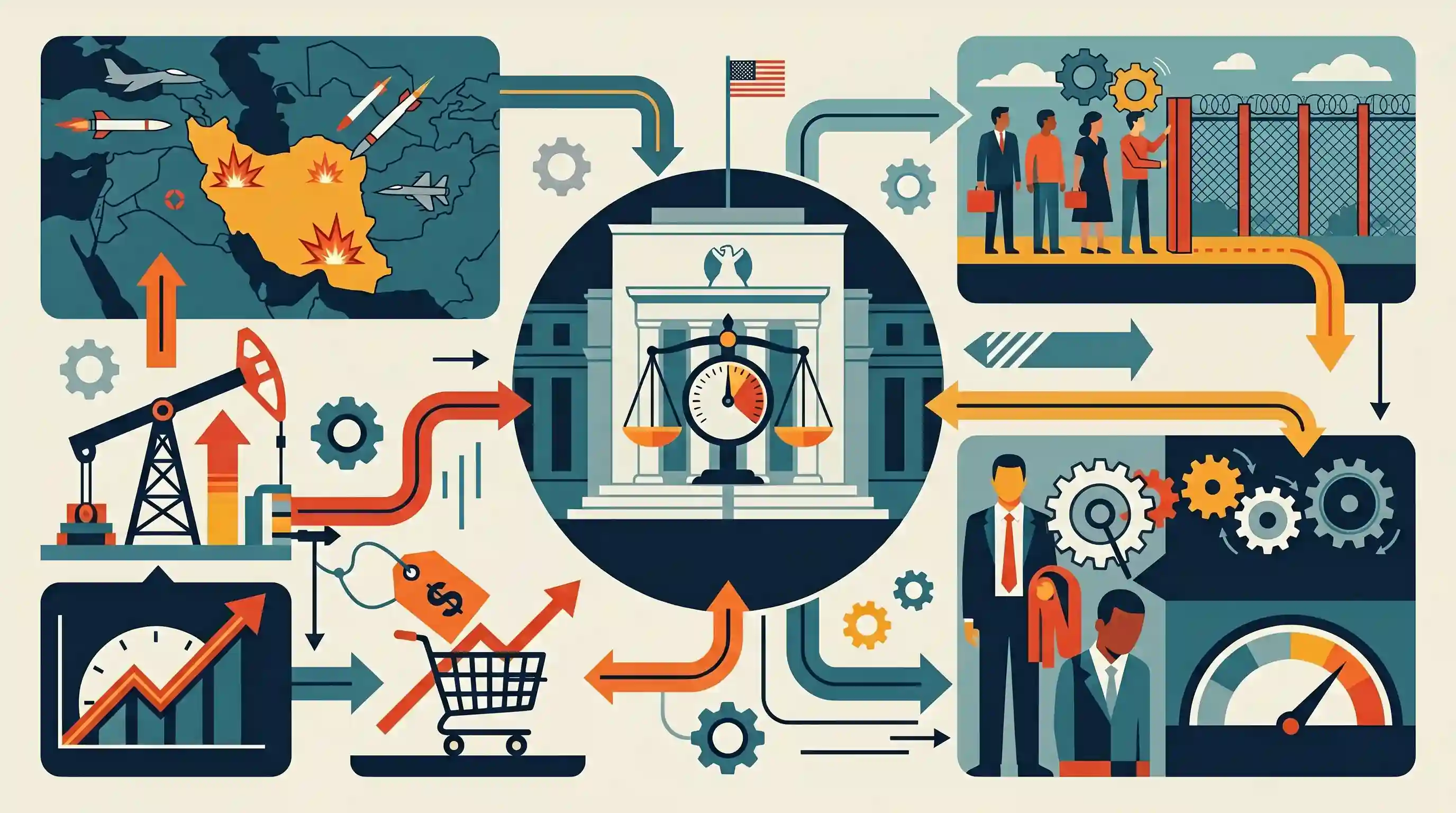
The US Federal Reserve has kept its benchmark interest rates unchanged at 3.50% to 3.75%, citing an uncertain economic outlook driven by the ongoing war in West Asia involving Iran. The conflict has led to a spike in global oil prices, complicating the Fed's efforts to control sticky inflation, which is now projected to remain above the 2% target at 2.7% by the end of 2026. Simultaneously, the US labor market is showing signs of weakness, with unemployment rising to 4.4% as labor supply drops due to recent immigration crackdowns. This scenario underscores the complex challenge of balancing domestic monetary policy mandates amidst geopolitical disruptions and supply-side shocks.
Key Points
- The US Federal Reserve held its benchmark interest rates unchanged at 3.50% to 3.75%, opting for a cautious approach amid economic uncertainty.
- Geopolitical tensions in West Asia, specifically the conflict involving Iran, have caused spikes in global oil prices, creating supply-side risks to inflation.
- The Fed anticipates inflation to remain sticky, projecting it to reach 2.7% by December 2026, which is above its long-term 2% target.
- The US labor market is experiencing sluggish demand, with unemployment rising to 4.4%, partly attributed to a shrinking workforce resulting from recent immigration crackdowns.
- The decision highlights the challenges of navigating a dual mandate (controlling inflation vs. maximizing employment) when faced with external supply shocks and domestic policy changes.
Important Terms
US Federal Reserve

The central banking system of the United States. It manages monetary policy, regulates banks, and sets interest rates that influence global capital flows, liquidity, and currency values.
UPSC context
GS III (Economy); crucial for understanding Foreign Portfolio Investment (FPI) outflows, exchange rate volatility, and the Rupee’s stability during global rate shifts.
Inflation Targeting
A monetary policy framework where a central bank (like the RBI or Fed) adjusts interest rates to achieve a specific annual inflation goal to ensure long-term price stability.
UPSC context
GS III (Economy); relates to the RBI’s legal mandate (4% +/- 2%) and the Monetary Policy Committee's role in managing price expectations.
Sticky Inflation
A phenomenon where prices and wages do not adjust quickly to changes in economic conditions, causing inflation to remain high even when demand slows or interest rates rise.
UPSC context
GS III (Economy); tests the understanding of persistent cost-push inflation and why rate hikes may take time to stabilize the economy.
Supply-side Shocks
Sudden disruptions in the supply of essential commodities (like oil or food) that cause sharp, immediate price increases, often resulting in cost-push inflation and reduced economic output.
UPSC context
GS III (Economy); relevant to India's vulnerability to global crude oil spikes and the limitations of monetary policy in addressing non-demand inflation.
Energy Security
A nation's ability to maintain a reliable, affordable, and sustainable supply of energy. It is often threatened by geopolitical conflicts that disrupt trade routes like the Strait of Hormuz.
UPSC context
GS II (IR) & GS III (Economy); vital for India’s strategic interests in West Asia and its impact on the national trade deficit.
Imported Inflation
General price increases within a country caused by the rising cost of imported raw materials or goods, often worsened when the domestic currency weakens against the US Dollar.
UPSC context
GS III (Economy); critical for analyzing how global wars and Rupee depreciation lead to higher domestic fuel and manufacturing costs.
Prelims Trap
Central banks primarily use interest rate hikes to directly eliminate cost-push inflation caused by geopolitical oil supply shocks.
Rate hikes primarily curb demand-pull inflation by reducing money supply. They cannot fix supply-side disruptions (like wars halting oil), and aggressively raising rates during supply shocks risks triggering stagflation.
Static Concepts Connected
How does Cost-Push inflation differ from Demand-Pull inflation?
- Demand-Pull: Occurs when aggregate demand outstrips supply. Effectively managed by central banks through interest rate hikes to curb excess money supply and borrowing.
- Cost-Push: Driven by supply-side shocks, like oil price spikes from geopolitical conflicts, raising overall production costs. It is notably harder to control via monetary policy.
- Sticky Inflation: Prices (especially wages, housing, and services) that resist downward adjustment despite monetary tightening or cooling demand.
What is the US Fed's Dual Mandate compared to the RBI's framework?
- US Dual Mandate: The US Federal Reserve is statutorily bound to pursue two equal macroeconomic goals: maximizing domestic employment and stabilizing prices.
- RBI FIT Framework: Operates under Flexible Inflation Targeting (FIT), making price stability (4% +/- 2%) the primary objective, while keeping the objective of economic growth in mind.
Cross-Topic Patterns
Immigration policies & wage-price spirals
Protectionist labor policies, like US immigration crackdowns, artificially shrink the workforce. This sparks labor shortages and wage-driven 'sticky inflation', severely complicating traditional macroeconomic monetary policy.
West Asia conflicts & India's CAD
Geopolitical tension in Iran spikes global crude prices. For import-dependent India, this translates to immediate imported inflation, a widening Current Account Deficit (CAD), and currency depreciation.

Expect a 2026 Prelims statement differentiating RBI's Flexible Inflation Targeting from the US Fed's Dual Mandate amid supply shocks.
Linked PYQs · 3
Linked PYQs · 3
- 2023PrelimsGS1
Consider the following statements: Statement-I: In the post-pandemic recent past, many Central Banks worldwide had carried out interest rate hikes. Statement-II: Central Banks generally assume that they have the ability to counteract the rising consumer prices via monetary policy means. Which one of the following is correct in respect of the above statements?
- 2022PrelimsGS1
With reference to the Indian economy, consider the following statements: 1. If the inflation is too high, Reserve Bank of India (RBI) is likely to buy government securities. 2. If the rupee is rapidly depreciating, RBI is likely to sell dollars in the market. 3. If interest rates in the USA or European Union were to fall, that is likely to induce RBI to buy dollars. Which of the statements given above are correct?
- 2024MainsGS3
What are the causes of persistent high food inflation in India? Comment on the effectiveness of the monetary policy of the RBI to control this type of inflation.
