US Extends Sanctions Waiver on Russian Seaborne Oil Amid Price Rise
Source:The Hindu ↗
Why It Matters
The crisis in West Asia and the resulting blockade of the Strait of Hormuz threaten global energy security, making it a critical issue for UPSC aspirants studying international relations and energy geopolitics. It also highlights the complexities of India's foreign policy navigating unilateral sanctions to secure its national interests.
Summary
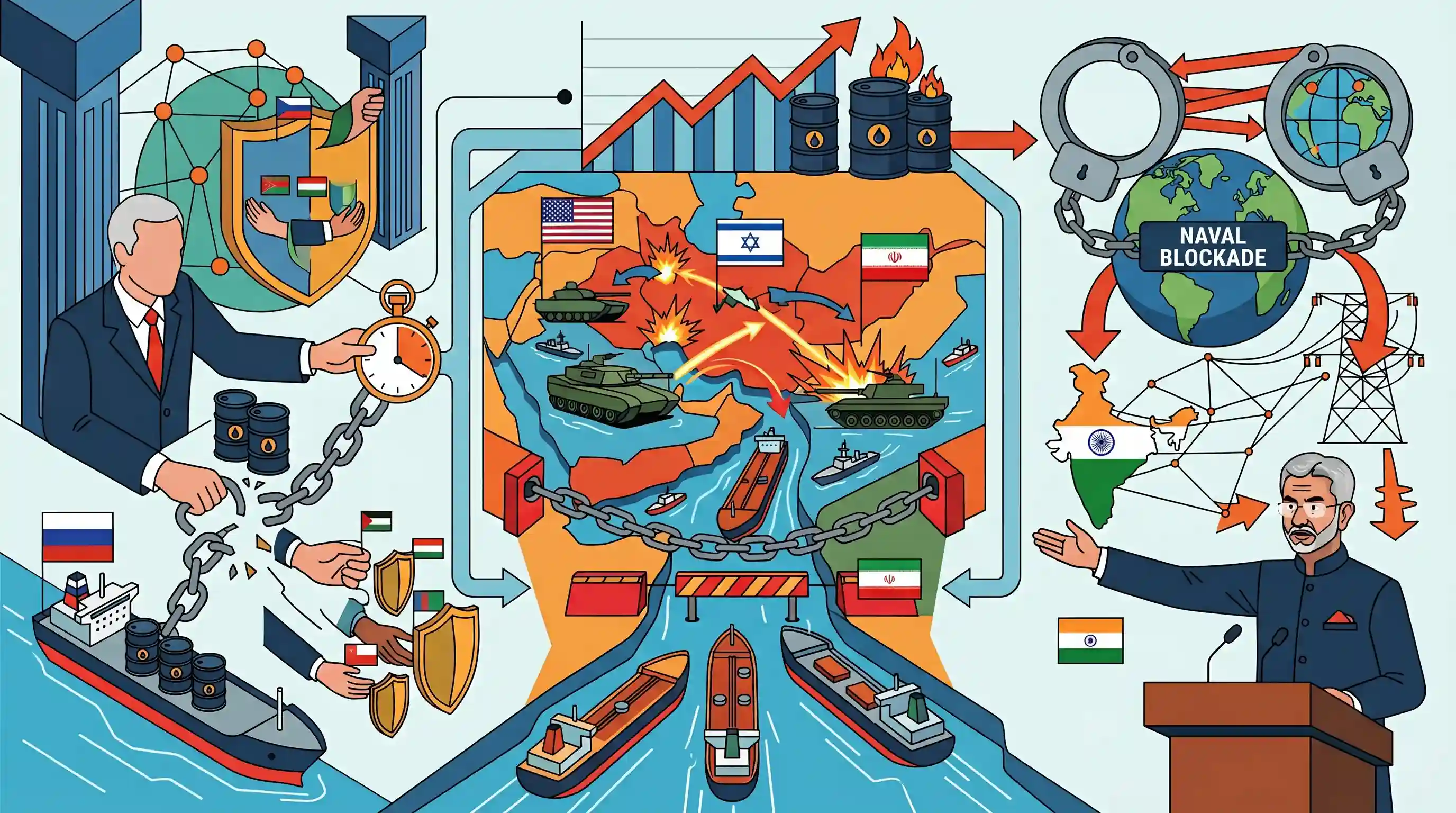
The United States has extended its sanctions waiver on Russian seaborne oil for an additional 30 days amid a sharp rise in global energy prices. The price surge is largely attributed to the U.S.-Israel war on Iran, which has resulted in Iran blocking the Strait of Hormuz—a critical chokepoint for global oil and gas distribution. The U.S. Treasury cited the need for flexibility to protect energy-vulnerable countries. Meanwhile, India's External Affairs Minister S. Jaishankar has criticized unilateral sanctions, emphasizing the challenges such policies pose to the global economy and India's energy security imperatives.
Key Points
- The U.S. has extended the sanctions waiver on Russian seaborne oil for 30 days to mitigate surging global energy prices.
- The global energy crisis has been exacerbated by the ongoing U.S.-Israel war on Iran.
- Iran has blocked the Strait of Hormuz, a crucial global oil and gas chokepoint, disrupting supply chains.
- The extension of the waiver provides temporary market stability for energy-vulnerable countries.
- India's External Affairs Minister criticized unilateral sanctions, highlighting India's focus on energy security and strategic autonomy.
Important Terms
Strait of Hormuz

A narrow waterway connecting the Persian Gulf and the Gulf of Oman; it is the world's most critical energy passage, handling approximately 20% of global oil consumption.
UPSC context
GS Paper 1 (Geography) and GS 2 (IR). Essential for mapping and understanding West Asia's influence on India’s energy imports.
Unilateral Sanctions
Economic or trade restrictions imposed by a single nation without authorization from a multilateral body like the UN, typically to influence another state's strategic behavior.
UPSC context
GS Paper 2 (IR). Relevant for analyzing international law, Indo-US relations, and the impact of extraterritorial laws on developing economies.
Strategic Autonomy
The core Indian foreign policy doctrine of making independent decisions based on national interest, avoiding formal military alliances while maintaining flexible partnerships with competing global powers.
UPSC context
GS Paper 2 (IR). Tests India's "multi-alignment" strategy in a multipolar world, especially regarding ties with the U.S., Russia, and Iran.
Energy Security
The uninterrupted availability of energy sources at an affordable price, crucial for a nation's economic stability and growth amid global supply chain disruptions.
UPSC context
GS Paper 3 (Economy). Vital for discussions on industrial growth, managing inflation, and reducing dependency on volatile energy routes.
Sanctions Waiver
A legal mechanism that temporarily exempts specific entities or transactions from existing sanctions to prevent unintended economic damage to global markets or partner nations.
UPSC context
GS Paper 2 (IR). Important for understanding diplomatic negotiations, energy trade carve-outs, and the G7 oil price cap mechanism.
U.S. Treasury Department
The U.S. federal agency responsible for economic policy and enforcing financial sanctions through the Office of Foreign Assets Control (OFAC) to advance national security goals.
UPSC context
GS Paper 2/3. Significant for studying global financial governance, the "weaponization of the dollar," and international banking regulations.
Maritime Chokepoint
A narrow geographic feature, such as a strait or canal, whose blockage can significantly disrupt global trade and energy supply chains due to limited alternative routes.
UPSC context
GS Paper 1 (Geography) and GS 2 (IR). Focuses on maritime security, freedom of navigation, and global trade vulnerabilities.
Prelims Trap
"India legally recognizes and enforces both UNSC multilateral sanctions and U.S. unilateral sanctions."
India's official policy recognizes ONLY UN Security Council sanctions. While Indian entities practically comply with U.S. sanctions to retain SWIFT access, the Indian state legally rejects unilateral economic measures.
Static Concepts Connected
Which water bodies and nations bound the Strait of Hormuz?
- Connecting Waters: It connects the Persian Gulf to the Gulf of Oman and the broader Arabian Sea.
- Bordering Nations: Bordered by Iran to the north and the UAE and Oman (Musandam exclave) to the south.
- Strategic Importance: It is the world's most critical oil transit chokepoint, handling roughly 20% of global daily oil consumption.
What are Secondary (Extraterritorial) Sanctions?
- Primary vs Secondary: Measures that restrict citizens and companies of the sanctioning country from doing business with the target nation.
- Extraterritorial Reach: Secondary sanctions penalize third-party nations or entities (like Indian banks) for trading with a sanctioned country, usually by denying them access to the sanctioning country's financial system.
- India's Official Stance: India strictly maintains that it is not legally bound by unilateral secondary sanctions, relying only on UN-mandated regimes to guide its foreign policy.
Cross-Topic Patterns
Maritime Chokepoints + Macroeconomic Shocks
The Hormuz blockade mirrors recent Red Sea/Bab-el-Mandeb disruptions. UPSC frequently tests the cascading impact of West Asian geopolitical instability on India's macroeconomic stability (inflation, current account deficit).
Secondary Sanctions + Rupee Internationalization
Vulnerability to secondary sanctions drives India's push for de-dollarization. Expect linkages between unilateral sanctions and RBI's initiatives for Rupee Vostro accounts and non-SWIFT payment settlements.

Expect a map-based multi-statement question in 2026 linking West Asian chokepoints (Hormuz, Bab-el-Mandeb) to bordering nations.
Linked PYQs · 2
Linked PYQs · 2
- 2025MainsGS2
"Energy security constitutes the dominant kingpin of India's foreign policy, and is linked with India's overarching influence in Middle Eastern countries.” How would you integrate energy security with India's foreign policy trajectories in the coming years?
- 2017MainsGS2
The question of India's Energy Security constitutes the most important part of India's economic progress. Analyze India's energy policy cooperation with West Asian countries.
