Restructuring Global Climate Governance and Finance
Source:Indian Express ↗
Why It Matters
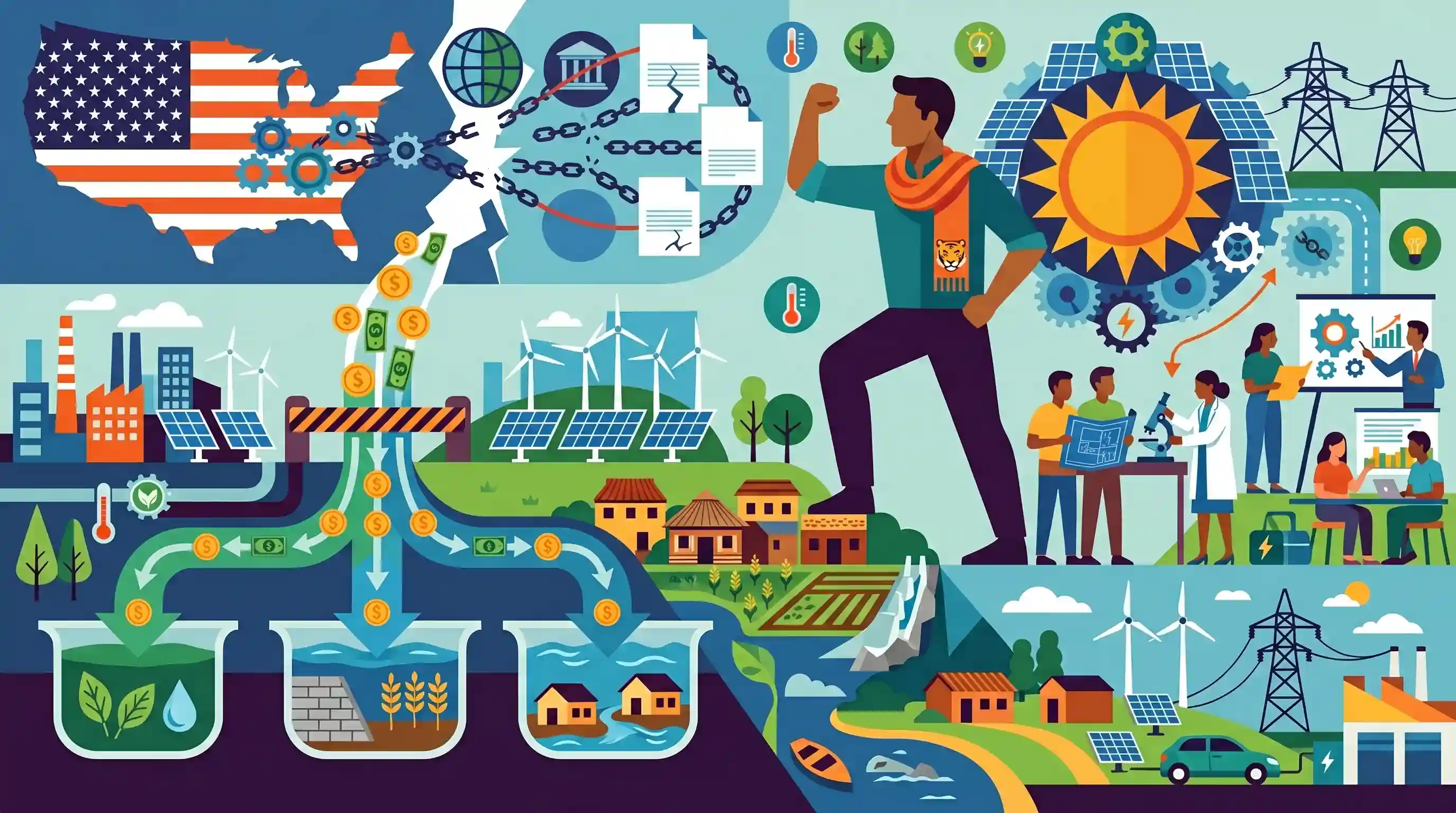
A US withdrawal from the UNFCCC drastically alters the landscape of global environmental geopolitics. It necessitates an understanding of equitable climate finance mechanisms and highlights India's strategic imperatives to lead Global South initiatives and renewable energy transitions.
Summary
The article discusses the implications of a potential US withdrawal from global climate governance frameworks, including the UNFCCC, Paris Agreement, and IPCC. While this creates a significant gap in climate finance and research, it also offers a strategic opportunity to restructure international climate efforts. The author argues for reforming climate finance to prioritize the Global South through the Green Climate Fund, Adaptation Fund, and Loss and Damage Fund, rather than disproportionately funding mitigation in middle-income countries. Furthermore, India is positioned to fill the leadership void by utilizing the International Solar Alliance (ISA) to drive capacity building and renewable energy development in poorer nations.
Key Points
- The anticipated withdrawal of the US from global climate agreements (UNFCCC, Paris Pact) and scientific bodies (IPCC) under Donald Trump will create a massive deficit in climate governance, finance, and research.
- This exit presents an opportunity to reimagine the global climate architecture, shifting focus from mitigation largely benefiting middle-income countries to addressing historical responsibilities toward the Global South.
- Future climate governance should prioritize the Green Climate Fund, Adaptation Fund, and Loss and Damage Fund to assist vulnerable nations in adaptation and recovery.
- India can leverage this transition to assume a leadership role by expanding the International Solar Alliance (ISA) to build renewable energy capacities and facilitate technology transfer in developing countries.
Important Terms
UNFCCC

An international environmental treaty adopted at the 1992 Rio Earth Summit. It provides the primary framework for global climate negotiations to stabilize greenhouse gas concentrations in the atmosphere.
UPSC context
GS Paper III (Environment). Tests knowledge of global institutional frameworks and the history of international climate negotiations.
Paris Agreement
A legally binding 2015 international treaty aiming to limit global warming to well below 2°C, preferably 1.5°C, through self-determined climate action plans called Nationally Determined Contributions.
UPSC context
GS Paper III. Essential for understanding mitigation targets, NDCs, and the shift from the Kyoto Protocol's top-down model.
IPCC
A UN scientific body established in 1988 (by WMO and UNEP) that provides policymakers with objective, periodic assessments of climate change science, impacts, and mitigation options.
UPSC context
GS Paper III. Evaluates understanding of scientific reporting and the technical basis informing global climate policies.
Green Climate Fund (GCF)
Established under the UNFCCC in 2010, it is the world’s largest climate fund, designed to help developing countries reduce emissions and adapt to climate change.
UPSC context
GS Paper III (Climate Finance). Tests understanding of North-South equity and the transfer of resources between nations.
Loss and Damage Fund
A financial mechanism established at COP27 to provide financial assistance to vulnerable developing nations suffering from unavoidable, irreversible climate impacts like sea-level rise or extreme weather.
UPSC context
GS Paper III. Focuses on climate justice, compensation for historical emissions, and recent environmental governance developments.
International Solar Alliance (ISA)
An India-France joint initiative launched in 2015 to promote solar energy deployment globally. It is the first treaty-based intergovernmental organization headquartered in India (Gurugram).
UPSC context
GS Paper II & III. Highlights India's leadership in renewable energy diplomacy and South-South cooperation.
Prelims Trap
Membership to the International Solar Alliance (ISA) is strictly restricted to countries situated between the Tropics.
False. A 2020 amendment to the ISA Framework Agreement opened membership to all United Nations member states, removing the original geographic restriction entirely.
Static Concepts Connected
What are the key multilateral climate funds under the UNFCCC framework?
- Green Climate Fund: Established at COP16 (Cancun, 2010) as the operating entity of the Financial Mechanism to assist developing countries in adaptation and mitigation.
- Adaptation Fund: Established in 2001 under the Kyoto Protocol to finance concrete adaptation projects in developing country Parties that are particularly vulnerable to climate effects.
- Loss and Damage Fund: Agreed upon at COP27 and operationalized at COP28 (hosted by the World Bank) to rescue and rebuild vulnerable nations facing severe climate impacts.
What is the International Solar Alliance (ISA)?
- Origin & Status: A treaty-based intergovernmental organization jointly launched by India and France in 2015 on the sidelines of COP21 in Paris.
- Core Objective: To collectively address scaling up of solar energy and mobilize USD 1,000 billion of investment in solar solutions by 2030.
- Headquarters: Its headquarters and secretariat are hosted by India in Gurugram, Haryana, making it the first international intergovernmental treaty-based organization headquartered in India.
Cross-Topic Patterns
Climate Finance & Global South Diplomacy
India’s push to restructure climate finance directly aligns with its recent "Voice of the Global South" summits and its steadfast advocacy for Common But Differentiated Responsibilities (CBDR) at the UN.
US Multilateral Retreat & Middle Powers
Historical US retreats from global bodies (like UNESCO and WHO) consistently create vacuums that elevate middle-power coalitions, giving prominence to India-led institutions like ISA and CDRI.

Expect a 2026 question linking US climate retreat to India's leadership in ISA, CDRI, and Global South climate finance architecture.
Linked PYQs · 5
Linked PYQs · 5
- 2025MainsGS3
Write a review on India's climate commitments under the Paris Agreement (2015) and mention how these have been further strengthened in COP26 (2021). In this direction, how has the first Nationally Determined Contribution intended by India been updated in 2022?
- 2022MainsGS3
Discuss global warming and mention its effects on the global climate. Explain the control measures to bring down the level of greenhouse gases which cause global warming, in the light of the Kyoto Protocol, 1997.
- 2025PrelimsGS1
Consider the following statements : Statement I: Article 6 of the Paris Agreement on climate change is frequently discussed in global discussions on sustainable development and climate change. Statement II: Article 6 of the Paris Agreement on climate change sets out the principles of carbon markets. Statement III : Article 6 of the Paris Agreement on climate change intends to promote inter-country non-market strategies to reach their climate targets. Which one of the following is correct in respect of the above statements?
- 2010PrelimsGS1
The United Nations Framework Convention on Climate Change (UNFCCC) is an international treaty drawn at
- 2016PrelimsGS1
With reference to the Agreement at the UNFCCC Meeting in Paris in 2015, which of the following statements is/are correct? 1. The Agreement was signed by all the member countries of the UN and it will go into effect in 2017. 2. The Agreement aims to limit the greenhouse gas emissions so that the rise in average global temperature by the end of this century does not exceed 2°C or even 1.5°C above pre-industrial levels. 3. Developed countries acknowledged their historical responsibility in global warming and committed to donate $ 1000 billion a year from 2020 to help developing countries to cope with climate change. Select the correct answer using the code given below.
