US Withdrawal from Global Climate Agreements
Source:Indian Express ↗
Why It Matters
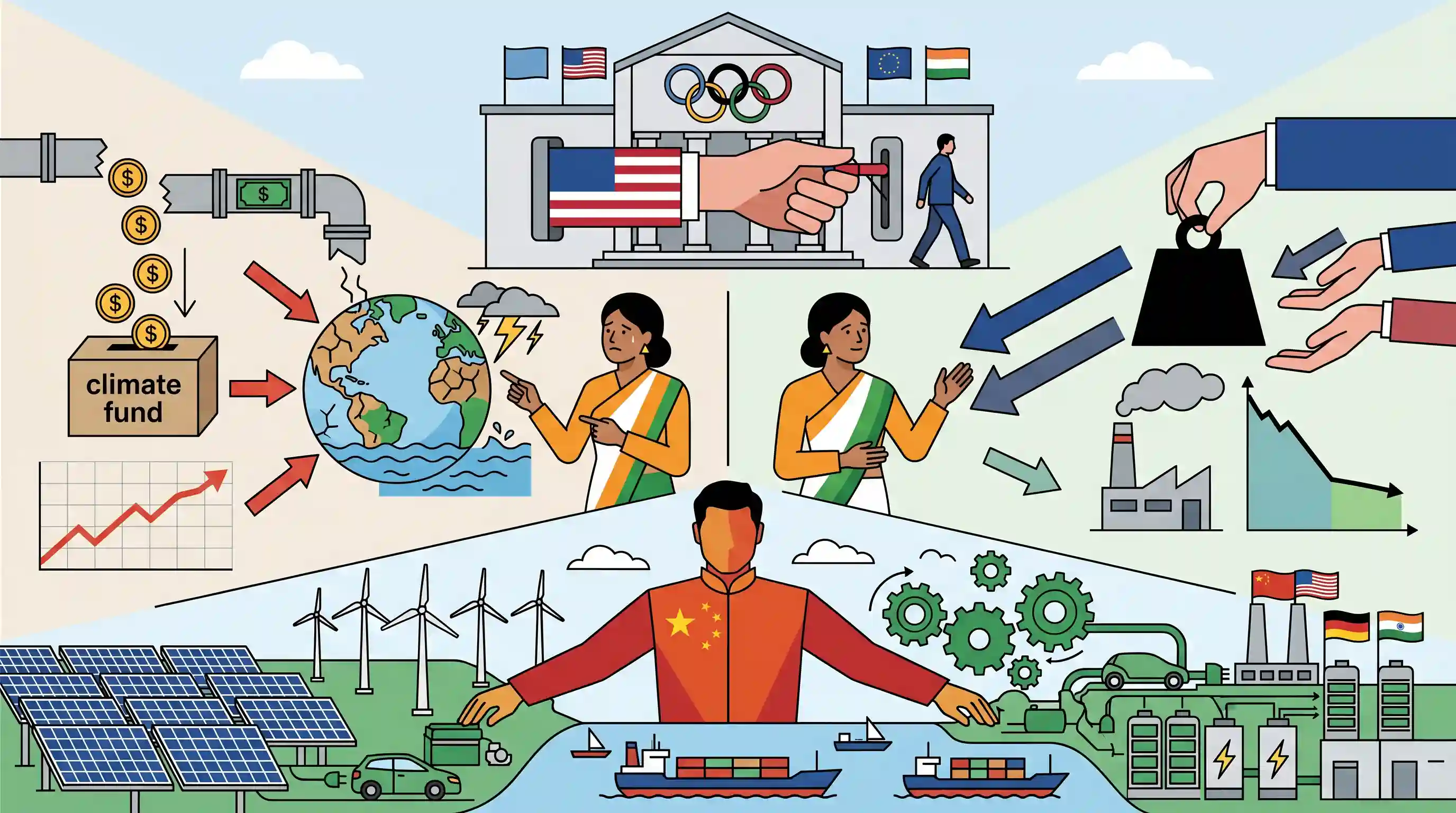
The US is a massive historical emitter and a key player in global climate finance. Its exit from multilateral agreements alters the geopolitical balance, directly impacting India's climate diplomacy, its negotiating stance on Common But Differentiated Responsibilities (CBDR), and its access to critical funding for the clean energy transition.
Summary
The article analyzes the dual implications for India following a potential US withdrawal from international climate bodies such as the UNFCCC and the Paris Agreement. While the US exit creates profound challenges—including a critical gap in climate finance and the weakening of global mitigation efforts—it also offers India temporary relief from aggressive Western pressure to rapidly phase out coal and escalate emission targets. Furthermore, the absence of the US is likely to reshape global climate geopolitics, potentially leaving China with unchecked dominance over clean energy technologies and supply chains.
Key Points
- The potential exit of the US from international climate bodies like the Paris Agreement significantly weakens global emission reduction efforts, posing severe risks to climate-vulnerable nations like India.
- A US withdrawal creates a massive shortfall in global climate finance and technology transfer, placing an increased burden on developing countries trying to fund their clean energy transitions.
- Conversely, the exit provides temporary diplomatic relief for India by easing the intense pressure previously exerted by the US to rapidly phase out coal and adopt tighter, more stringent mitigation targets.
- Geopolitically, the vacuum left by the US risks allowing China to cement its dominance over the global clean energy transition and critical renewable technology supply chains.
- India must adapt its climate diplomacy to navigate this changing multilateral landscape, balancing domestic energy security needs with its Nationally Determined Contributions (NDCs).
Important Terms
UNFCCC

Adopted at the 1992 Rio Earth Summit, this international treaty provides the foundational framework for global cooperation to stabilize greenhouse gas concentrations and prevent dangerous human interference with the climate system.
UPSC context
GS Paper II (International Relations) and GS Paper III (Environment). It is the parent treaty for all major climate agreements.
Paris Agreement
A legally binding international treaty adopted in 2015 (COP21) aiming to limit global warming to well below 2°C, preferably 1.5°C, compared to pre-industrial levels through voluntary national commitments.
UPSC context
GS Paper III (Environment). Tests knowledge of global mitigation targets and India's 'Panchamrit' climate pledges.
CBDR-RC
A foundational principle of the UNFCCC acknowledging that while all states are responsible for addressing climate change, developed nations bear greater historical responsibility and possess more financial/technological capacity.
UPSC context
GS Paper II & III. Central to India's 'Climate Justice' stance, highlighting the equity debate between the Global North and South.
Nationally Determined Contributions (NDCs)
Self-determined climate action plans submitted every five years by parties to the Paris Agreement, outlining their specific targets for reducing emissions and adapting to climate impacts.
UPSC context
GS Paper III. Focuses on India's specific targets, such as reducing emissions intensity and increasing non-fossil fuel capacity.
Climate Finance
Local, national, or transnational funding—from public, private, and alternative sources—intended to support climate mitigation and adaptation actions, particularly in developing and vulnerable nations.
UPSC context
GS Paper III. Critical for questions on the $100 billion annual pledge and the New Collective Quantified Goal (NCQG).
Conference of the Parties (COP)
The supreme decision-making body of the UNFCCC, consisting of all member nations, which meets annually to review the implementation of the Convention and associated legal instruments.
UPSC context
GS Paper III. Frequently tested in Prelims regarding specific outcomes (e.g., COP26 Glasgow, COP28 Dubai).
Prelims Trap
A member state can withdraw from the Paris Agreement with immediate effect upon formal notification.
Under Article 28, a party can only give notice of withdrawal three years after the Agreement's entry into force, taking effect one year later. It is not immediate.
Static Concepts Connected
What are the primary climate finance mechanisms under the UNFCCC?
- GEF and GCF: The Global Environment Facility (GEF) and Green Climate Fund (GCF) serve as the primary operating entities of the UNFCCC's financial mechanism to fund mitigation and adaptation.
- Loss and Damage Fund: Operationalized at COP28, this fund aims to provide financial assistance to vulnerable developing countries facing severe, unavoidable impacts of climate change.
- Adaptation Fund: Established under the Kyoto Protocol, it continues to fund adaptation projects in developing countries, though largely overshadowed by the GCF today.
What are the exact commitments under India’s 'Panchamrit' strategy?
- 500 GW Capacity: India pledged to reach 500 GW of non-fossil energy capacity by the year 2030.
- 50% Renewable Share: India committed to meeting 50% of its total energy requirements from renewable energy sources by 2030.
- Emissions & Net Zero: India will reduce projected total carbon emissions by one billion tonnes and reduce the carbon intensity of its economy by 45% by 2030, aiming for Net Zero by 2070.
Cross-Topic Patterns
Climate geopolitics & critical minerals
US withdrawal consolidates China’s near-monopoly on solar and battery mineral supply chains, escalating the strategic importance of groupings like the Quad and the Minerals Security Partnership for India.
Multilateralism vs. Bilateral climate finance
The exit highlights the fragility of climate finance commitments, forcing developing nations to increasingly rely on bilateral partnerships rather than multilateral UNFCCC mechanisms to fund their clean energy transitions.

The geopolitical vacuum in climate treaties and its impact on critical mineral supply chains is a prime 2026 Mains GS-2/GS-3 crossover.
Linked PYQs · 4
Linked PYQs · 4
- 2022MainsGS2
‘Clean energy is the order of the day.’ Describe briefly India's changing policy towards climate change in various international fora in the context of geopolitics.
- 2025MainsGS3
Write a review on India's climate commitments under the Paris Agreement (2015) and mention how these have been further strengthened in COP26 (2021). In this direction, how has the first Nationally Determined Contribution intended by India been updated in 2022?
- 2014MainsGS3
Should the pursuit of carbon credits and clean development mechanisms set up under UNFCCC be maintained even though there has been a massive slide in the value of a carbon credit? Discuss with respect to India's energy needs for economic growth.
- 2022MainsGS3
Do you think India will meet 50 percent of its energy needs from renewable energy by 2030 ? Justify your answer. How will the shift of subsidies from fossil fuels to renewables help achieve the above objective ? Explain.
