US-EU Trade Agreement Protectionist Tariffs and Supply Chain Impact
Source:The Hindu ↗
Why It Matters
The US and the EU together constitute 44% of the global economy. Their pivot from historically low tariffs to a managed, 15%-baseline protectionist trade framework highlights a profound shift away from multilateral free trade. For UPSC aspirants, this illustrates the tangible economic consequences of geoeconomic policies, trade wars, and how protectionism directly impacts global supply chains, corporate profits, and macroeconomic stability—all of which are critical to understanding the external challenges facing the Indian economy.
Summary
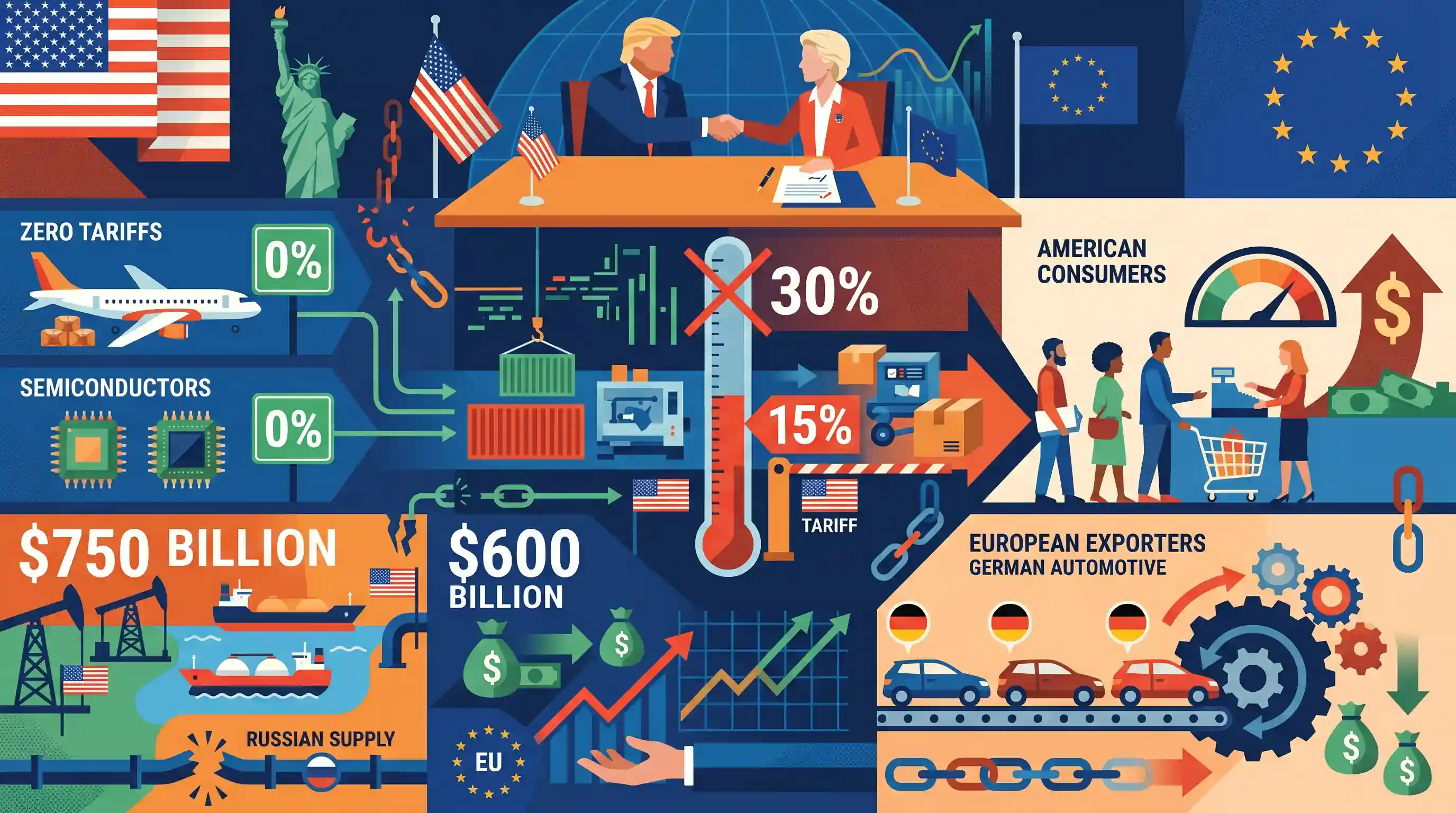
US President Donald Trump and European Commission President Ursula von der Leyen have negotiated a broad trade agreement that sets a 15% tariff on most European goods entering the US, warding off worse threats of up to 30%. While establishing zero tariffs on certain strategic sectors like semiconductors and aircraft, the deal mandates massive EU purchases of American energy ($750 billion) to substitute Russian supplies, alongside a $600 billion investment pledge. Though the agreement averts an all-out trade war escalation, the 15% tariff represents a sharp increase from previous lows, which will likely trigger higher costs for American consumers and squeeze the profit margins of major European exporters like German automobile manufacturers.
Key Points
- The US and the EU reached a sweeping trade agreement imposing a 15% tariff on most European goods entering the US, averting the threat of a 30% or higher tariff rate.
- Zero tariffs were established for 'strategic' goods, including aircraft parts, semiconductor equipment, specific chemicals, and critical raw materials.
- In exchange for tariff relief, the EU agreed to purchase $750 billion of US natural gas, oil, and nuclear fuel to replace Russian supplies, plus invest an additional $600 billion in the US.
- Despite easing the immediate trade war threat, the baseline 15% tariff significantly exceeds previous norms (~1%), leading to potential price increases for US consumers and diminished profits for European export hubs, notably German automakers.
- The deal underscores a global structural shift toward managed, protectionist bilateral trade agreements between major economic blocs, moving away from free trade multilateralism.
Important Terms
European Union (EU)

A supranational political and economic union of 27 European member states that operates through common institutions, a single market, and a standardized system of laws.
UPSC context
Relevant for GS-II (International Relations) regarding regional groupings and global governance models affecting India's trade and strategic interests.
European Commission
The executive arm of the European Union responsible for proposing legislation, implementing decisions, and representing the bloc in international trade negotiations.
UPSC context
Tested under GS-II (International Institutions) for its role in global trade diplomacy and bilateral agreements (e.g., India-EU BTIA).
European Central Bank (ECB)
The central bank for the 20 EU member states using the Euro; it manages monetary policy, ensures price stability, and supervises significant banking institutions.
UPSC context
Critical for GS-III (Economy) regarding global monetary policy, inflation management, and its spillover effects on emerging economies like India.
Federation of German Industries (BDI)
The umbrella organization representing the interests of German industry and related services, acting as a powerful lobby in national and international trade policy.
UPSC context
Significant for GS-II/III as an example of how industrial interest groups influence geoeconomic policies and global supply chain dynamics.
Prelims Trap
The new US-EU trade pact establishes a comprehensive Free Trade Area eliminating tariffs across all major economic sectors.
The agreement is a 'managed trade' pact setting a steep 15% baseline tariff. It eliminates tariffs only on select strategic goods, diverging from typical free-trade models.
Static Concepts Connected
What is Managed Trade versus Free Trade?
- Free Trade: Market forces determine global flows with minimal tariffs and quotas, operating on the principle of comparative advantage (the traditional WTO ideal).
- Managed Trade: Governments actively intervene using quotas, targeted tariffs, and mandated purchase agreements (like the EU buying US energy) to achieve geopolitical and domestic goals.
How does the MFN principle function under the WTO?
- Core Principle: Most-Favored-Nation (MFN) requires countries to offer the same trade concessions and tariff rates to all WTO members without discrimination.
- Current Erosion: Unilateral tariff hikes and exclusive bilateral managed-trade quotas bypass MFN, reflecting a global structural shift away from consensus-based multilateral trade governance.
Cross-Topic Patterns
Protectionism & Nearshoring trends
High baseline tariffs among Western allies accelerate the fragmentation of global supply chains, forcing auto and tech manufacturers to nearshore production to bypass trade barriers.
Energy Security as Geoeconomics
The EU's massive $750 billion US energy purchase formalizes its pivot away from Russian gas, restructuring global LNG dynamics and heavily impacting India's spot market sourcing.

The shift from WTO multilateralism to 'managed trade' quotas and bilateral protectionism is a highly probable 2026 GS-2 Mains question.
Linked PYQs · 3
Linked PYQs · 3
- 2025MainsGS3
What are the challenges before the Indian economy when the world is moving away from free trade and multilateralism to protectionism and bilateralism? How can these challenges be met?
- 2018MainsGS3
How would the recent phenomena of protectionism and currency manipulations in world trade affect macroeconomic stability of India?
- 2023MainsGS2
‘The expansion and strengthening of NATO and a stronger US-Europe strategic partnership works well for India.’ What is your opinion about this statement ? Give reasons and examples to support your answer.
