Global Trade Rule Shifts and India Strategy
Source:Indian Express ↗
Why It Matters
The transition from a multilateral free-trade regime to a fragmented, protectionist global trade order is a pivotal economic and geopolitical issue. Aspirants must understand how new trade norms dictated by the US, EU, and China (e.g., carbon border taxes, tech decoupling) impact India, necessitating strategic policy adaptations and robust FTAs. This is a recurring theme in both GS2 (IR/WTO) and GS3 (Economy/Trade).
Summary
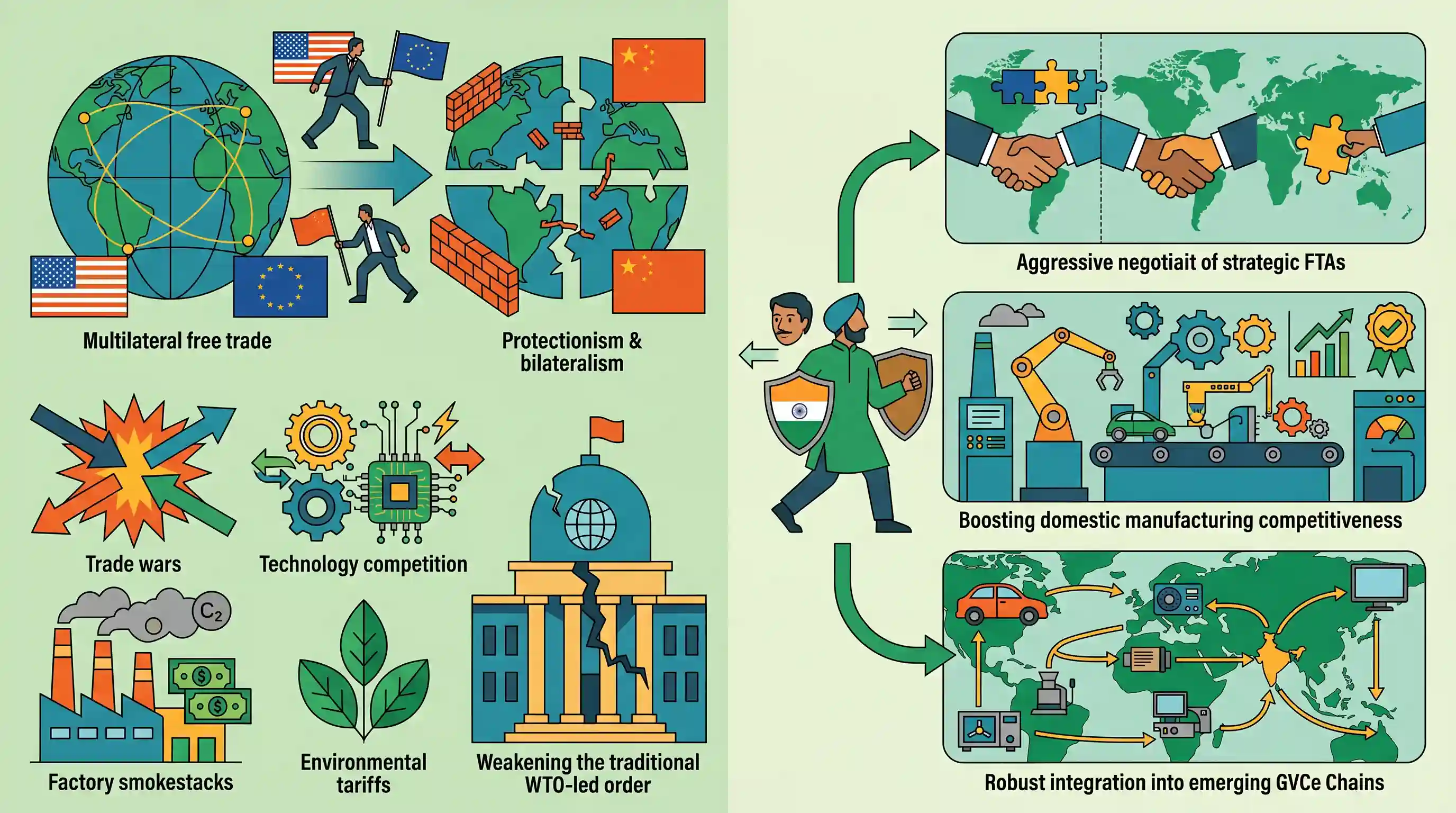
Major global powers, including the US, the EU, and China, are actively reshaping international trade rules, marking a stark shift from multilateral free trade toward protectionism, bilateralism, and geo-economic fragmentation. Driven by escalating trade wars, technological competition, and new regulatory frameworks like environmental tariffs, the traditional WTO-led order is weakening. Consequently, India cannot rely on outdated strategies. To navigate this complex landscape, India must urgently develop its own strategic playbook. This involves pivoting from defensive trade postures to aggressively negotiating strategic Free Trade Agreements (FTAs), boosting domestic manufacturing competitiveness, and ensuring robust integration into emerging Global Value Chains (GVCs).
Key Points
- The global trade architecture is undergoing a paradigm shift as major powers like the US, EU, and China move away from traditional multilateralism toward protectionism and geo-economic fragmentation.
- New trade norms are increasingly being shaped by geopolitical competition, environmental regulations (such as carbon border taxes), and technological decoupling, undermining the WTO's framework.
- In an era of friend-shoring and supply chain realignments, India faces significant challenges in protecting its export markets and economic interests.
- India needs a proactive and customized trade playbook focused on forging strategic Free Trade Agreements (FTAs), enhancing domestic manufacturing competitiveness, and integrating deeply into Global Value Chains (GVCs).
Important Terms
World Trade Organization (WTO)

A global intergovernmental organization (est. 1995) that regulates international trade, ensures non-discrimination (MFN principle), and provides a framework for resolving trade disputes through its now-paralyzed Appellate Body.
UPSC context
GS Paper II (International Institutions) and Paper III (Economy); tests knowledge of trade governance, multilateralism, and institutional reforms.
Free Trade Agreements (FTAs)
Formal pacts between two or more nations to reduce or eliminate tariffs, quotas, and barriers on goods and services, aimed at deepening economic integration while maintaining independent trade policies with non-members.
UPSC context
GS Paper II (IR) and Paper III (Economy); tests India’s strategic trade negotiations (e.g., CEPA, ECTA) and market access challenges.
Geo-economic Fragmentation
A policy-driven reversal of global economic integration characterized by the formation of rival geopolitical blocs, trade restrictions, and "friend-shoring," which threatens to reduce global GDP and innovation.
UPSC context
GS Paper III (Economy); featured in Economic Survey 2024-25; tests understanding of shifting global trade orders and India's manufacturing resilience.
Global Value Chains (GVCs)
A production method where manufacturing stages are fragmented across multiple countries to optimize efficiency and know-how, accounting for nearly 70% of total merchandise trade.
UPSC context
GS Paper III (Industrial Growth); tests strategies for India’s integration into global electronics, pharma, and automotive supply networks.
Carbon Border Adjustment Mechanism (CBAM)
The EU's landmark climate-trade policy that imposes carbon-linked tariffs on energy-intensive imports (like steel and aluminium) to prevent "carbon leakage" and ensure foreign producers face costs similar to EU firms.
UPSC context
GS Paper III (Environment & Economy); tests knowledge of "green protectionism" and its impact on Indian export competitiveness.
Protectionism
Government policies such as high tariffs, quotas, and subsidies designed to restrict imports and protect domestic industries from foreign competition, often countering the principles of liberalized free trade.
UPSC context
GS Paper III (Liberalization); tests the ability to analyze the shift from globalization to economic nationalism and its impact on India's trade.
Prelims Trap
"Friend-shoring initiatives and carbon border taxes like CBAM are new plurilateral frameworks adopted under the mandate of the World Trade Organization."
CBAM and friend-shoring are unilateral or plurilateral geopolitical measures that actively bypass or undermine traditional WTO multilateral rules (like MFN). They are not mandates designed or approved by the WTO.
Static Concepts Connected
What are the core WTO principles of non-discrimination and their permitted exceptions?
- Most-Favored-Nation (MFN): Members must treat all WTO members equally. A trade concession granted to one member must immediately be extended to all other members.
- National Treatment: Once imported goods enter a domestic market, they must be treated no less favorably than identical or similar domestically-produced goods.
- Permitted Exceptions: WTO allows exceptions for Regional Trade Agreements (Article XXIV) like FTAs, and measures essential for national security, public morals, or human/animal health (Articles XXI and XX).
How do PTA, FTA, CECA, and CEPA differ in scope of trade integration?
- PTA vs FTA: PTAs reduce tariffs on a positive list of specific goods. FTAs eliminate tariffs on a negative list, offering broader goods coverage.
- CECA: Broader than an FTA; it includes trade in services and investment but is generally less comprehensive in its regulatory alignment.
- CEPA: The most comprehensive pact. Covers trade in goods, services, investments, Intellectual Property Rights, and government procurement (e.g., India-UAE CEPA).
Cross-Topic Patterns
Trade protectionism masking as climate action
The EU's Carbon Border Adjustment Mechanism (CBAM) bridges trade and climate change, testing the UNFCCC principle of Common But Differentiated Responsibilities (CBDR) through unilateral tariffs on developing nations.
Mineral security driving supply chain alliances
Friend-shoring pacts (e.g., US-led Minerals Security Partnership) connect global trade fragmentation directly to India's domestic critical mineral block auctions and clean energy transition goals.

Expect a 2026 Prelims question testing EU's CBAM and friend-shoring alliances against WTO's core Most-Favored-Nation principle.
Linked PYQs · 4
Linked PYQs · 4
- 2025MainsGS3
What are the challenges before the Indian economy when the world is moving away from free trade and multilateralism to protectionism and bilateralism? How can these challenges be met?
- 2018MainsGS2
What are the key areas of reform if the WTO has to survive in the present context of "Trade War', especially keeping in mind the interest of India?
- 2023PrelimsGS1
Consider the following statements: Statement-I: Recently, the United States of America (USA) and the European Union (EU) have launched the 'Trade and Technology Council'. Statement-II: The USA and the EU claim that through this they are trying to bring technological progress and physical productivity under their control. Which one of the following is correct in respect of the above statements?
- 2016MainsGS2
The broader aims and objectives of WTO are to manage and promote international trade in the era of globalization. But the Doha round of negotiations seem doomed due to differences between the developed and the developing countries." Discuss in the Indian perspective.
